Reptile Nutrition
Gecko Diet Guide
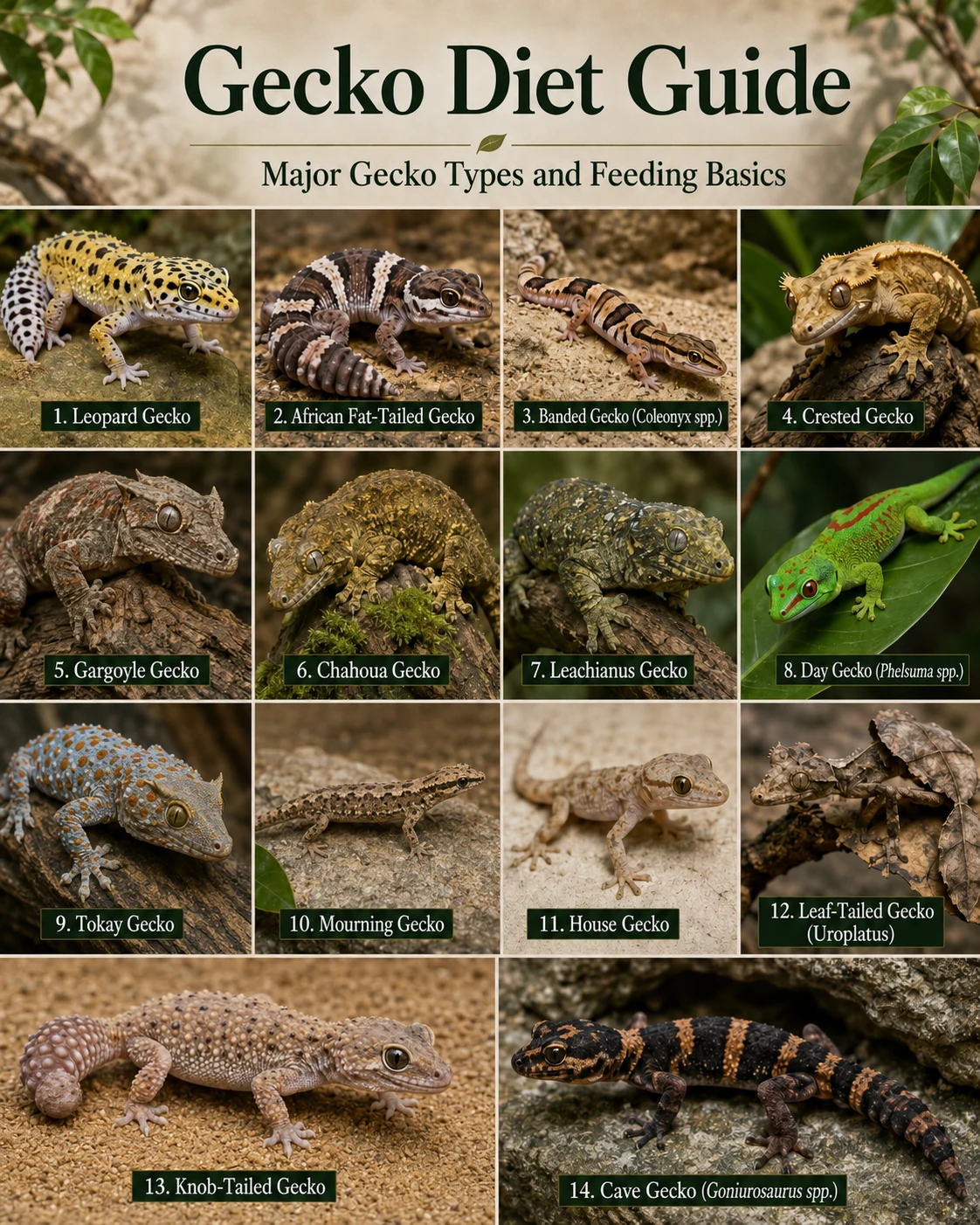
Species-specific feeding guidance for the major geckos kept as pets, with emphasis on matching the diet to natural feeding biology, feeder-insect quality, complete gecko diets, calcium balance, hydration, body condition, and safe long-term management.
Diet Overview
There is no single correct “gecko diet.” Geckos occupy several very different nutritional niches. Leopard geckos, African fat-tailed geckos, banded geckos, tokays, house geckos, Madagascar leaf-tailed geckos, knob-tailed geckos, and cave geckos are primarily insectivorous. Crested, gargoyle, chahoua, and other New Caledonian geckos naturally consume both animal prey and fruit or nectar-type foods. Day geckos commonly combine arthropods with nectar, pollen, and soft fruit. Mourning geckos also use both tiny invertebrates and fruit or nectar resources.
Successful feeding therefore depends on identifying the species first, then matching food type, prey size, feeding frequency, supplementation, and presentation to that species. Reptile nutrition cannot be separated from husbandry: temperature, humidity, UVB exposure, stress, reproductive status, and enclosure design all influence appetite, digestion, calcium metabolism, and body condition.
Exact nutrient requirements have not been established for most gecko species. The recommendations below combine veterinary nutrition principles, published reptile guidance, natural feeding ecology, zoological husbandry practice, and practical monitoring of growth and body condition.
Core Feeding Principles for All Geckos
- Feed the species, not the label “gecko.” Strict insectivores should not be maintained on fruit diets, while New Caledonian and day geckos need a broader nutritional plan.
- Use variety. Rotate several appropriate feeder insects rather than relying on crickets, mealworms, or any single prey item.
- Match prey size to the gecko. Prey should be easy to capture and swallow; for small and juvenile geckos, choose prey no wider than the space between the eyes or roughly the width of the head.
- Control calories. Waxworms, butterworms, and other very fatty larvae are best reserved for occasional use. Adult geckos commonly become overweight when offered unlimited high-energy foods.
- Feed at the correct time of day. Nocturnal and crepuscular species are usually best fed in late afternoon or evening. Day geckos should be fed during their normal daytime activity period.
- Use species-appropriate feeding stations. Arboreal New Caledonian and day geckos often feed more naturally from elevated dishes or ledges; terrestrial leopard and fat-tailed geckos can be fed from the enclosure floor or smooth feeding dishes.
- Remove leftovers. Uneaten live crickets can bite or stress geckos. Prepared fruit-based diets spoil rapidly and should usually be removed within about 24 hours, sooner in very warm enclosures.
Feeder Insects, Gut Loading, and Hand-Feeding
Most commonly cultured feeder insects contain substantially more phosphorus than calcium. Without correction, an insect-heavy diet can contribute to calcium deficiency and secondary nutritional hyperparathyroidism. Two complementary techniques improve prey quality: gut loading (feeding the insect a nutrient-dense, calcium-rich ration before it is offered) and dusting (lightly coating the insect with an appropriate supplement immediately before feeding).
Do not assume insects are nutritionally ready when they arrive from a pet store or shipping container. Newly purchased prey may be dehydrated or poorly fed. Whenever practical, place them in a clean holding container, provide food and moisture, and complete the final gut-loading period before offering them to the gecko.
Supplies to keep on hand
- Escape-resistant, well-ventilated feeder containers sized for crickets, roaches, or larvae, with smooth sides where appropriate.
- Egg-carton sections, cardboard tubes, or other disposable hides for crickets and roaches so insects are not overcrowded.
- A commercial high-calcium gut-loading ration formulated for feeder insects. A normal maintenance insect food is not always the same as a short-term high-calcium gut load.
- A safe moisture source such as small amounts of fresh high-moisture vegetables or a commercial insect hydration product. Avoid open water dishes in cricket or roach bins because insects can drown.
- Shallow food lids or dishes that keep dry gut load away from wet foods and make spoiled food easy to remove.
- Reptile calcium and, when indicated, a reptile multivitamin selected as part of the animal's overall UVB and supplementation plan.
- A small dusting cup or clean plastic bag for coating insects immediately before feeding.
- Smooth, rounded or silicone-tipped feeding tongs for controlled prey presentation. Avoid sharp forceps that can injure the mouth if the gecko strikes the tool.
- Escape-resistant feeding dishes or elevated feeder cups for worms, larvae, and arboreal species.
- Paper towels, a small sieve or transfer cup, and dedicated cleaning tools for keeping feeder bins dry and removing dead insects, shed skins, frass, and moldy food.
Step-by-step gut loading
- Choose healthy prey of the correct size. Discard dead, weak, mold-contaminated, or foul-smelling insects. The prey should be small enough for the gecko to capture and swallow safely.
- Move the insects to a clean holding container. Provide adequate ventilation and enough surface area or hides to prevent crowding. Keep species that require different conditions in separate containers.
- Feed and hydrate the colony. If the insects have just arrived, allow them to rehydrate and eat before the final gut-loading period. Replace wet or spoiled foods promptly.
- Begin the final calcium-rich gut load. Use a nutritionally complete commercial gut-loading ration for approximately 24–48 hours before feeding; some veterinary protocols use up to about 72 hours. Follow the gut-load manufacturer's directions when they specify a particular interval.
- Keep the gut load available continuously during that period. The goal is for the insect's gastrointestinal tract and, when possible, body nutrient content to be enriched when the gecko eats it. Do not let the insects become dehydrated while gut loading.
- Transfer only the insects you intend to feed. Do not pour shipping substrate, frass, dead insects, or feeder-bin debris into the gecko enclosure.
- Dust immediately before feeding when indicated. Place the selected insects in a small cup or bag with a small amount of supplement and gently swirl or shake until they have a light, even coating. They should look lightly powdered, not heavily caked.
- Offer the prey promptly. Insects groom powder from their bodies and loose dust falls off, so dusted prey should be fed soon after preparation.
- Remove leftovers. Collect uneaten crickets, roaches, superworms, or other mobile prey after the feeding period so they cannot bite or stress the gecko.
Important: gut loading and dusting are not interchangeable. Gut loading improves the insect from the inside; dusting supplies nutrients on the outside. Veterinary reptile-nutrition guidance commonly uses both techniques, with the exact supplement schedule adjusted for species, age, reproductive status, UVB exposure, feeder choice, and any nutritionally complete prepared diet being used.
Gut-loading and handling common feeder types
Crickets
- Keep in a ventilated container with substantial climbing surface such as egg-carton sections; crowding and damp conditions rapidly increase losses.
- Provide the calcium-rich gut load during the final feeding period plus a safe moisture source. Remove wet food before it molds.
- For tong feeding, pick up one cricket gently with rounded-tip tongs and present it a short distance in front of the gecko so the insect can move naturally. Do not push the insect against the gecko's lips.
- For geckos that prefer hunting, release only a few crickets at a time and watch the feeding session. Remove uneaten crickets afterward.
Dubia and other feeder roaches
- Use an escape-resistant container with ventilation and cardboard hides. Provide a complete gut load and moisture without making the enclosure wet.
- When using tongs, hold the roach gently along the rear of the body without crushing it and allow the legs to move; motion helps trigger a feeding response.
- Roaches can also be placed in a smooth-sided feeder dish so terrestrial geckos can hunt without the prey disappearing under enclosure furnishings.
- Use only legally permitted feeder species in your area and never release feeder roaches outdoors.
Mealworms and superworms
- Keep larvae in a dry, ventilated container with an appropriate nutritious feed substrate and a small fresh moisture source. They can be gut loaded, but hydration and cleanliness remain important.
- A smooth, shallow escape-resistant dish is usually the easiest presentation method. This also reduces accidental ingestion of loose enclosure substrate.
- For tong feeding, grasp the posterior portion of the worm lightly and let the front end move. Do not squeeze the insect.
- Superworms are larger and can bite; use tongs for controlled presentation and do not leave oversized or uneaten superworms loose with a small gecko.
Black soldier fly larvae
- These larvae naturally contain more calcium than many traditional feeder insects. Keep them according to the supplier's instructions and consider their calcium contribution when planning dusting.
- Because they are small and difficult to hold without injury, offer them in a shallow smooth-sided dish rather than individually with forceps.
- Their movement in the dish usually provides enough stimulation for leopard, banded, fat-tailed, and other terrestrial insectivorous geckos.
Silkworms
- Silkworms are specialist feeders and should receive fresh mulberry leaves or a properly prepared commercial mulberry-based silkworm chow rather than a generic cricket diet.
- Keep their food and enclosure clean and dry enough to prevent mold; replace contaminated chow promptly.
- Offer small silkworms in a feeding dish or hold the posterior third very gently with smooth tongs. Their soft bodies are easily crushed.
Hornworms
Wild hornworm warning: Feed only commercially raised hornworms intended for reptile feeding. Do not offer hornworms collected from tomato, tobacco, pepper, eggplant, potato, or other nightshade plants. Wild hornworms may contain plant-derived alkaloids and may also have been exposed to pesticides or other environmental contaminants. Commercial feeder hornworms raised on controlled hornworm chow are the safer choice.
- Maintain them on the commercial hornworm chow supplied or recommended for the culture. They grow extremely rapidly, so check their size before every feeding.
- Use hornworms mainly as a high-moisture rotation feeder rather than the sole diet.
- For tong presentation, support the worm gently near the rear portion of the body. Never squeeze the soft abdomen, and do not offer a hornworm that has grown too large for the gecko to swallow easily.
Locusts or cultured grasshoppers
- Use only commercially raised, pesticide-free cultures. Gut load and hydrate them in much the same manner as crickets, while providing adequate vertical space.
- Present with feeding tongs or release one at a time into a supervised feeding area. Their speed and jumping ability make controlled feeding especially useful in planted enclosures.
Flightless fruit flies, bean beetles, and other tiny prey
- Maintain these insects on their appropriate culture medium; the culture itself is part of their nutritional preparation.
- For tiny geckos and hatchlings, tap a small number into a feeding cup, leaf cluster, or controlled feeding area rather than attempting to grasp individual insects with tongs.
- If dusting is part of the supplementation plan, use only a very light coating so the tiny prey do not become immobilized.
Waxworms and other high-fat larvae
- Use as occasional treats or short-term appetite enticement, not as a staple regardless of whether they can be gut loaded.
- Offer from a shallow dish or with smooth feeding tongs so the number eaten can be controlled.
How to hand-feed or tong-feed safely
- Feed during the species' normal activity period. For leopard, fat-tailed, banded, tokay, leaf-tailed, and most cave geckos, this is usually toward dusk or after lights begin to dim. Day geckos should be fed during daylight activity.
- Use a calm approach. Bring the prey into the gecko's visual field from the front or side without touching the face. Allow a moment for the gecko to orient and stalk.
- Keep the tongs still enough for an accurate strike but let the prey move. Gentle insect movement is usually more effective than repeatedly waving the tongs at the animal.
- Release as soon as the gecko has a secure bite. Never pull against the gecko's mouth. If the gecko bites the tongs, keep the tool still and allow it to release rather than tugging.
- Offer one prey item at a time. This makes intake easy to count and helps prevent multiple loose insects from hiding in the enclosure.
- Stop when interest declines. Do not repeatedly touch the mouth or force prey between the jaws of a gecko that refuses food.
- Preserve normal hunting behavior. Tong feeding is useful for monitoring intake, shy animals, complicated enclosures, or occasional individual feeding, but healthy geckos should still have opportunities to stalk and capture appropriate prey when it can be done safely.
Useful staple or rotation insects
- appropriately sized crickets;
- dubia or other appropriately sized feeder roaches where legal;
- black soldier fly larvae;
- silkworms;
- locusts or grasshoppers from controlled, pesticide-free commercial cultures;
- mealworms and superworms in rotation rather than as the sole diet;
- hornworms as an occasional high-moisture feeder;
- flightless fruit flies, bean beetles, small crickets, and other tiny cultured prey for very small species and hatchlings.
Waxworms and other very fatty larvae are useful as occasional treats or short-term appetite stimulants but are poor choices as staple foods. Wild-caught insects should generally be avoided because pesticide, parasite, and toxin exposure cannot be reliably controlled. Wash hands after handling feeder insects, feeder-bin debris, or reptile equipment, and keep feeder-preparation utensils separate from human food-preparation equipment.
Complete Gecko Diets, Fruit, and Nectar-Type Foods
Commercial powdered diets formulated specifically as complete diets for fruit- and insect-eating geckos are useful for crested, gargoyle, chahoua, leachianus, and many similar New Caledonian geckos. These products are mixed with water according to the manufacturer's directions and provide a more predictable calcium, vitamin, protein, and energy profile than plain fruit or baby food.
When a nutritionally complete gecko diet is used as the staple, do not routinely add extra calcium or multivitamin directly to the prepared food unless the manufacturer or veterinarian specifically recommends it. Excess supplementation can be as undesirable as deficiency.
Fresh soft fruit can be used as a small enrichment item for species that naturally consume fruit, but it should not replace a complete formulated diet. Useful occasional fruits include papaya, mango, fig, pear, berries, and melon. Plain fruit baby food, honey, jam, and sweetened fruit products are not balanced staple foods and can promote excessive sugar intake and selective feeding.
Calcium, Vitamins, and UVB Exposure
Calcium management is especially important for rapidly growing juveniles and egg-producing females. Insectivorous geckos require properly gut-loaded prey and usually benefit from light calcium dusting of feeder insects. A reptile multivitamin should be used according to the product label and the animal's overall diet rather than added indiscriminately to every meal.
- Juveniles and reproductive females: usually require more frequent calcium support than maintenance adults. Lightly dust appropriate insect meals with a phosphorus-free calcium supplement unless the feeder or a nutritionally complete prepared diet already supplies the intended calcium.
- Healthy nonbreeding adults: use lighter, less frequent supplementation than for growing or reproductive animals, adjusted to insect frequency, gut loading, UVB exposure, and any complete prepared diet being fed.
- Multivitamins: follow the product label and species-specific veterinary guidance rather than using a universal schedule. Avoid layering several products that contain the same fat-soluble vitamins or minerals.
- Vitamin D3: coordinate dietary D3 with UVB exposure. Do not assume that heavy oral D3 supplementation is a safer substitute for appropriate species-level UVB, and avoid unnecessary duplication between gut loads, dusting powders, and complete diets.
Low-level, appropriately controlled UVB can be useful even for many nocturnal and crepuscular geckos, while diurnal day geckos have a stronger expectation for UVB exposure. Lighting, basking opportunity, supplement choice, and diet should therefore be considered together.
Species-Specific Feeding Guidelines
The schedules below are practical starting points rather than fixed prescriptions. Use the individual species section for food type, timing, feeding location, and presentation, then adjust intake to age, body condition, reproduction, temperature, season, and veterinary assessment.
Leopard Gecko (Eublepharis macularius)
Diet type: terrestrial insectivore.
- Diet: rotate gut-loaded crickets, appropriately sized roaches, black soldier fly larvae, silkworms, and other suitable cultured insects. Mealworms and superworms can be part of the rotation; waxworms and other very fatty larvae should be occasional treats.
- Frequency: hatchlings and juveniles generally eat every 1–2 days; healthy adults usually do well with about 2–3 feedings weekly, adjusted to body and tail condition.
- When: offer food in late afternoon or evening as normal activity begins.
- Where: feed at ground level on a clean slate/tile, paper-lined area, or shallow smooth-sided insect dish near the gecko's normal emergence route. Avoid placing prey directly on loose particulate substrate.
- How: controlled release of a few insects at a time encourages hunting while making intake easy to observe. A separate feeding container can be used for selected animals if transfer does not cause stress, but it is not required.
- After feeding: remove uneaten crickets and other active prey. Do not feed fruit as a routine dietary component.
African Fat-Tailed Gecko (Hemitheconyx caudicinctus)
Diet type: terrestrial nocturnal insectivore.
- Diet: offer crickets, small-to-moderate roaches, silkworms, black soldier fly larvae, and mealworms in rotation. Vertebrate prey is not required for routine maintenance.
- Frequency: young geckos usually eat daily or every other day; adults commonly do well with 2–3 feedings weekly, with additional intake during growth or reproduction when body condition warrants it.
- When: feed at dusk or shortly after lights-out, when shy animals are more likely to emerge voluntarily.
- Where: place a feeding tile or shallow insect dish on the enclosure floor close to the entrance of a favored hide, rather than forcing the gecko into an exposed area.
- How: offer a few prey items at a time. For reluctant feeders, allow prey to move near the hide entrance or use soft-tipped tongs rather than repeatedly handling or relocating the gecko.
- Body condition: a naturally thick tail is an energy reserve, not a target for overfeeding; progressive obesity can be hidden by the normal fat-tail appearance.
Banded Geckos (Coleonyx spp.), Including Western Banded Geckos
Diet type: small terrestrial nocturnal insectivores.
- Diet: use small gut-loaded crickets, roach nymphs, small mealworms, flightless flies, bean beetles, small cultured isopods, and other appropriately sized invertebrates.
- Frequency: adults can generally be offered food about 3–4 times weekly; growing juveniles require smaller, more frequent meals.
- When: feed in the evening after the geckos normally leave their shelters.
- Where: present prey at ground level on a clean tile or in a shallow smooth-sided dish placed between the warm shelter and the normal nighttime activity area. A second feeding point can help if animals are housed together under an appropriate species-specific plan.
- How: offer several very small prey items rather than one large item. If insects are released for hunting, limit the number and remove leftovers after the feeding period.
- Substrate caution: because these geckos strike rapidly at small prey, a defined feeding surface reduces accidental ingestion of sand or other loose substrate.
Crested Gecko (Correlophus ciliatus)
Diet type: arboreal fruit/nectar and insect feeder; best maintained on a complete formulated gecko diet with optional live insects.
- Diet: use a reputable nutritionally complete crested-gecko-type powdered diet as the staple, mixed with water exactly as directed. Plain fruit or fruit baby food should not replace a complete diet.
- Frequency: hatchlings and juveniles can be offered fresh complete diet daily or nearly daily; adults commonly receive it every other night or about 3–4 times weekly. Insects may be offered about 1–2 times weekly to juveniles and about weekly to many adults.
- When: place fresh food in the enclosure shortly before evening activity begins.
- Where: use a secure elevated feeding ledge or magnetic/suction cup station in the upper or middle portion of the enclosure, near a frequently used climbing route but not directly beneath a heat source.
- How: use shallow cups so the gecko can feed comfortably while clinging to the ledge or adjacent branch. Live insects can be offered in an elevated escape-resistant cup, with tongs, or by limited release onto branches and foliage.
- Food safety: remove prepared diet within about 24 hours, sooner in warm conditions, and clean the cup before refilling.
Gargoyle Gecko (Rhacodactylus auriculatus)
Diet type: arboreal omnivorous New Caledonian gecko.
- Diet: use a complete powdered gecko diet as the nutritional foundation, with calcium-managed live insects for enrichment and protein.
- Frequency: juveniles can receive complete diet daily or nearly daily and insects 1–2 times weekly; adults often do well with complete diet about 3 times weekly and insects about weekly.
- When: offer food in late afternoon or evening.
- Where: place the prepared diet on an elevated ledge at branch height. In larger enclosures, a second elevated station can help reveal food preferences and ensure a shy animal is finding the diet.
- How: offer insects in a cup or by controlled release onto sturdy branches. Gargoyles may spend more time on lower branches than crested geckos, so the feeding ledge need not be at the very top of the enclosure.
- Monitoring: inspect the cup for lick marks and weigh the gecko periodically; apparent lack of food disappearance can be difficult to judge from a small serving.
Chahoua or Mossy Prehensile-Tailed Gecko (Mniarogekko chahoua)
Diet type: arboreal omnivore with a relatively strong insect component.
- Diet: combine a complete New Caledonian gecko diet with varied, gut-loaded insects. Do not maintain chahoua on fruit alone.
- Frequency: juveniles should be offered food most days, with insects several times weekly; adults can start with complete diet about 3 times weekly and insects about 1–2 times weekly, adjusted to body condition and reproduction.
- When: offer both prepared diet and insects at dusk or early evening.
- Where: secure the prepared-diet cup on an elevated ledge beside cork bark, a horizontal branch, or another commonly used perch. This species often feeds confidently from sturdy platforms.
- How: place roaches or other climbing-resistant prey in a smooth cup, offer individual insects from soft-tipped tongs, or release a small number onto branches to stimulate hunting.
- Reproductive animals: monitor calcium intake and body weight closely in females because repeated egg production can substantially increase mineral demand.
Leachianus or New Caledonian Giant Gecko (Rhacodactylus leachianus)
Diet type: large arboreal omnivorous/frugivorous gecko.
- Diet: use a nutritionally complete New Caledonian gecko diet as the staple with appropriately sized insects for dietary variety and enrichment.
- Frequency: juveniles may receive complete diet about 4–5 times weekly and insects 1–2 times weekly; adults commonly receive complete diet 2–3 times weekly and insects roughly weekly.
- When: feed in the evening.
- Where: use a large, stable elevated cup or shelf attached beside a substantial cork tube or branch. The station should support the animal's full weight without flexing or tipping.
- How: provide insects in a deep smooth-sided cup or with long soft-tipped tongs; limited release onto large branches can provide hunting enrichment. Avoid hand-feeding with fingers because territorial adults can bite forcefully.
- Calories: vertebrate prey is unnecessary for routine captive nutrition and may add excessive fat and energy. Monitor weight because large adults can become obese.
Day Geckos (Phelsuma spp.), Including Giant and Gold-Dust Day Geckos
Diet type: diurnal insectivore plus nectar, pollen, and soft fruit foods.
- Diet: keep varied, gut-loaded arthropods central to the diet. For many adults, insects can be offered about 2–3 times weekly, with a small amount of a species-appropriate complete nectar/fruit gecko diet or soft fruit/nectar-type food offered as a supplemental component. Young and reproductive animals may require more frequent feeding.
- When: feed during daylight after the gecko has warmed and become active, rather than immediately at lights-on.
- Where: place supplemental nectar or prepared diet in a small elevated cup near a favored horizontal branch, bamboo perch, or foliage. The gecko should be able to feed while remaining above ground.
- How: release small insects onto leaves and branches or use an elevated feeder cup; very small day geckos can be offered fruit flies and bean beetles directly among foliage. Avoid forcing food onto the animal's delicate skin.
- Multiple animals: if animals are housed together under an appropriate species-specific plan, use more than one feeding point and visually confirm that each individual is eating because dominant animals can monopolize a single station.
- UVB: appropriate UVB exposure is an important part of calcium and vitamin D management for these diurnal geckos.
Tokay Gecko (Gekko gecko)
Diet type: large nocturnal arboreal insectivorous predator.
- Diet: rotate large appropriately sized gut-loaded crickets, roaches, locusts, silkworms, and other cultured invertebrates.
- Frequency: juveniles can be fed daily to every other day; adults generally start around 3 feedings weekly, then adjust to activity, body condition, and reproductive status.
- When: offer prey shortly before or after lights-out, when the gecko begins patrolling the enclosure.
- Where: place an escape-resistant insect cup on an elevated ledge or cork surface, or release a limited number of prey onto trunks and branches. Floor-only feeding does not match this species' normal arboreal hunting behavior.
- How: long feeding tongs may be used for individual prey, but keep hands away from the feeding strike zone because tokays can deliver a powerful bite.
- Hydration with feeding: evening misting can be timed shortly before feeding so the gecko can drink droplets as it becomes active.
Mourning Gecko (Lepidodactylus lugubris)
Diet type: tiny arboreal omnivore/insectivore that also uses nectar and fruit resources.
- Diet: offer a nutritionally complete fruit-eating gecko diet in very small portions plus tiny live prey such as flightless fruit flies, pinhead crickets, bean beetles, and springtails.
- Frequency: complete diet about 3 times weekly and small live prey about 1–2 times weekly is a reasonable adult starting point; rapidly growing juveniles often benefit from smaller, more frequent offerings.
- When: provide prepared diet near dusk; tiny insects can be introduced in late afternoon so they are available as the colony becomes active.
- Where: use several tiny elevated cups or bottle-cap-sized feeding stations at different heights among branches and foliage.
- How: disperse microprey through planted areas rather than concentrating everything at one point. Multiple stations are particularly important in colonies so no individual can monopolize the food.
- Safety: dishes must be very shallow; remove spoiled prepared food promptly and avoid excessive supplement powder on tiny insects.
House Geckos (Hemidactylus spp.), Including the Asian Flat-Tailed House Gecko (H. platyurus)
Diet type: mostly nocturnal insectivorous wall and branch hunters.
- Diet: feed small gut-loaded crickets, roach nymphs, flies, moths from controlled cultures, small silkworms, and other appropriately sized invertebrates.
- Frequency: juveniles can receive small prey daily or every other day; adults generally do well with about 3–4 feedings weekly depending on size and body condition.
- When: offer insects at dusk or shortly after lights-out.
- Where: attach a small feeder cup to a wall, cork slab, or branch, or release a few insects onto vertical climbing surfaces and foliage. These geckos naturally hunt above the enclosure floor.
- How: flying or climbing prey can provide useful hunting enrichment. Remove excess crickets before the gecko rests for the day.
- Fruit: some house geckos may opportunistically sample fruit or nectar, but a diverse insect diet remains the appropriate captive foundation unless reliable species-specific evidence supports otherwise.
Madagascar Leaf-Tailed or Flat-Tailed Geckos (Uroplatus spp.)
Diet type: nocturnal arboreal insectivores. This is the group referred to as “Flat Tailed Gecko” by the flat-tailed gecko article linked from the site's Reptile Resources page.
- Diet: use appropriately sized gut-loaded crickets, roaches, moths, silkworms, and other cultured invertebrates. Some species also take snails or other invertebrate prey in nature. Vertebrate prey is not necessary for routine maintenance.
- Frequency: growing animals can be offered smaller meals most evenings or every other evening; healthy adults commonly do well with several feeding nights per week, adjusted to species, body condition, temperature, and reproductive status.
- When: offer prey in the evening after the enclosure begins to darken. Uroplatus are strongly nocturnal and may ignore food presented during the day.
- Where: present prey at branch or trunk height among cork slabs, vertical branches, and foliage where the gecko normally waits in ambush. Avoid making the animal descend to the floor to feed.
- How: controlled release onto branches or soft-tipped tong feeding works well. If a feeder cup is used, choose a smooth, lightweight container positioned so a forceful feeding strike is not directed into a rigid edge.
- Monitoring: in breeding pairs or groups, feed in more than one location and confirm intake for each animal. Remove uneaten crickets before daytime rest.
- Hydration: coordinate feeding with evening misting so clean droplets are available on leaves and enclosure surfaces.
Knob-Tailed Geckos (Nephrurus spp.)
Diet type: terrestrial nocturnal insectivores.
- Diet: feed gut-loaded crickets, roaches, mealworms, and other appropriately sized insects; fatty larvae such as waxworms should be used sparingly.
- Frequency: juveniles usually require small meals every 1–2 days; adults can generally begin around 2–3 feedings weekly, adjusted to species and body condition.
- When: feed after dusk when the gecko emerges from its burrow or shelter.
- Where: use a ground-level feeding tile or shallow escape-resistant dish near the burrow entrance or normal surface activity area.
- How: allow the gecko to stalk a small number of insects across a clear feeding area. Do not scatter numerous prey items into deep loose substrate where both intake and accidental substrate ingestion are difficult to monitor.
- Species differences: humidity requirements vary substantially among Nephrurus species, so feeding and hydration should be coordinated with the enclosure's species-specific moisture plan.
Chinese and Japanese Cave Geckos (Goniurosaurus spp.)
Diet type: terrestrial nocturnal insectivores.
- Diet: offer crickets, roaches, black soldier fly larvae, silkworms, and other moderate-sized cultured invertebrates.
- Frequency: juveniles generally eat daily to every other day; adults usually do well with about 2–3 feedings weekly.
- When: feed at dusk or after lights-out.
- Where: place prey at floor level on a clean feeding tile or in a shallow dish adjacent to a secure hide rather than in a brightly exposed area.
- How: shy individuals may feed best when prey is allowed to move near the hide entrance. Remove leftovers once the feeding period is over.
- Husbandry link: persistent poor appetite may reflect excessive temperature, inadequate humidity, or stress rather than insufficient food variety.
Water and Hydration
Provide clean fresh water in a shallow, stable dish for all pet geckos even when the species commonly laps droplets from foliage. Arboreal species such as crested, gargoyle, chahoua, leachianus, mourning, tokay, and day geckos may drink readily from leaves or enclosure surfaces after misting.
Misting should be used to create the species-appropriate humidity cycle, not simply to keep the enclosure continuously wet. Chronic excessive humidity with poor ventilation can be as harmful as dehydration. Prepared gecko diets should be mixed with clean water and discarded before they ferment or mold.
Foods and Practices to Avoid
- Fireflies: never feed them; they contain toxins that can be fatal to lizards.
- Wild-caught insects from treated areas: pesticide and contaminant exposure cannot be predicted.
- Fruit as the sole diet: plain fruit is deficient in protein and minerals and is not a complete diet for fruit-eating geckos.
- Baby food, honey, jam, or syrup as staples: these are high-sugar foods and do not provide balanced reptile nutrition.
- Dog food, cat food, or processed human foods: inappropriate for routine gecko nutrition.
- One-insect diets: feeding only mealworms or only crickets increases the risk of nutrient imbalance and selective feeding.
- Uncontrolled vitamin supplementation: do not combine multiple calcium/D3 and multivitamin products without accounting for ingredients already present in complete diets.
- Oversized prey: large insects increase the risk of regurgitation, oral injury, and gastrointestinal problems.
- Live prey left overnight: hungry crickets and other insects can injure resting geckos.
Weight and Body-Condition Monitoring
Feeding recommendations should always be adjusted to the individual. A small digital gram scale is one of the most useful tools for gecko husbandry. Record juvenile weights every 1–2 weeks during rapid growth and adult weights approximately monthly. Sudden or progressive weight loss deserves investigation even when the gecko appears to be eating.
Leopard and African fat-tailed geckos should have well-muscled bodies and substantial tail reserves without marked abdominal fat or an excessively bulbous tail. Arboreal geckos should maintain good muscle over the pelvis and tail base without heavy fat deposits around the abdomen or limbs.
Selected References
- Merck Veterinary Manual. Nutrition in Lizards. Full review September 2025.
- Merck Veterinary Manual. Nutrition in Reptiles. Full review September 2025; updated October 2025.
- Merck Veterinary Manual. Management and Husbandry of Reptiles.
- Pollock C. Basic Information Sheet: Leopard Gecko. LafeberVet.
- Latney L. Reptile Nutrition 101: Veggie & Insectivores Delight. LafeberVet; published 2024.
- Attard L. The development and evaluation of a gut-loading diet for feeder crickets formulated to provide a balanced nutrient source for insectivorous amphibians and reptiles. 2013.
- Smithsonian's National Zoo and Conservation Biology Institute. New Caledonian Gecko; Madagascar Giant Day Gecko; Yellow-Headed Day Gecko.
- LafeberVet. Feeding Insect-Eating Reptiles. Christal Pollock, DVM, DABVP; practical guidance on prey size, gut loading, dusting, and feeder selection.
- VCA Animal Hospitals. Leopard Geckos: Care and Feeding. Updated August 2024.
- Spiess P. Genus Coleonyx, Banded Geckos in the United States. Established herpetoculture reference retained on the site's Reptile Resources page.
- Spiess P. Genus Uroplatus (Flat-Tailed Geckos). Established herpetoculture reference retained on the site's Reptile Resources page.
- Reptiles Magazine. Satanic Leaf-Tailed Gecko Care Sheet. Updated February 2023.
- Reptiles Magazine. Giant Day Gecko Care Sheet; Tokay Gecko Care; 8 of the Most Popular Geckos for Reptile Keepers.
- PetMD. Crested Gecko Care Sheet; What Do Geckos Eat? Veterinary-reviewed reptile guidance.
- Divers SJ, Stahl SJ. Mader's Reptile and Amphibian Medicine and Surgery. 3rd ed. Elsevier; 2019.