Reptile Nutrition
Bearded Dragon Diet Guide
Evidence-reviewed feeding guidance for bearded dragons, with emphasis on life-stage changes, species differences within Pogona, feeder-insect quality, high-fiber plant foods, calcium and UVB physiology, hydration, seasonal appetite, body condition, and safe food presentation.
Diet Overview
Bearded dragons are Australian agamid lizards in the genus Pogona. They are omnivores, but the balance between animal prey and plant foods changes with age, sex, season, species, activity level, and reproductive status. The central or inland bearded dragon (Pogona vitticeps) dominates the international pet trade and is the species for which most veterinary nutrition recommendations have been developed.
The best current veterinary review emphasizes that exact nutrient requirements and exact feeding frequencies are still incompletely studied. For companion P. vitticeps, a practical evidence-based framework is to provide at least half of the diet as high-fiber plant matter and less than half as appropriately selected insects, while adjusting the balance for age and body condition. Rapidly growing juveniles generally require a greater insect contribution; adults should shift toward a more plant-heavy diet to reduce obesity and other nutrition-related disease.
Diet cannot be separated from husbandry. Bearded dragons need appropriate basking temperatures and reliable UVB exposure to digest food normally and to maintain calcium and vitamin-D physiology. A perfectly selected diet can still fail if the animal is chronically too cool, dehydrated, over-supplemented, or deprived of effective UVB.
Species, Subspecies, and Color Morphs
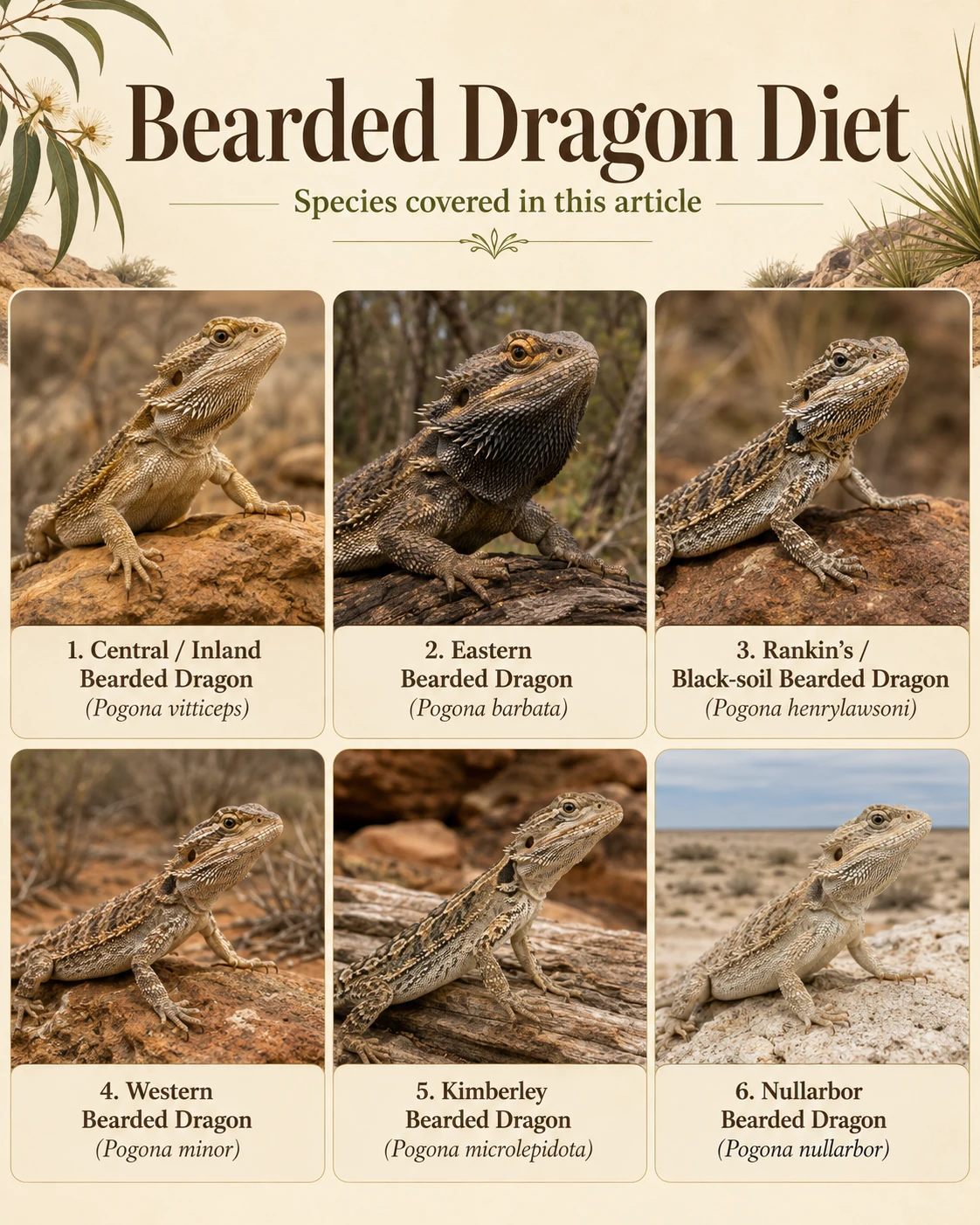
The 2026 Reptile Database recognizes six living species in the genus Pogona: P. barbata, P. henrylawsoni, P. microlepidota, P. minor, P. nullarbor, and P. vitticeps. Older books and websites may use additional names or different rankings, particularly for forms historically associated with P. minor.
Most pet bearded dragons are Pogona vitticeps. Rankin's or black-soil bearded dragons (P. henrylawsoni) are also kept in captivity, while eastern bearded dragons (P. barbata) and western/dwarf bearded dragons (P. minor) are encountered less commonly. Species-specific nutrition research for P. microlepidota and P. nullarbor is sparse.
Core Feeding Principles for Bearded Dragons
- Feed for life stage. Juveniles need more animal protein and energy for growth; adults need a greater proportion of fibrous plant matter.
- Keep plant foods available from an early age. Do not wait until adulthood to introduce greens. Early familiarity reduces later selective feeding.
- Use feeder variety. Rotate crickets, appropriately sized roaches, black soldier fly larvae, silkworms, and other suitable cultured insects rather than depending on one prey species.
- Choose lower-fat feeders more often. Adult insects and lower-fat larvae are preferable staples; waxworms and other very fatty larvae should be treats.
- Use high-fiber plant matter. Dark leafy greens, edible weeds/herbs, safe flowers, and vegetables should dominate the plant portion rather than fruit or watery lettuce.
- Feed during the active daylight period. Allow the dragon to warm and bask before the main meal. Avoid large meals immediately before lights and heat shut off.
- Use a clean feeding surface. Shallow ceramic dishes, slate, tile, or another washable surface reduce accidental ingestion of loose substrate and allow food intake to be measured.
- Control portion size. Captive dragons expend much less energy than wild animals and commonly become overweight when high-calorie insects are offered freely.
- Remove leftovers. Uneaten insects can hide, bite, or stress the dragon, and damp produce spoils quickly in a warm enclosure.
Natural Feeding Ecology and Life-Stage Change
Wild bearded dragons are opportunistic foragers. They consume arthropods, leaves, flowers, fruits, and occasionally small vertebrate prey. The proportions are not fixed throughout the year. A stomach-content study of free-ranging P. vitticeps found that animal material dominated the sampled dry-matter intake, largely because the animals had exploited a seasonal abundance of winged termites. That field snapshot demonstrates opportunism, but it does not mean that captive adults should receive unlimited insects or a termite-like high-energy ration every day.
Captive feeding must account for reduced exercise, constant food availability, and the poor calcium-to-phosphorus ratio of many cultured insects. For that reason, modern veterinary recommendations intentionally shift companion dragons toward a greater high-fiber plant contribution than might appear in a short seasonal sample of wild stomach contents.
Age-related dietary change is especially important. Juvenile bearded dragons are active insect hunters and use animal protein to support rapid growth. Adult animals become more plant-oriented. In P. barbata, a field study found juveniles to be strongly insectivorous, adults to be omnivorous, and large mature males to be particularly herbivorous; adult females retained a greater animal-food contribution than large males, plausibly reflecting reproductive demands.
Feeder Insects, Gut Loading, and Safe Presentation
Most common feeder insects contain substantially more phosphorus than calcium. A cricket- or mealworm-heavy diet without correction is therefore a classic risk factor for secondary nutritional hyperparathyroidism. Two complementary techniques improve feeder quality: gut loading, which enriches the insect before it is eaten, and dusting, which applies a light supplement coating immediately before feeding.
Useful feeder insects
- Crickets: useful staple when healthy, well hydrated, gut loaded, and appropriately sized.
- Dubia or other legally permitted feeder roaches: good staple option with a favorable protein-to-fat profile compared with many larvae.
- Black soldier fly larvae: naturally higher in calcium than many traditional feeders and useful in rotation. Much of that calcium is associated with the mineralized exoskeleton, so calcium bioavailability is not complete; they should not be treated as a reason to abandon an otherwise appropriate supplementation plan.
- Silkworms: soft-bodied, relatively lean feeders that require mulberry leaves or a proper silkworm diet.
- Hornworms: high-moisture feeders useful for variety and hydration; they grow rapidly and can become too large.
- Mealworms and superworms: acceptable in rotation but should not dominate the diet, especially in overweight adults.
- Waxworms and other very fatty larvae: reserve for occasional treats, appetite enticement, or specific veterinary situations.
Step-by-step feeder preparation
- Select healthy prey of appropriate size. A practical safety rule is to choose prey no wider than the distance between the dragon's eyes, especially for hatchlings and small juveniles.
- Rehydrate newly purchased insects. Recently shipped prey may be dehydrated or poorly fed.
- Use a proper high-calcium gut load. Professional reptile-nutrition references describe a final high-calcium gut-loading period before feeding; commercial products are preferable to improvising mineral concentrations at home.
- Keep the insects eating and hydrated during the gut-loading period. Remove wet or moldy food promptly.
- Transfer only the insects to be fed. Do not pour shipping medium, frass, shed skins, or dead insects into the dragon enclosure.
- Dust lightly immediately before feeding. Current veterinary nutrition guidance supports plain calcium dusting as part of routine feeding; the exact vitamin and D3 schedule should reflect the UVB setup and the concentration of the supplement being used.
- Offer measured prey. Use a smooth feeder dish, a clean supervised hunting area, or rounded feeding tongs so the number eaten is known.
- Remove leftovers. Do not leave mobile prey in the enclosure overnight.
Wild insects
Do not use insects collected from yards, gardens, agricultural areas, roadsides, or other uncontrolled locations. Pesticides, fertilizers, parasites, environmental contaminants, and toxic plant material may all be relevant. Never feed fireflies or lightning bugs; their defensive compounds can be highly toxic to lizards.
Hornworm warning: use commercially raised hornworms intended as reptile feeders. Do not offer hornworms collected from tomato, tobacco, pepper, eggplant, potato, or other nightshade plants because plant-derived alkaloids and pesticide exposure may make them unsafe.
Tong feeding versus hunting
Bearded dragons normally respond strongly to movement, so controlled hunting provides useful behavioral enrichment. Offer only a few insects at a time so the dragon must locate and pursue them without becoming overwhelmed. Rounded or silicone-tipped tongs are useful for measured feeding, but do not strike the lips with the tool or pull backward once the dragon has bitten the prey.
Greens, Vegetables, Flowers, and Fruit
High-fiber plant matter should make up at least half of the long-term diet of most companion P. vitticeps and a still larger share for many healthy adults. Plant foods should be varied across the week rather than built around a single favorite green.
Strong everyday choices
- collard greens;
- turnip greens;
- dandelion greens and flowers from untreated sources;
- endive and escarole;
- watercress;
- mustard greens as part of a rotation;
- safe edible weeds and leaves such as plantain or mulberry when positively identified and free of chemicals;
- nopal or Opuntia cactus pad with spines and glochids completely removed.
Useful vegetables and flowers for rotation
- butternut, acorn, delicata, or other winter squash;
- green beans;
- bell pepper;
- okra;
- small amounts of carrot or sweet potato for color and variety;
- hibiscus, nasturtium, rose petals, and other confirmed edible pesticide-free flowers.
Foods to use sparingly rather than as staples
Spinach, Swiss chard, and beet greens contain substantial oxalate and should not dominate the salad. Brassica greens such as kale, bok choy, mustard greens, cabbage, and broccoli can be useful foods in rotation; the practical concern is excessive reliance on a narrow diet, not the occasional use of one of these vegetables. Iceberg lettuce and similarly watery lettuces provide little nutritional density and should not form the base of the salad.
Fruit
Fruit is not required for a healthy bearded-dragon diet and is best reserved for rare, small treats if it is used at all. Captive P. vitticeps fed fruit have been reported to have greater odds of dental disease. For routine feeding, prioritize leafy greens, fibrous vegetables, and safe flowers rather than grapes, melon, banana, berries, or other sweet produce.
Preparation
Wash produce thoroughly and remove spoiled portions. Chop or tear leaves and vegetables into pieces that are easy to grasp, but do not puree the salad. Mixing several ingredients together reduces selective feeding. Offer the salad on a shallow dish or clean tile, ideally before insects, so a hungry dragon encounters plant food first.
If an otherwise healthy dragon refuses greens: first make sure insects are not being overfed. Try several safe plant types, vary presentation between chopped mixtures and larger leaves, and occasionally place a few favored insects among the greens to encourage investigation. Persistent loss of appetite, weight loss, or refusal of both insects and plants warrants evaluation of temperature, UVB, season, and health rather than simply offering increasingly palatable foods.
Commercial Bearded-Dragon Diets
Pellets, dried vegetable blends, canned products, and other commercial reptile foods can be convenient, but evidence comparing them with carefully prepared fresh diets is limited. Product labels may not disclose enough nutrient information to determine whether a food is genuinely complete for a bearded dragon.
If a commercial diet is used, choose a product that provides a clear ingredient list and meaningful nutrient analysis and use it as part of the total ration rather than automatically adding it on top of an already adequate diet. Account for calcium, vitamin D, and multivitamins already present in the product so supplementation is not unintentionally duplicated. Fresh greens and safe foraging foods remain valuable for fiber, moisture, texture, and normal feeding behavior.
Calcium, Vitamins, UVB, and Heat
Calcium deficiency, excessive dietary phosphorus, inadequate UVB, and insufficient basking temperature can converge to produce metabolic bone disease. Nutritional management therefore has to address all four factors rather than treating calcium powder as a substitute for correct husbandry.
Calcium
The 2024 veterinary nutrition review recommends lightly dusting plant foods and feeder insects with plain calcium whenever they are offered. A 2025 zoological-medicine review describes a more conservative clinician schedule of calcium without vitamin D3 or phosphorus two to three times weekly. These differing professional recommendations illustrate an important limitation: an evidence-based universal household supplementation schedule has not yet been established. “Lightly” matters—the food should be evenly coated, not buried under powder—and the plan should account for age, reproductive status, UVB exposure, feeder gut loading, black soldier fly larvae, fortified commercial diets, and any calcium already supplied elsewhere.
Gut loading
Current professional guidance describes feeding insects a high-calcium gut load before they are offered. Merck notes that adding approximately 8–10% calcium to the insect diet during the final gut-loading period can markedly improve insect calcium content. For owners, the safest practical approach is to use a reputable commercial high-calcium gut-load product according to its directions rather than trying to formulate a mineral concentrate from scratch.
Multivitamins
The 2024 nutrition review recommends a reptile multivitamin approximately weekly, with monthly considered a minimum; the 2025 LafeberVet zoological-medicine review describes use two to three times monthly. Products vary greatly in vitamin A, vitamin D3, and trace-mineral concentration, so frequency should be matched to the actual product and total ration. Avoid layering several fortified powders, pellets, and high-D3 products without considering cumulative exposure.
UVB
Reliable UVB exposure is essential for normal vitamin-D physiology and calcium utilization. A 2026 controlled study of juvenile P. vitticeps found that artificial UVB exposure increased both total and ionized blood calcium under the tested supplementation conditions, strengthening the evidence that UVB is an active part of calcium management rather than an optional accessory. The study did not establish an ideal household supplement schedule. Use a UVB source appropriate for a diurnal, basking lizard, follow the manufacturer's distance and replacement guidance, and remember that ordinary window glass and most plastics block useful UVB. A lamp can still look bright after its UVB output has declined.
Heat and digestion
Bearded dragons digest and assimilate food only when body temperature is appropriate. Feed during the daylight activity period after the dragon has had time to warm and bask. A dragon kept too cool may eat poorly, digest slowly, and become constipated even when the food itself is correct.
Species-Specific Feeding Guidelines
Nutrition data are strongest for Pogona vitticeps and P. barbata. For the less-studied species, the recommendations below distinguish published natural-history observations from practical captive management so that limited data are not presented as proven nutrient requirements.
Central or Inland Bearded Dragon — Pogona vitticeps
This is the common pet bearded dragon. It is an opportunistic omnivore with a strong ontogenetic shift: young animals are more insect-oriented, while healthy adults should receive a diet weighted toward high-fiber plant matter. A wild diet may temporarily become highly insect-heavy when seasonal prey such as termite alates are abundant, but a captive adult should not be maintained on unlimited high-calorie insects simply to imitate that short-term event.
- Frequency: Offer plant foods every day from an early age. During rapid growth, juveniles commonly receive one or two controlled insect feeding sessions daily; as growth slows, progressively reduce insect frequency. Healthy adults generally do well with daily plant foods and measured insects about two or three times weekly, adjusted for body condition, activity, and reproductive status. These frequencies are practical managed-care schedules rather than experimentally established requirements.
- When: Feed during the daytime after basking and normal activity have begun. Avoid a large meal shortly before the nighttime temperature drop.
- Where: Use a shallow washable dish or clean tile on the warm side but not directly beneath the hottest basking point. Supervised insects can also be offered in a separate clean feeding area for exercise and hunting behavior.
- How: Offer the mixed salad first, then a measured number of appropriately sized gut-loaded insects. Do not use an “all-you-can-eat” insect bowl for adults.
Eastern Bearded Dragon — Pogona barbata
Field evidence demonstrates an especially clear age- and sex-related dietary change. Juveniles were strongly insectivorous; adults were omnivorous; and large mature males were predominantly herbivorous. Adult females retained more animal food than large males, which may reflect the greater protein and energy demands of reproduction.
- Frequency: Feed growing juveniles a controlled insect-rich ration while offering greens daily. As maturity approaches, increase the plant contribution. Large nonbreeding adult males can be maintained more plant-heavy than juveniles; reproductive females may require somewhat greater insect and energy intake while producing follicles or eggs.
- When: Feed during the daylight active period after warming. In hot weather, natural activity can shift toward morning and later afternoon rather than midday.
- Where: Because this species is often semi-arboreal and uses logs, trunks, and elevated basking sites, a low raised feeding platform or dish near a secure perch can work well, while still keeping food away from loose substrate.
- How: Use mixed fibrous greens and safe browse as the adult foundation, with measured insects matched to age, sex, body condition, and reproductive state.
Rankin's / Black-Soil / Downs Bearded Dragon — Pogona henrylawsoni
This smaller bearded dragon is kept in captivity but has far less published nutrition research than P. vitticeps. Available husbandry practice supports an omnivorous diet with an age-related shift toward more plant matter, but no validated species-specific percentage has been established.
- Frequency: Offer greens daily. Growing juveniles can receive small insects daily; healthy adults generally need insects only several times weekly, with quantity adjusted to their much smaller body size.
- When: Feed during normal daylight activity after the dragon has warmed sufficiently.
- Where: Use a small shallow dish or clean feeding tile with nearby low branches or rocks for security and normal vantage behavior.
- How: Use the same high-quality feeder categories as for P. vitticeps, but choose substantially smaller individual prey and smaller total portions. Do not simply scale the number of insects used for a central bearded dragon.
Western / Dwarf Bearded Dragon — Pogona minor
Field work describes P. minor as a widely foraging generalist. Ants and other invertebrates are part of the natural diet, and plant material is also consumed. These observations suggest that animal prey can remain important, but there is not enough evidence to prescribe a unique captive insect percentage.
- Frequency: Offer safe plant foods regularly and provide measured cultured invertebrates several times weekly, increasing frequency for growing juveniles and reducing high-energy prey if adults gain excess weight.
- When: Feed during the daytime after warming and during the animal's normal active foraging period.
- Where: This species actively uses shrubs, logs, open ground, and elevated perches. A combination of a clean feeding dish plus occasional controlled prey hunting around low structure encourages normal movement.
- How: Use small cultured crickets, roaches, black soldier fly larvae, and similar feeders rather than attempting to reproduce the wild ant component. Do not collect ants from outdoors because of pesticide exposure, stings, defensive chemicals, and uncertain species safety.
Kimberley Bearded Dragon — Pogona microlepidota and Nullarbor Bearded Dragon — Pogona nullarbor
Published captive-nutrition evidence for these uncommon species is extremely limited. They should not be assigned precise feeding percentages simply by copying P. vitticeps. Until better species-specific data are available, a varied omnivorous ration using high-fiber plant foods and appropriately sized cultured insects is a reasonable starting framework, with close monitoring of weight, fecal output, activity, and reproductive state.
- Frequency: Offer plant material regularly and adjust insect frequency to age, body condition, and observed feeding behavior rather than using a rigid central-bearded-dragon schedule.
- When: Feed during the daylight active period after warming.
- Where: Present food on a clean surface positioned within the species' normal terrestrial/perching activity zone.
- How: Use multiple plant and feeder types, document intake, and avoid high-energy foods as routine staples. Managed populations should follow institution- or breeder-specific protocols when those are based on documented long-term outcomes.
Growth, Adulthood, and Reproduction
Hatchlings and juveniles
Young dragons grow rapidly and therefore need frequent access to high-quality protein, calcium, and energy. However, “more insects” does not mean unlimited mealworms or crickets. Use varied, gut-loaded prey, introduce greens immediately, and monitor growth so the dragon develops steadily without becoming excessively fat.
Subadults
As linear growth slows, reduce insect frequency and increase the proportion of fibrous plant matter. This transition should occur gradually rather than abruptly. A dragon that was allowed to ignore salads throughout juvenile life can become difficult to transition later.
Adults
Healthy nonbreeding adults generally require fewer calories than rapidly growing juveniles. Daily access to fibrous plant foods with measured insect meals is preferable to a constant supply of high-fat larvae. Obesity is common when juvenile feeding intensity is continued into adulthood.
Reproductive females
Follicle development and egg production increase energy and mineral demands. A reproductive female may require more food, more frequent high-quality insects, and careful calcium management than a nonbreeding adult male. Repeated egg production, poor body condition, weakness, tremors, straining, or reduced appetite warrants veterinary evaluation rather than simply adding supplements.
Water and Hydration
Provide fresh clean water at all times in a stable dish large enough for the dragon to drink from comfortably and, if it chooses, to sit in briefly. Change the water daily and whenever it is contaminated with food or feces.
Moisture-rich greens, vegetables rinsed immediately before feeding, and hornworms used in rotation can contribute dietary water. Some dragons respond to droplets on leaves or enclosure surfaces, but misting does not replace a clean water source. Routine forced soaking is not necessary for a normally hydrated dragon and should not be used to compensate for chronic husbandry problems.
Persistent tacky oral tissues, sunken appearance, unusually hard urates, constipation, reduced appetite, or lethargy should prompt a review of temperature and hydration and, when persistent, veterinary examination.
Seasonal Appetite and Brumation
Bearded dragons may show seasonal reductions in activity and food intake even in captivity. A healthy adult entering a true brumation pattern may eat little or stop eating as activity and body temperature decline. This is different from unexplained anorexia in a warm, active animal.
Do not intentionally cool or brumate a sick, underweight, dehydrated, newly acquired, or very young dragon. Before planned brumation, body weight, hydration, parasite risk, and general health should be assessed. Food should not be pushed into an animal that is no longer maintaining temperatures adequate for digestion.
During any seasonal slowdown, record weight rather than judging health by appetite alone. Progressive or excessive weight loss, weakness, abnormal feces, respiratory signs, or failure to resume normal activity should prompt veterinary evaluation.
Foods and Practices to Avoid
- Wild-caught insects: avoid because of pesticides, parasites, environmental contaminants, and toxic prey species.
- Fireflies/lightning bugs: never feed them; their defensive compounds can be highly toxic to lizards.
- Wild hornworms from nightshade plants: use commercially cultured feeder hornworms instead.
- Unlimited crickets, mealworms, superworms, or waxworms: an insect-heavy captive diet promotes mineral imbalance and obesity.
- Routine vertebrate prey, raw meat, dog food, or cat food: unnecessary for routine feeding and generally too energy dense or nutritionally inappropriate.
- Fruit as a regular food: it is unnecessary and has been associated with increased dental disease risk in captive P. vitticeps.
- Iceberg lettuce as a staple: low nutrient density.
- Large quantities of spinach, Swiss chard, or beet greens: high oxalate content makes them poor choices as dominant greens.
- Oversized prey: increases risk of traumatic feeding problems and gastrointestinal obstruction, especially in juveniles.
- Loose supplement piles or heavy powdering: more calcium or vitamin D is not automatically better.
- Feeding immediately before lights-out: digestion is compromised if the dragon cannot remain warm after the meal.
Weight and Health Monitoring
A good diet is judged by the animal, not only by the ingredient list. Track growth, adult body condition, appetite, fecal quality, urates, activity, oral health, and shedding. Weigh growing juveniles every one to two weeks during periods of rapid change and healthy adults at least monthly; use the same scale and similar timing for meaningful trends.
Watch for excessive abdominal fat, steadily increasing adult weight, reduced activity, or dependence on high-fat larvae. At the other extreme, progressive weight loss, loss of muscle over the limbs or spine, weakness, or depleted fat stores should not be corrected blindly with high-calorie foods until illness and husbandry problems have been considered.
Inspect the mouth regularly. Bearded dragons are prone to dental and periodontal disease, and sweet or sticky foods offer no nutritional advantage. Persistent oral redness, swelling, calculus, tooth changes, reluctance to bite food, or dropping food warrants veterinary examination.
Selected References
- Barboza T, Bercier M. An Update on Companion Inland Bearded Dragon (Pogona vitticeps) Nutrition. Veterinary Clinics of North America: Exotic Animal Practice. 2024;27(1):71-84. doi:10.1016/j.cvex.2023.08.002.
- Doss G. Clinical Medicine of Bearded Dragons. LafeberVet. Published October 2025; updated December 2025. Current zoological-medicine review and expert Q&A covering nutrition, supplementation, UVB, husbandry, and common clinical conditions.
- Hetényi N, Abonyi-Tóth Z, Sátorhelyi T, Hullár I. Effect of different dietary supplements on the growth and blood parameters of bearded dragons (Pogona vitticeps). Acta Veterinaria Hungarica. 2026;74(1):1-7. doi:10.1556/004.2025.01209.
- Merck Veterinary Manual. Nutrition in Reptiles. Full review September 2025; updated October 2025.
- Merck Veterinary Manual. Nutrition in Lizards. Full review September 2025.
- Divers SJ, Comolli JR. Management and Husbandry of Reptiles. Merck Veterinary Manual. Reviewed July 2025.
- Oonincx DGAB, van Leeuwen JP, Hendriks WH, van der Poel AFB. The diet of free-roaming Australian Central Bearded Dragons (Pogona vitticeps). Zoo Biology. 2015;34(3):271-277.
- Wotherspoon D, Burgin S. Sex and ontogenetic dietary shift in Pogona barbata, the Australian eastern bearded dragon. Australian Journal of Zoology. 2016;64(1):14-20. doi:10.1071/ZO15019.
- Thompson SA, Thompson GG. The western bearded dragon, Pogona minor (Squamata: Agamidae): An early lizard coloniser of rehabilitated areas. Journal of the Royal Society of Western Australia. 2003;86:1-6.
- Australian Museum. Central Bearded Dragon (Pogona vitticeps). Updated December 2025.
- The Reptile Database. Genus Pogona. 2026 release.
- Mott R, et al. Prevalence and risk factors for dental disease in captive Central bearded dragons (Pogona vitticeps) in the United Kingdom. Journal of Exotic Pet Medicine. 2020.
- UC Davis School of Veterinary Medicine. Bearded Dragon Care. General veterinary husbandry reference.
- Divers SJ, Stahl SJ, eds. Mader's Reptile and Amphibian Medicine and Surgery. 3rd ed. Elsevier; 2019.