Reptile Husbandry & Preventive Care
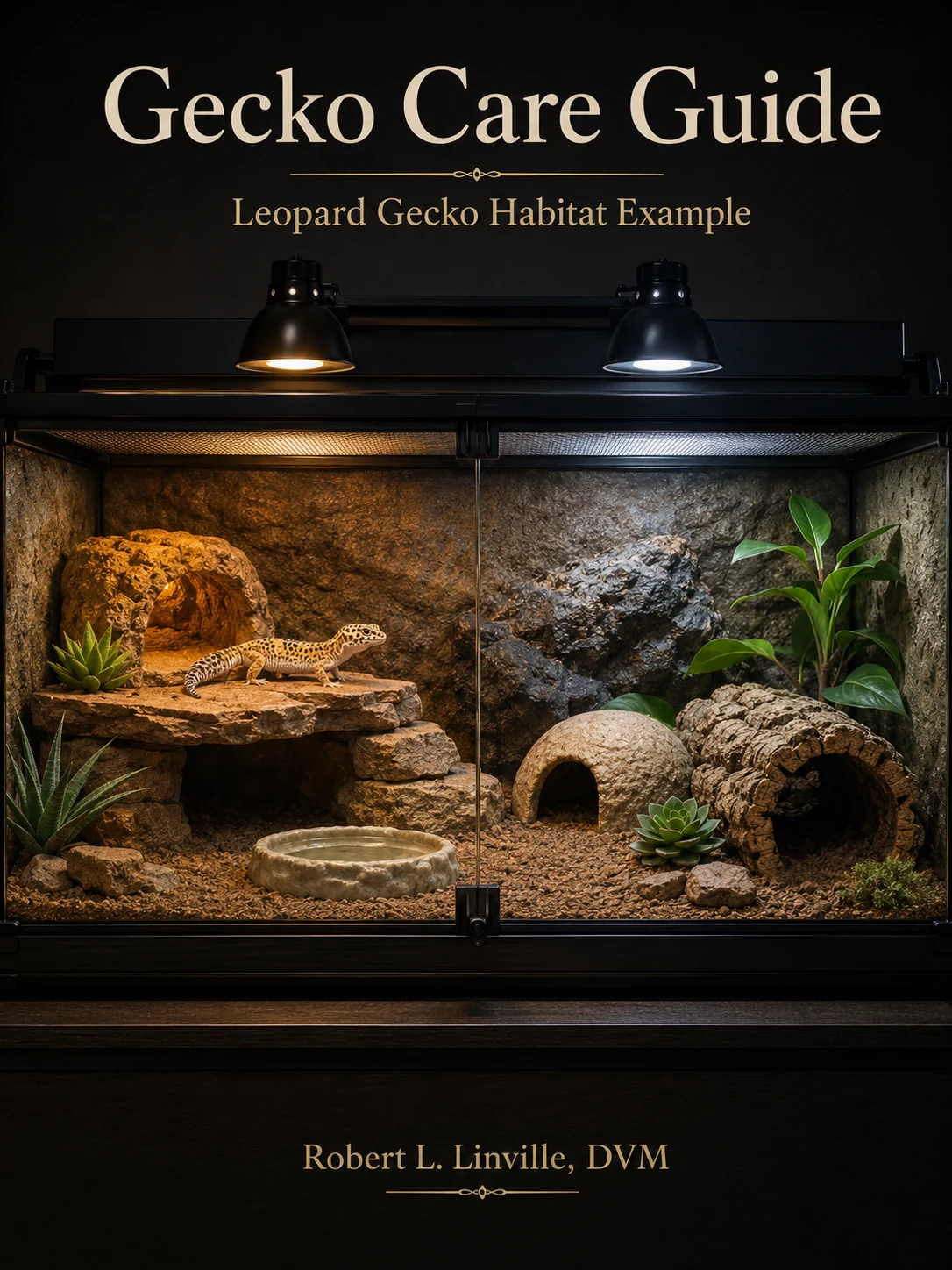
Gecko Care Guide
Comprehensive husbandry and preventive-care guidance for the major gecko groups kept in human care, with species-specific recommendations for enclosure design, thermal gradients, UVB and visible light, humidity cycling, behavior, reproduction, handling, sanitation, and common health problems.
Quick Care Guide
There is no single “gecko setup.” Gekkota includes tiny tropical wall geckos, desert burrowers, cool rainforest specialists, large high-canopy New Caledonian geckos, and brightly lit diurnal day geckos. The species must be identified before temperature, humidity, lighting, substrate, enclosure orientation, or social housing is selected.
| Care area | Practical starting principle | Important qualification |
|---|---|---|
| Housing | Use a secure enclosure large enough for a real thermal and humidity gradient, normal locomotion, hides, and enrichment. | Terrestrial geckos need floor area; arboreal geckos need height and usable horizontal branches and surfaces. |
| Temperature | Provide a measured warm-to-cool gradient rather than one uniform temperature. | Some species bask near 95–100°F (35–38°C); others, especially many Uroplatus and Goniurosaurus, can become dangerously heat stressed in temperatures tolerated by tropical geckos. |
| UVB | Provide species-appropriate UVB with a shaded escape route and measure the actual UV Index when possible. | Nocturnal does not mean biologically isolated from daylight. Target UVI is usually low for nocturnal species and higher for diurnal Phelsuma. |
| Visible light | Provide a clear day/night cycle; bright daytime illumination is especially important for diurnal species and planted enclosures. | Avoid red, blue, or purple “night bulbs.” Geckos can perceive light that disrupts the dark period. |
| Humidity | Match the species and provide cycling rather than leaving the enclosure constantly wet. | Even arid species require humid retreats; humid forest species still require ventilation and drying between misting events. |
| Water | Provide clean drinking water and species-appropriate misting or droplets where useful. | Misting should support drinking and humidity cycling, not create stagnant, continuously wet conditions. |
| Social housing | One gecko per enclosure is the safest general companion-animal rule. | Mourning geckos are naturally more social and parthenogenetic; professionally managed breeding groups are a separate situation. |
| Handling | Support the body and allow voluntary movement from hand to hand. | Never restrain a gecko by the tail. Day geckos and leaf-tailed geckos have especially delicate skin; tokays can deliver a powerful bite. |
| Nutrition | Use the companion Gecko Diet Guide. | Insectivorous, omnivorous, and nectar/fruit-using geckos have very different dietary requirements. |
| Veterinary care | Establish a baseline weight and veterinary relationship soon after acquisition. | Chronic weight loss, tail thinning, diarrhea, retained shed, reproductive problems, abnormal posture, and respiratory signs deserve prompt investigation. |
Gecko Diversity and Taxonomy
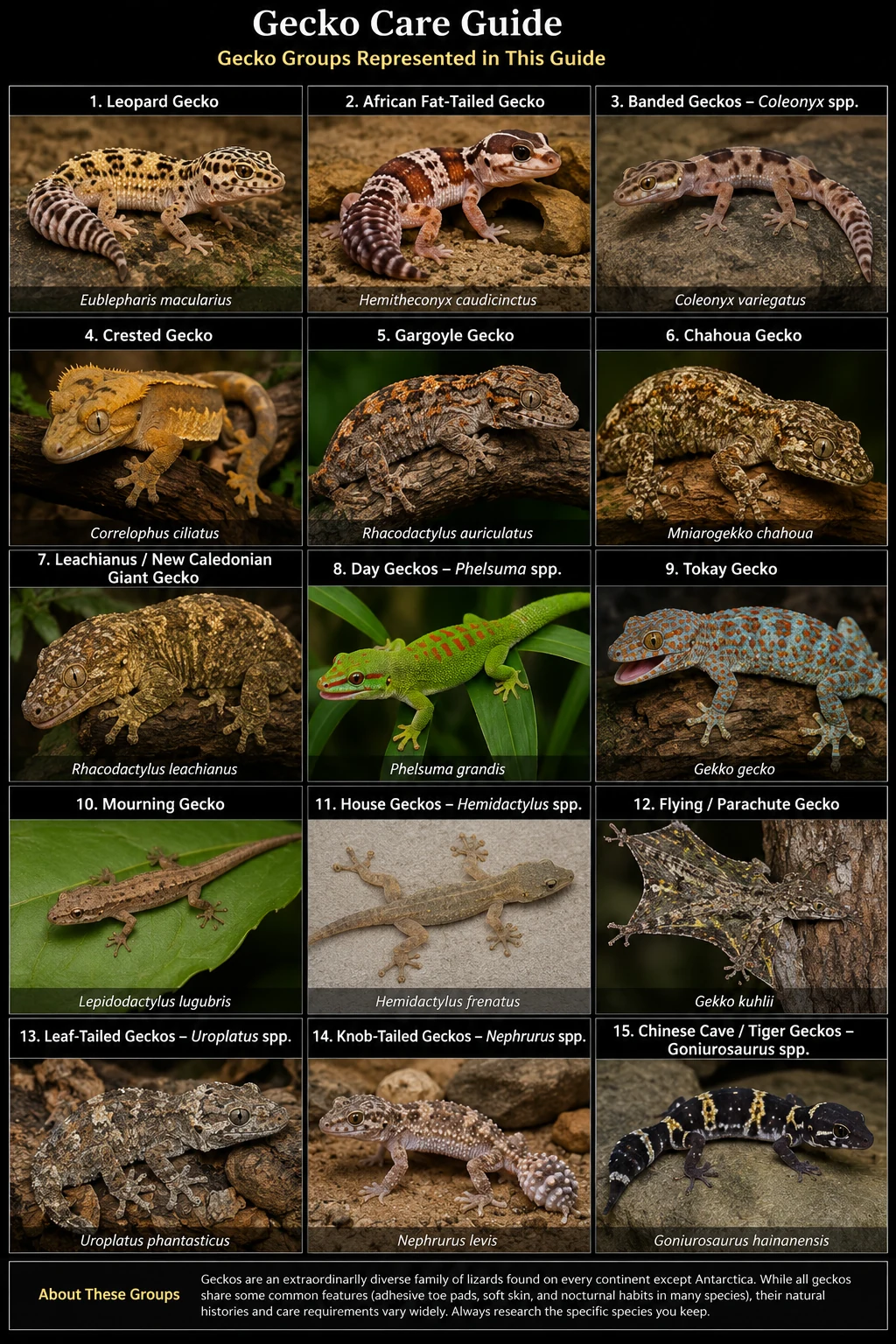
“Gecko” describes a major evolutionary radiation rather than one husbandry type. Modern classifications place living geckos in the infraorder Gekkota, distributed among several families. The animals commonly kept as pets include members of Eublepharidae, Diplodactylidae, Gekkonidae, Phyllodactylidae, and related lineages.
Leopard geckos, African fat-tailed geckos, banded geckos, and Chinese cave geckos are eyelid geckos: unlike most geckos, they have movable eyelids and lack the highly developed adhesive toe pads of many arboreal species. Crested, gargoyle, chahoua, leachianus, tokay, house, day, mourning, flying, and leaf-tailed geckos use specialized adhesive structures to climb bark, leaves, glass, and other surfaces.
Taxonomy continues to change. A useful example is the flying or parachute gecko, now generally treated as Gekko kuhli; older literature and the pet trade frequently use the former genus name Ptychozoon. New Caledonian taxa have also undergone major generic revisions. Scientific names should therefore be checked against a current taxonomic database when acquiring an unusual species.
Natural History and Ecological Groups
Matching the enclosure to the animal's ecological niche is more useful than copying a generic “tropical” or “desert” terrarium. The major groups covered in this guide can be viewed as follows:
- Arid and semi-arid terrestrial geckos: leopard geckos, many banded geckos, and many knob-tailed geckos use ground-level shelters, burrows, rock crevices, and humid microclimates within otherwise dry habitats.
- Seasonally humid terrestrial geckos: African fat-tailed geckos occupy West African savanna and woodland mosaics where temperature and rainfall cycle markedly.
- Cool, humid forest-floor and rock geckos: Chinese cave/tiger geckos require much cooler conditions than many tropical arboreal species and are vulnerable to overheating.
- New Caledonian arboreal geckos: crested, gargoyle, chahoua, and leachianus geckos live among shrubs, trunks, branches, and forest canopy. They need vertical structure, nighttime cooling, and humidity cycles rather than constant heat.
- Diurnal arboreal geckos: day geckos (Phelsuma) are bright-light specialists that bask, use stronger UV exposure than most nocturnal geckos, and move rapidly over vertical vegetation.
- Large tropical nocturnal arboreal geckos: tokays use warm, humid vertical habitats and defend favored shelters aggressively.
- Tiny commensal and microgeckos: house and mourning geckos exploit narrow cracks and small vertical surfaces; escape prevention is a primary design requirement.
- Parachuting / bark-associated geckos: flying geckos use flattened bodies, skin flaps, broad toe pads, and bark camouflage in Southeast Asian forests.
- Madagascar leaf-tailed geckos: Uroplatus are humidity-sensitive, ventilation-dependent forest specialists; several are far less tolerant of prolonged warmth than common pet geckos.
Before Your Gecko Arrives
Set up and stabilize the enclosure before bringing the gecko home. Run all lamps, thermostats, timers, and misting systems for several days and record the actual warm-side, cool-side, nighttime, humidity, and UVI values. A label on a bulb or thermostat setting is not a measurement of what the animal experiences.
- Confirm the exact species and, when relevant, locality or subspecies.
- Ask whether the animal is captive bred, its age, sex if known, previous temperatures and humidity, diet, supplementation, and reproductive history.
- Ask about recent weight trends, shedding, stool quality, appetite, previous veterinary testing, and any deaths or chronic wasting in the source collection.
- Have a secure transport container, quarantine enclosure, digital gram scale, probe thermometers, hygrometer, thermostat/dimmer, and appropriate UVB equipment ready.
- Locate a veterinarian comfortable with reptile medicine before an emergency occurs.
Captive-Bred Animals, Conservation, and Legal Trade
Captive-bred geckos are generally preferred. They reduce pressure on wild populations, usually adapt more readily to human care, and provide better information about age, origin, diet, and disease history. Wild-caught geckos may arrive dehydrated, parasitized, injured, stressed, or poorly adapted to captivity.
Conservation and trade status varies greatly. Some New Caledonian, Malagasy, and Asian species are regulated or have restricted international trade. Uroplatus and several Goniurosaurus populations warrant particular attention to legal provenance and conservation status. Requirements can change, so verify current federal, state, local, CITES, and country-of-origin rules before purchase, breeding, sale, or transport.
Never release a pet gecko outdoors. House geckos and other adaptable species can establish invasive populations, while most nonnative geckos released into unsuitable climates simply die.
Housing and Enclosure Design
The enclosure must be large enough to create choice: choice of temperature, humidity, light, cover, elevation, and resting surface. Minimal containers that keep a gecko alive but do not permit those choices are poor long-term housing.
Terrestrial species
Leopard, African fat-tailed, banded, knob-tailed, and cave geckos need meaningful horizontal floor area, multiple shelters, and a gradient from a warm zone to a cool zone. Floor dimensions generally matter more than excessive height. Climbing structure should still be provided where safe.
Arboreal species
Crested, gargoyle, chahoua, leachianus, day, tokay, mourning, house, flying, and leaf-tailed geckos require height plus a dense network of branches, cork, vines, foliage, ledges, and retreats. A tall empty tank is not an arboreal habitat.
Enclosure size is a starting point, not a goal
The dimensions in the species table are practical minimum or starting sizes derived from current husbandry and zoological guidance. Larger well-designed enclosures generally make thermal gradients, enrichment, exercise, and behavioral choice easier. Juvenile grow-out enclosures can be smaller when necessary for monitoring, but should not become permanent adult housing.
Enclosure Materials, Security, and Escape Prevention
- Front-opening glass or PVC: useful for many species when ventilation is adequate. PVC retains heat and humidity efficiently; glass allows good observation but can overheat rapidly in direct sun.
- Screen: useful when very high ventilation is needed, but it loses humidity and heat rapidly and may abrade noses/toes if poorly designed.
- Locks and gap control: essential. Mourning geckos, hatchlings, house geckos, and many other small species can pass through surprisingly narrow gaps around doors, cable ports, or screen frames.
- Ventilation: humidity must never be maintained by sealing an enclosure to the point of stagnant air. Cross-ventilation is especially important for humid forest geckos.
- Heat-source guards: any lamp or ceramic heater mounted inside an enclosure must be protected so the gecko cannot contact it. Adhesive geckos can reach surfaces an owner assumes are inaccessible.
- Stable furnishings: rocks, cork, and heavy branches must be anchored so digging or climbing cannot cause collapse.
Substrate, Drainage, Humid Hides, and Nesting Areas
Substrate should reflect the species and the enclosure's moisture strategy. No single substrate is appropriate for every gecko.
- Arid terrestrial species: a firm, diggable soil/sand/clay-type substrate can provide natural traction and burrowing opportunity. Avoid excessively dusty or unstable material.
- Humid terrestrial and arboreal species: moisture-retentive soil-type substrate with leaf litter can buffer humidity. A drainage layer may be useful in planted enclosures, but the surface should not remain waterlogged.
- Humid hides: leopard, fat-tailed, banded, knob-tailed, and other terrestrial geckos should have a localized humid retreat even when the main enclosure is comparatively dry.
- Quarantine: paper towels or another easily inspected substrate can be useful initially because feces, urates, mites, regurgitation, and abnormal discharge are easier to detect.
- Egg-laying females: species that bury eggs need a secure, appropriately moist nesting area deep enough to dig without reaching a hard floor immediately.
Substrate ingestion is most concerning when husbandry is poor, prey is inappropriate, the animal is dehydrated, or the substrate is unsuitable. Feeding dishes and controlled prey presentation can reduce accidental ingestion, but the larger goal is a healthy, well-hydrated gecko maintained at appropriate temperatures.
Temperature and Basking Heat
Geckos are ectotherms. They regulate body temperature by moving among different microclimates. A thermostat set to one number does not replace an enclosure gradient.
Use overhead radiant heat where practical because it creates a natural warm surface and a vertical/horizontal gradient. Heat mats may supplement a carefully designed terrestrial enclosure, but should not be the only source of environmental warmth when they fail to warm the surrounding air. Every electrical heat source should be controlled with the appropriate thermostat, dimmer, or both.
Nighttime cooling is normal for most species. The required degree varies substantially: leopard geckos can tolerate nights near 60°F (16°C), while tokays generally need much warmer nights. Conversely, cool-adapted Uroplatus and Goniurosaurus can suffer from chronic overheating if kept at typical “tropical reptile” room temperatures.
Measuring Temperature Correctly
| Tool | Best use | Limitation |
|---|---|---|
| Digital probe thermometer | Continuous measurement of basking surfaces, warm hides, or shaded air zones. | Measures only the location of the probe; one probe cannot describe the whole enclosure. |
| Infrared temperature gun | Rapid mapping of surface temperatures on rock, cork, branches, substrate, and hides. | Does not measure air temperature; reflective surfaces can give misleading readings. |
| Digital thermometer/hygrometer | Continuous air temperature and relative humidity. | Placement matters; a single sensor should not be assumed to represent both the hot upper enclosure and cool lower enclosure. |
| Thermostat | Limits or regulates heater output and improves safety. | A thermostat controls equipment; it does not prove the resulting surface and air temperatures are correct. |
For arboreal geckos, measure the upper basking branch, shaded upper foliage, mid-enclosure air, and lower cool zone. For terrestrial geckos, measure the basking surface, warm hide, cool-side surface/air, and nighttime minimum.
UVB, UVA, and Visible Light
Natural sunlight is a complex package of visible light, UVA, UVB, and infrared heat. Captive lighting should recreate the biologically relevant parts of that environment rather than treating “a UVB bulb” as the entire lighting plan.
Nocturnal does not mean “no daylight exposure”
Many nocturnal and crepuscular geckos hide during the brightest part of the day but expose portions of the body while resting, emerge before sunset, or voluntarily cryptic-bask. Current veterinary and zoological lighting practice therefore increasingly provides low-level UVB to many species historically maintained without it.
Typical practical basking targets in this guide are approximately UVI 0.5–2 for many nocturnal geckos, UVI 2–3 for leachianus in a suitably shaded tall enclosure, and UVI 3–4 for giant day geckos and comparable diurnal Phelsuma. These are exposure zones at the animal, not lamp-brand percentages.
Visible light
A clear photoperiod supports circadian and seasonal biology. Bright white full-spectrum visible light is particularly important for day geckos and useful for planted enclosures. Avoid colored night lights. If nighttime heat is required, use a properly controlled lightless source.
Shade is mandatory
UVB and heat should overlap in a limited basking zone, while dense foliage, cork, hides, and lower levels allow the animal to move into lower UVI and lower temperature. Lighting the entire enclosure uniformly removes the animal's ability to regulate exposure.
Checking UV Output: UV Test Cards Versus UV Index Meters
UV-sensitive cards can demonstrate that some UV is reaching a location and can help identify a lamp that has failed completely. They are useful qualitative checks but do not provide a reliable numerical UV Index.
A UV Index meter designed for reptile husbandry, such as a Solarmeter 6.5/6.5R or equivalent, is the preferred quantitative tool. Measure where the gecko's back actually reaches the basking zone, with the normal screen or mesh in place. Mesh type, lamp age, reflector design, distance, and manufacturing variation can all change output.
Glass and most ordinary plastics block biologically useful UVB. Never assume sunlight through a closed window or a UVB lamp shining through glass provides meaningful UVB exposure.
Humidity, Water, Hydration, and Ventilation
Humidity should be thought of as a daily cycle and a set of microclimates, not one number. A gecko may need a dry basking surface, a moderately humid ambient zone, a humid hide, and a nighttime humidity rise within the same enclosure.
- Arid species: keep the primary enclosure relatively dry but provide a humid hide and drinking water.
- New Caledonian species: generally benefit from evening misting that raises humidity, followed by substantial daytime drying.
- Tokays and house geckos: generally use moderate-to-high humidity but still need airflow and drying surfaces.
- Leaf-tailed geckos: require high humidity with excellent ventilation; remaining wet and stagnant is undesirable.
- Cave geckos: need moist, cool refuges and higher humidity without warm stagnant conditions.
Provide a clean water dish unless a species-specific managed-care protocol gives a compelling reason not to. Arboreal geckos often drink droplets readily, so evening misting may provide both environmental humidity and drinking opportunities. Observe actual drinking rather than assuming misting alone is adequate.
Furnishings and Environmental Enrichment
Enrichment begins with a biologically appropriate enclosure, not with novelty objects. Useful furnishings provide different orientations, textures, elevations, hiding opportunities, and routes through the enclosure.
- Multiple snug hides for terrestrial species, including at least one humid hide.
- Cork rounds, cork flats, bark slabs, and securely anchored rocks.
- Horizontal, diagonal, and vertical branches sized so the feet can grip naturally.
- Dense foliage and visual barriers, especially for arboreal forest geckos.
- Broad vertical surfaces for tokay, house, flying, and leaf-tailed geckos.
- Hollow cork and large trunk-like retreats for leachianus and chahoua geckos.
- Burrowing substrate and protected surface clutter for knob-tailed and banded geckos.
- Bamboo and smooth but grip-capable vertical perches for many day geckos.
Live plants can improve cover, humidity buffering, and visual complexity. Use nontoxic species, avoid pesticide residues, and protect root balls from digging where necessary.
Outdoor Sunlight and Secure Exercise
Natural unfiltered sunlight can provide excellent visible light and UVB, but routine outdoor exposure is not necessary for a gecko maintained under a well-designed indoor lighting system. For many geckos it also creates disproportionate escape and overheating risks.
If outdoor exposure is used, it should occur only in a fully escape-proof, predator-proof, shaded enclosure with continuous temperature monitoring. Never place a glass or plastic terrarium in direct sun: greenhouse heating can raise temperatures to lethal levels rapidly. Never carry a small adhesive gecko outdoors loose on a hand, shoulder, or branch.
Handling, Acclimation, and Cooperative Interaction
Handling tolerance varies enormously. Leopard and African fat-tailed geckos often become calm with gentle interaction; day geckos and leaf-tailed geckos should generally be regarded as display animals; tokays may become conditioned to routine care but can bite forcefully.
- Allow a newly acquired gecko to establish feeding and normal behavior before unnecessary handling.
- Approach slowly from the side rather than pinning from above.
- Encourage the gecko to walk onto a hand, cork tube, or transfer container.
- Support the trunk and all four feet when possible.
- Never grasp or lift by the tail.
- For adhesive geckos, do not peel toes forcefully from glass or a hand; allow the animal to release its own toe pads as it walks.
- Keep sessions short and low to the ground until the animal's jumping behavior is understood.
Target training and entering a transport tube or box voluntarily can be especially useful for large leachianus, tokays, and delicate species that are poor candidates for routine manual restraint.
Normal Behavior and Communication
- Activity period: leopard, fat-tailed, tokay, house, leaf-tailed, leachianus, and many others are mainly nocturnal or crepuscular; day geckos are conspicuously diurnal.
- Vocalization: tokays are famous for loud calls, but New Caledonian and house geckos also use chirps, clicks, or growls.
- Tail signaling: waving or twitching may occur during hunting, courtship, defense, or agitation.
- Autotomy: many geckos can shed the tail as a defense. Regenerative ability varies; a crested gecko's lost tail does not regenerate normally, while several other species regrow a structurally different replacement.
- Color change: crested and gargoyle geckos may “fire up” or “fire down.” Day gecko coloration can change with stress, temperature, and physiologic state. Color alone is not a disease diagnosis.
- Cryptic basking: nocturnal geckos may expose part of the body to light while remaining in a shelter. This is one reason low-level UVB can still be biologically relevant.
Sex Identification
Sexual dimorphism varies by species and may not be obvious until maturity.
| Feature | Male tendency | Female tendency / caution |
|---|---|---|
| Hemipenal bulges | Paired bulges at the tail base in many species. | Absent or much less prominent; juveniles may be difficult to judge. |
| Preanal / femoral pores | Often larger and more conspicuous. | Usually smaller or absent, depending on species. |
| Head/body shape | Some species develop broader heads or larger adult size. | Overlap is substantial; shape should not be the only criterion. |
| Color | Some day gecko species show sex-linked pattern differences. | Many morphs and species do not; color alone is unreliable. |
| Mourning gecko | Functional males are exceptionally rare. | Populations are predominantly female and reproduce by parthenogenesis. |
Do not probe or evert hemipenes in a pet gecko without appropriate training. When sex matters medically or for breeding management, a reptile veterinarian or experienced zoological professional can confirm it.
Reproductive Considerations
Female geckos can develop serious reproductive disease even when no male is present. Species differ in egg number, shell characteristics, nesting behavior, sperm storage, and seasonality.
- Provide adequate calcium status, correct UVB/thermal husbandry, hydration, and body condition before breeding.
- Provide suitable nesting substrate before a gravid female begins searching frantically for a site.
- Persistent digging, restlessness, anorexia, abdominal enlargement, straining, weakness, or prolonged failure to lay can indicate dystocia or follicular disease.
- Crested, gargoyle, New Caledonian, leopard, fat-tailed, and many other females typically bury eggs in substrate.
- Mourning geckos commonly adhere eggs to hard surfaces and can rapidly populate an enclosure without a male.
- Do not incubate eggs or breed conservation-sensitive species without a plan for legal, responsible placement of offspring.
Species-Specific Husbandry Guidelines
The following table gives practical adult starting points. These values are not interchangeable between species. Temperatures are separated into basking/warm areas, cooler zones, and nighttime ranges whenever reliable current guidance is available.
| Species/group | Approximate adult size | Adult enclosure starting point | Temperature | Humidity | UV target | Key caution |
|---|---|---|---|---|---|---|
| Leopard gecko Eublepharis macularius | ~7–10 in (18–25 cm) | 36×18×18 in (91×46×46 cm) or larger; terrestrial | Bask 94–97°F (34–36°C); warm hide 90–92°F (32–33°C); cool 70–77°F (21–25°C); night may fall to ~60°F (16°C) | ~30–40% ambient; humid hide ~70–80% | UVI ~0.5–1.5; hypopigmented morphs ~0.5–0.7 | Retained toe shed, obesity, MBD, cryptosporidial wasting. |
| African fat-tailed gecko Hemitheconyx caudicinctus | ~8–10 in (20–25 cm) | 36×18×18 in (91×46×46 cm) or larger | Warm season: warm hide 90–94°F (32–34°C), cool 72–77°F (22–25°C); cool season substantially lower if intentionally cycled | Seasonal: ~50–80% day with higher nights; humid hide always | UVI ~1–2 | Needs more humidity than leopard gecko; seasonal ecology matters. |
| Banded geckos Coleonyx spp. | ~4–6 in (10–15 cm) | ~24×18×18 in (61×46×46 cm) for one adult; larger preferred | Reasonable starting bask/warm zone 88–92°F (31–33°C); cool 72–78°F (22–26°C); night 65–72°F (18–22°C) | Generally dry-moderate, ~30–50%, with humid retreat | Low UVI ~0.5–1.5 | Group is ecologically variable; these are cautious genus-level starting ranges. |
| Crested gecko Correlophus ciliatus | ~7–9 in (18–23 cm) | 18×18×36 in (46×46×91 cm) or larger; arboreal | Bask 82–85°F (28–29°C); cool 70–75°F (21–24°C); night 65–72°F (18–22°C) | ~60–80% after misting, drying to ~40–50% before next cycle | UVI ~1–2 | Chronic temperatures above ~85°F (29°C) can be hazardous; lost tail does not normally regrow. |
| Gargoyle gecko Rhacodactylus auriculatus | ~7–9 in (18–23 cm) | 18×18×36 in (46×46×91 cm) or larger | Bask ~84°F (29°C); shaded upper air ~77–84°F (25–29°C); cool ~72–74°F (22–23°C); night ~68–77°F (20–25°C) | ~50–70% with nighttime rise and daytime drying | UVI ~1–2 | Avoid chronic heat above ~86°F (30°C); individuals can be territorial. |
| Chahoua gecko Mniarogekko chahoua | ~10–12 in (25–31 cm) | 24×24×36 in (61×61×91 cm) or larger | Bask 82–85°F (28–29°C); cool 72–75°F (22–24°C); night 65–72°F (18–22°C) | ~60–80%, usually higher at night | UVI ~1–2 | Needs substantial climbing area and bark/hollow structure; solitary housing safest. |
| Leachianus gecko Rhacodactylus leachianus | Up to ~14 in (35.5 cm); 8–12 oz (227–340 g) | Main-island forms ~48×24×48 in (122×61×122 cm); smaller henkeli forms ~36×18×36 in (91×46×91 cm) | Bask 86–88°F (30–31°C); ambient 72–78°F (22–26°C); night 66–72°F (19–22°C) | Average ~60–80%, with daytime lows and nighttime peaks | UVI ~2–3 | Large, territorial, powerful; heat stress and pair incompatibility are important risks. |
| Giant day gecko benchmark Phelsuma grandis | Up to ~10 in (25 cm) | 24×24×48 in (61×61×122 cm) or larger | Bask 85–90°F (29–32°C); cool 77–82°F (25–28°C); night 73–77°F (23–25°C) | ~40–75%, cycling | UVI ~3–4 | Diurnal; delicate skin; strong lighting required. Other Phelsuma may need different values. |
| Tokay gecko Gekko gecko | ~10–14 in (25–36 cm), sometimes larger | 24×24×48 in (61×61×122 cm) minimum for many adults; larger specimens benefit from 36×24×48 in (91×61×122 cm) | Bask 90–100°F (32–38°C); cool 80–85°F (26–29°C); night 76–80°F (24–26°C) | ~60–80% | UVI ~1–2 | Strong bite, territorial, vocal, highly capable climber. |
| Mourning gecko Lepidodactylus lugubris | ~4 in (10 cm) | Very secure arboreal enclosure; ~12×12×18 in (30×30×46 cm) or larger for a small compatible group | Bask 80–85°F (26–29°C); cool 70–75°F (21–24°C); night 65–72°F (18–22°C) | Moderate-high, commonly ~60–80% with drying cycle | Low UVI ~1–2 | Parthenogenetic; reproduces rapidly; hatchlings escape through tiny gaps. |
| House geckos Hemidactylus spp. | Often ~3–6 in (7.5–15 cm) | Secure vertical enclosure; ~18×18×24 in (46×46×61 cm) or larger for many species | For Mediterranean house gecko: bask 80–85°F (26–29°C), cool 70–75°F (21–24°C), night 65–75°F (18–24°C) | Often ~60–80% average, but species and climate vary | Low UVI ~1–2 | Hemidactylus spans many climates; identify species before final settings. |
| Flying / parachute gecko Gekko kuhli | ~6–8 in (15–20 cm) | At least ~18×18×24 in (46×46×61 cm); taller/larger preferred | Provisional: day ~75–82°F (24–28°C), localized warm area ~84–88°F (29–31°C), night ~68–75°F (20–24°C) | ~60–80% with daily drying | Low-moderate UVI ~1–2 | Less standardized captive evidence; bark surface area and escape-proofing are critical. |
| Henkel's leaf-tailed gecko Uroplatus henkeli | Large Uroplatus, roughly ~10–12 in (25–30 cm) | EAZA: adult pair ≥24×24×39 in (60×60×100 cm); larger is better | Day average 72–79°F (22–26°C); night 63–70°F (17–21°C) | ~60–100% with excellent ventilation and drying between sprays | Generally low UVI ~1–2 | Heat-sensitive; chronic >81°F (27°C) can be harmful and >90°F (32°C) may cause rapid decline. |
| Knob-tailed geckos Nephrurus spp. | ~4–6+ in (10–15+ cm), species dependent | ≤4 in species ~24×18×18 in (61×46×46 cm); larger species ~36×18×18 in (91×46×46 cm) | Bask ~88–90°F (31–32°C); cool ~70–81°F (21–27°C); night >64°F (>18°C) | Arid overall; humid hide and localized damp substrate | UVI ~1–2 | Burrowing substrate and localized moisture are essential; do not confuse arid with dehydrated. |
| Chinese cave / tiger geckos Goniurosaurus spp. | Many ~7–9.5 in (18–24 cm) | 24×18×18 in (61×46×46 cm) for one adult; larger preferred | Warm hide 80–82°F (27–28°C); cool 72–77°F (22–25°C); night 68–72°F (20–22°C) | ~50–90%, lower by day and higher at night | UVI ~1–2 | Cool-adapted and vulnerable to overheating; several taxa are conservation/trade-sensitive. |
Leopard Gecko — Eublepharis macularius
Approximate adult size: commonly 7–10 in (18–25 cm), with substantial variation among sex, lineage, and selective-breeding lines. The tail is an important fat-storage organ.
Habitat and enclosure
Leopard geckos are terrestrial eyelid geckos from arid and semi-arid regions of South-Central Asia. A modern adult starting enclosure of 36×18×18 in (91×46×46 cm) or larger provides substantially more useful floor area than older small-aquarium recommendations. Provide a warm hide, cool hide, humid hide, additional cover, low climbing structure, and a diggable naturalistic surface when appropriate.
Temperature
Use a broad basking surface around 94–97°F (34–36°C), a warm hide around 90–92°F (32–33°C), and a cool end around 70–77°F (21–25°C). Healthy adults can tolerate a nighttime decline toward about 60°F (16°C), provided they can warm normally the following day. Merck lists a general leopard-gecko POTZ of 77–86°F (25–30°C); this is an air-temperature range and should not be confused with the warmer localized basking surface.
Humidity and shedding
Background daytime humidity around 30–40% is a useful practical target in many homes, while the humid hide should remain approximately 70–80%. Retained shed around toes is common and can constrict digits. Check every toe after shedding.
UVB
For normally pigmented animals, a basking UVI around 0.5–1.5 is appropriate. Albino, patternless, and other hypopigmented morphs are more light sensitive; keep maximum exposure around 0.5–0.7 and provide extensive shade.
Health emphasis
Monitor body weight and tail thickness. Progressive weight loss despite eating, tail thinning, diarrhea, regurgitation, or chronic poor body condition should prompt evaluation for husbandry error, parasites, obstruction, oral disease, reproductive disease, and Cryptosporidium. Recent research confirms that cryptosporidial infections can be persistent and associated with wasting in leopard geckos; prevalence from a single breeding facility must not be generalized to the pet population.
African Fat-Tailed Gecko — Hemitheconyx caudicinctus
Approximate adult size: about 8–10 in (20–25 cm).
This West African terrestrial eyelid gecko occupies savanna and woodland environments that cycle between warmer/wetter and cooler/drier periods. Husbandry should therefore not simply duplicate a dry leopard-gecko enclosure.
Housing
Use at least 36×18×18 in (91×46×46 cm) for one adult, with secure hides on both warm and cool sides, a humid hide, leaf litter/cork cover, and a substrate capable of maintaining localized moisture without becoming swampy.
Temperature and seasonality
During a warm/rainy-season simulation, use a warm hide around 90–94°F (32–34°C), a cool side around 72–77°F (22–25°C), and nighttime around 72–77°F (22–25°C). Advanced keepers or breeders may use a cooler dry-season cycle: current husbandry guidance describes a warm area around 79°F (26°C), cool area 68–74°F (20–23°C), and night around 63–64°F (17–18°C). Do not impose a major seasonal cooling cycle on an underweight, ill, newly acquired, or reproductively compromised animal.
Humidity
Current husbandry guidance ranges from approximately 70–80% daytime with very high nighttime humidity in the wet season to around 50% daytime and 70–75% nighttime in the dry season. A continuously available humid hide is important.
UVB
Provide low-level UVB around UVI 1–2 at the accessible basking zone with deep shade.
Banded Geckos — Coleonyx spp.
Approximate adult size: commonly about 4–6 in (10–15 cm), depending on species.
North American banded geckos occupy deserts, arid grasslands, washes, rocky outcrops, and related dry habitats, but they use sheltered retreats where humidity and temperature differ markedly from exposed ground.
Reasonable starting husbandry
Robust current captive standards are less standardized than for leopard geckos. For a common desert-adapted Coleonyx, a practical single-animal starting enclosure is around 24×18×18 in (61×46×46 cm), with deep cover and a humid retreat. Begin with a localized warm surface around 88–92°F (31–33°C), cool zone 72–78°F (22–26°C), and nights around 65–72°F (18–22°C). Ambient humidity can remain relatively low to moderate, roughly 30–50%, while the retreat is substantially more humid.
Low-level UVB around UVI 0.5–1.5 is a reasonable provision. Because Coleonyx species span different elevations and climates, use these numbers as a cautious starting point and refine them for the exact species and locality.
Crested Gecko — Correlophus ciliatus
Approximate adult size: about 7–9 in (18–23 cm) total length when the tail is present.
Crested geckos are arboreal New Caledonian geckos adapted to relatively mild forest temperatures. They are not tropical-heat specialists.
Housing
Use at least 18×18×36 in (46×46×91 cm) for an adult, with abundant branches, cork, foliage, and perches throughout the full height. Horizontal branches are as important as vertical vines because they provide comfortable resting positions.
Temperature
Provide a small upper basking zone around 82–85°F (28–29°C), a cooler zone around 70–75°F (21–24°C), and nighttime around 65–72°F (18–22°C). Sustained temperatures above about 85°F (29°C) can produce heat stress, especially when the animal cannot retreat downward.
Humidity
Allow an evening misting peak around 60–80%, then let the enclosure dry toward approximately 40–50% before the next major misting. Constantly saturated substrate, glass, and foliage are not desirable.
UVB and tail
Provide approximately UVI 1–2. If a crested gecko drops its tail, the tail generally does not regenerate; a tailless “frogbutt” adult can still live normally when otherwise healthy.
Gargoyle Gecko — Rhacodactylus auriculatus
Approximate adult size: about 7–9 in (18–23 cm).
Gargoyle geckos are New Caledonian arboreal geckos that use shrubs, branches, bark, and hollow retreats. They often move more horizontally through dense structure than a sparse vertical tank suggests.
Provide at least 18×18×36 in (46×46×91 cm). A basking area near 84°F (29°C), shaded upper temperatures around 77–84°F (25–29°C), cool area around 72–74°F (22–23°C), and nighttime around 68–77°F (20–25°C) are reasonable current targets. Avoid sustained temperatures above approximately 86°F (30°C).
Humidity around 50–70% with an evening/night rise and daytime drying works well in a ventilated enclosure. Provide UVI 1–2 with shade. Single housing avoids territorial bites and feeding competition.
Chahoua Gecko — Mniarogekko chahoua
Approximate adult size: about 10–12 in (25–31 cm).
Chahoua geckos are robust New Caledonian arboreal geckos that benefit from thick branches, cork tubes, hollow bark, and broad resting platforms.
An adult should have at least 24×24×36 in (61×61×91 cm), with larger strongly preferred. Provide a small basking area around 82–85°F (28–29°C), cool zone 72–75°F (22–24°C), and night 65–72°F (18–22°C). Humidity around 60–80% should rise after misting and fall as surfaces dry. Target UVI 1–2.
Chahoua can be territorial and should not be casually cohabitated. Their strong grip and body size make voluntary transfer using cork or hands safer than grabbing.
New Caledonian Giant / Leachianus Gecko — Rhacodactylus leachianus
Approximate adult size: up to about 14 in (35.5 cm) and roughly 8–12 oz (227–340 g), making this the largest living gecko species.
Leachianus geckos are high-canopy forest animals and require much more enclosure volume and branch diameter than smaller New Caledonian geckos. Main-island and insular/locality forms differ in adult size.
Housing
For larger main-island R. l. leachianus, a current practical minimum is approximately 48×24×48 in (122×61×122 cm). Smaller henkeli-type forms can begin around 36×18×36 in (91×46×91 cm), although larger remains preferable. Provide thick trunk-like climbing surfaces, large cork hollows, branches, and foliage at several heights.
Temperature and humidity
Use a basking zone around 86–88°F (30–31°C), general ambient around 72–78°F (22–26°C), and nights around 66–72°F (19–22°C). Maintain average humidity around 60–80%, allowing daytime drops near 50% and nighttime peaks much higher when ventilation remains good.
UVB and behavior
Target approximately UVI 2–3 at the upper basking zone with extensive shaded retreats. Adults can be territorial, vocal, and powerful. Single housing is safest unless breeding is carefully managed, and pairs that once appeared compatible can later injure each other.
Day Geckos — Phelsuma spp.
Day geckos are a diverse radiation of strongly diurnal, visually oriented arboreal geckos. Species range from roughly 3–4 in (7.6–10 cm) in small forms such as the yellow-headed day gecko to about 10 in (25 cm) in the Madagascar giant day gecko.
Giant day gecko benchmark — Phelsuma grandis
For an adult giant day gecko, use at least 24×24×48 in (61×61×122 cm) with bamboo-like branches, smooth and textured vertical perches, heavy foliage, and open basking sites. Provide a basking zone around 85–90°F (29–32°C), cooler air around 77–82°F (25–28°C), nighttime around 73–77°F (23–25°C), humidity around 40–75% with cycling, and a basking UV Index around 3–4.
Do not apply giant-day-gecko values to every Phelsuma. Smaller or montane species can differ significantly in heat and humidity requirements.
Handling caution
Day gecko skin is delicate and can tear or slough when grabbed. They are rapid jumpers with adhesive feet and should usually be managed as display animals using voluntary transfer, a tube, or a small catch container when movement is necessary.
Tokay Gecko — Gekko gecko
Approximate adult size: commonly about 10–14 in (25–36 cm), with large males sometimes larger.
Tokays are large tropical nocturnal arboreal geckos famous for loud territorial vocalizations and a strong defensive bite. Captive-bred juveniles can become more predictable, but the species should never be treated as a naturally placid handling pet.
Provide at least 24×24×48 in (61×61×122 cm) for a typical adult; large specimens benefit from 36×24×48 in (91×61×122 cm) or more. Use thick branches, hollow cork, vertical bark, foliage, and several dark resting sites.
Current husbandry targets are a basking area around 90–100°F (32–38°C), cool zone 80–85°F (26–29°C), nighttime 76–80°F (24–26°C), humidity around 60–80%, and UVI around 1–2. Some homes therefore require controlled lightless nighttime heat.
Mourning Gecko — Lepidodactylus lugubris
Approximate adult size: about 4 in (10 cm).
Mourning geckos are tiny, highly adaptable arboreal geckos best known for predominantly female parthenogenetic reproduction. They can form compatible social groups but can also multiply rapidly.
A small group can use an extremely secure enclosure around 12×12×18 in (30×30×46 cm) or larger, densely furnished with cork, twigs, leaves, bamboo, and narrow retreats. Every cable hole, door gap, and screen edge must be hatchling-proof.
Provide a basking area around 80–85°F (26–29°C), cool zone 70–75°F (21–24°C), nighttime 65–72°F (18–22°C), moderate-high humidity commonly around 60–80% with drying cycles, and low UVB around UVI 1–2.
Eggs are often glued to enclosure furnishings or walls. Attempting to remove a firmly adhered egg can destroy it. Population control should be considered before maintaining a breeding colony.
House Geckos — Hemidactylus spp.
Approximate adult size: many common house geckos are about 3–6 in (7.5–15 cm), but the genus is diverse.
House geckos are excellent examples of why a common name is not enough for husbandry. Mediterranean house geckos, tropical Asian house geckos, and other Hemidactylus come from different climates even though all may live around human buildings.
For a Mediterranean house gecko, current practical guidance uses a basking area around 80–85°F (26–29°C), cool zone 70–75°F (21–24°C), nighttime 65–75°F (18–24°C), and average humidity around 60–80% with substantial day/night variation. A secure vertical enclosure around 18×18×24 in (46×46×61 cm) or larger works for many small species, but identify the exact species before finalizing conditions.
Use cork, bark slabs, branches, crevices, and foliage. These geckos are rapid and escape through small openings; routine free handling is unnecessary.
Flying / Parachute Gecko — Gekko kuhli (formerly Ptychozoon kuhli)
Approximate adult size: roughly 6–8 in (15–20 cm).
This Southeast Asian arboreal gecko has a flattened body, webbed digits, broad skin flaps, and exceptional bark camouflage. Older husbandry sources commonly list it under Ptychozoon; current taxonomy places it in Gekko.
Use a tall enclosure with extensive cork and bark surface area rather than a few thin vines. Approximately 18×18×24 in (46×46×61 cm) is a reasonable minimum for one adult, with larger preferred.
Published modern captive standards are not as robust as those for leopard or crested geckos. A cautious starting range is daytime air 75–82°F (24–28°C), localized upper warmth around 84–88°F (29–31°C), nighttime 68–75°F (20–24°C), humidity around 60–80% with good ventilation and daily drying, and low-moderate UVB around UVI 1–2. Refine these values according to the exact origin, measured behavior, and veterinary/managed-care experience.
Leaf-Tailed Geckos — Uroplatus spp.
Uroplatus are Madagascar-endemic arboreal geckos with extraordinary bark or leaf camouflage. Species vary dramatically in adult size and microhabitat. Small leaf mimics may be only about 3.5–4 in (9–10 cm), while large bark mimics can exceed 10 in (25 cm).
Henkel's leaf-tailed gecko benchmark
EAZA recommends at least 24×24×39 in (60×60×100 cm) for an adult pair and 35×35×47 in (90×90×120 cm) for a professionally managed group of 3–5, with larger enclosures improving environmental choice. For companion care, single housing simplifies observation and avoids social stress.
Maintain approximately 60–100% relative humidity depending on time of day and season, but combine misting with strong ventilation and evaporation. The enclosure should not remain wet all day. Provide a network of broad bark surfaces, trunks, foliage, and shaded resting sites. Low UVB around UVI 1–2 is a reasonable genus-level target, adjusted for species and microhabitat.
Uroplatus skin and tails are delicate. Handle only when necessary and with minimal pressure. Some individuals decline quickly when environmental conditions are wrong, making close daily observation essential.
Knob-Tailed Geckos — Nephrurus spp.
Approximate adult size: commonly about 4–6+ in (10–15+ cm), depending on species; some are substantially heavier and larger than others.
Australian knob-tailed geckos are terrestrial, nocturnal, and often highly adapted to digging. Their desert origin should not be interpreted as a need for sterile, bone-dry conditions.
For smaller species up to roughly 4 in (10 cm), use at least 24×18×18 in (61×46×46 cm); larger species should begin around 36×18×18 in (91×46×46 cm). Provide deep diggable substrate, protected hides, and a cool-side humid retreat.
A practical basking area around 88–90°F (31–32°C), cool zone around 70–81°F (21–27°C), and nighttime above about 64°F (18°C) suit many commonly kept forms. Provide UVI 1–2. Keep drinking water available and mist a localized cool area several times weekly rather than soaking the entire enclosure.
Chinese Cave / Tiger Geckos — Goniurosaurus spp.
Approximate adult size: many commonly kept species reach roughly 7–9.5 in (18–24 cm).
These striking eyelid geckos inhabit cool, humid forest, limestone, and cave-associated habitats in East and Southeast Asia. They are among the geckos most likely to be harmed by the assumption that “tropical” means hot.
For a single adult, use at least 24×18×18 in (61×46×46 cm), with larger preferred. Create deep shaded cover, cork, rocks, leaf litter, and moist retreats.
For commonly kept Chinese forms, use a warm hide around 80–82°F (27–28°C), cool area 72–77°F (22–25°C), and nighttime 68–72°F (20–22°C). Avoid allowing the entire enclosure to rise above approximately 82°F (28°C). Humidity can cycle broadly around 50–90%, generally lower by day and higher at night, with good ventilation. Provide UVI 1–2.
Several Goniurosaurus taxa are conservation-sensitive and internationally regulated. Captive-bred, legally documented animals should be strongly preferred.
Shedding, Skin, Toe Pads, and Tail Care
Healthy geckos usually remove and often eat shed skin. Retained shed becomes clinically important when it constricts toes, remains over the eyes or nostrils, or accumulates around the tail tip.
- Inspect toes after every shed, especially in leopard, fat-tailed, cave, and other small-toed geckos.
- Correct the underlying humidity, hydration, temperature, nutrition, and health problem rather than repeatedly peeling skin manually.
- Do not pull dry retained skin from a toe. Controlled soaking/moistening and veterinary assistance may be necessary.
- Adhesive toe pads function best when clean and intact. Avoid oily residues, sticky adhesives, and inappropriate disinfectant residues on climbing surfaces.
- Day geckos and Uroplatus have particularly delicate skin. Never “scruff” or pinch loose skin to control them.
- After tail autotomy, keep the enclosure clean and monitor for persistent bleeding, swelling, discoloration, or infection. Regrowth varies by species.
Seasonality and Annual Cycling
Wild geckos experience changes in day length, rainfall, temperature, food abundance, and reproductive activity. A completely static environment is therefore not always biologically ideal.
- New Caledonian geckos: modest seasonal photoperiod and temperature shifts can support normal annual cycling.
- African fat-tailed geckos: distinct warm/wet and cooler/dry periods can be reproduced deliberately in stable adults.
- Uroplatus: professional best-practice guidance emphasizes seasonal changes in temperature, rainfall, and photoperiod, especially for reproduction.
- Knob-tailed and banded geckos: activity and reproductive timing may reflect seasonal desert cycles.
- Leopard geckos: modest winter reductions in light and temperature may occur, but routine deep cooling is unnecessary for a companion animal and should not be imposed on an unhealthy gecko.
Seasonal cycling is an advanced husbandry tool, not a reason to expose a pet to uncontrolled cold, prolonged fasting, or dehydration.
Cleaning and Sanitation
- Remove feces, urates, shed skin, spoiled prepared food, dead insects, and contaminated substrate promptly.
- Wash and refill water dishes regularly; biofilm can develop even when water looks clear.
- Clean feeding ledges and prepared-diet cups after each use.
- Use reptile-safe disinfectants at appropriate concentration and contact time, followed by rinsing when the product requires it.
- Do not mix cleaning equipment among quarantined or unrelated geckos.
- In bioactive systems, continue spot cleaning and health surveillance. “Bioactive” does not mean self-cleaning or pathogen-free.
Persistent gastrointestinal pathogens such as Cryptosporidium require more stringent biosecurity than routine cleaning and may be difficult to eliminate from porous furnishings. Veterinary diagnosis should guide decontamination decisions.
Salmonella and Household Hygiene
Healthy reptiles can carry Salmonella and other potentially harmful organisms without appearing sick. Good hygiene protects the household without implying that a healthy gecko is “dirty” or diseased.
- Wash hands with soap and running water after touching the gecko, enclosure, feces, water dish, feeder insects, or cleaning equipment.
- Keep reptile equipment and food-preparation items out of kitchens and human food-preparation sinks.
- Do not allow reptiles to roam freely through food-preparation or children's play areas.
- Do not kiss geckos or hold them close to the face.
- Children younger than 5 years, adults 65 years and older, and immunocompromised people are at higher risk of serious reptile-associated infection.
Quarantine and Biosecurity
A new gecko should be housed separately from established reptiles. A practical quarantine period is at least 60–90 days, and longer may be appropriate when origin is uncertain, clinical signs develop, or disease testing is pending.
- Use separate tools, feeding equipment, scale containers, and cleaning supplies.
- Care for established healthy animals before quarantined animals, then wash hands and change contaminated clothing as appropriate.
- Record weight, appetite, fecal quality, shedding, and reproductive events.
- Discuss fecal examination and parasite testing with a reptile veterinarian. One negative fecal sample does not exclude every parasite.
- For leopard geckos or collections with unexplained wasting, regurgitation, chronic diarrhea, or deaths, discuss specific Cryptosporidium testing. Repeated sampling and molecular testing may be necessary because shedding can be intermittent or prolonged.
Routine Health Monitoring and Preventive Veterinary Care
Geckos often conceal disease until physiologic reserves are limited. Objective trend data are therefore valuable.
| Monitor | Suggested approach | Why it matters |
|---|---|---|
| Body weight | Use a gram scale; weekly for new, juvenile, ill, or reproductive animals, then monthly for stable adults. | Small changes can be significant in a 10–50 g gecko. |
| Body condition / tail | Photograph from the same angle and track tail base, pelvic prominence, muscle mass, and abdominal contour. | Weight alone may miss loss of fat or muscle during egg development or fluid shifts. |
| Appetite | Record actual intake rather than merely whether food was offered. | Declining intake may precede obvious illness. |
| Feces and urates | Watch frequency, consistency, blood, mucus, undigested prey, and urate color. | Useful for hydration, GI disease, parasites, obstruction, or reproductive disease. |
| Skin/toes | Inspect after shedding. | Retained shed can cause toe necrosis. |
| Environment | Record hot/cool temperatures, nighttime minimum, humidity cycle, and UVI periodically. | Lamp aging, seasonal room changes, and equipment failure alter husbandry over time. |
A veterinary examination soon after acquisition is particularly useful for wild-caught, imported, poorly documented, thin, symptomatic, or conservation-sensitive geckos. Stable captive-bred adults should still have periodic preventive examinations based on age and risk.
Common Diseases and Health Problems
| Problem | Common contributing factors / signs | Prevention and response |
|---|---|---|
| Nutritional secondary hyperparathyroidism / metabolic bone disease | Inadequate calcium, vitamin D/UVB, inappropriate supplementation, poor gut loading, or temperatures that impair digestion. Weakness, tremors, soft jaw, deformity, fractures, poor climbing. | Correct diet/UVB/temperature; veterinary evaluation and imaging/lab work when clinically affected. Nutrition details are in the Gecko Diet Guide. |
| Dysecdysis / retained toe shed | Low humidity, dehydration, poor humid-hide access, systemic illness. Constricting shed can cause swollen or necrotic toes. | Correct humidity microclimate; inspect toes; veterinary treatment if tissue is injured. |
| Heat stress and dehydration | Uniformly hot enclosure, direct sun on glass, failed thermostat, excessive basking temperature, inadequate nighttime cooling. Restlessness, open-mouth breathing, weakness, collapse. | Species-specific gradient, shaded retreat, thermostat, independent thermometer, emergency cooling and veterinary care if symptomatic. |
| Obesity / hepatic lipidosis | Excess calories, fatty insects, little exercise, adult fed like juvenile. Thick tail/body, reduced activity; severe cases may develop hepatic disease. | Control calories and body condition; increase enclosure complexity; veterinary workup for unexplained obesity or anorexia. |
| Reproductive disease | Dystocia, postovulatory egg retention, preovulatory follicular stasis, ectopic eggs, yolk coelomitis. Digging, anorexia, abdominal enlargement, weakness, straining. | Correct nesting, calcium/UVB/temperature/hydration; imaging and veterinary treatment promptly. |
| Cryptosporidiosis / chronic wasting | Progressive weight loss, tail thinning, regurgitation, diarrhea, poor appetite; infection may persist or be subclinical. | Strict quarantine and dedicated tools; reptile-veterinary testing. Molecular testing may be needed. Do not generalize colony prevalence to all geckos. |
| Other internal parasites | Wild-caught origin, contaminated collections, poor sanitation. Weight loss, abnormal stool, anorexia, sometimes no signs. | Fecal testing guided by risk and signs; treat identified parasites appropriately rather than deworming blindly. |
| Stomatitis / oral disease | Trauma, infection, systemic disease, poor husbandry. Swelling, discharge, reluctance to eat, abnormal jaw use. | Veterinary examination; correct environmental and nutritional contributors. |
| Dermatitis / bacterial or fungal skin disease | Constantly wet dirty substrate, poor ventilation, burns, trauma, retained shed. Redness, crusts, blisters, discoloration. | Clean, ventilated species-appropriate environment; veterinary diagnostics rather than empirical topical treatment alone. |
| Respiratory disease | Incorrect temperature, stagnant humidity, systemic infection. Increased respiratory effort, bubbles/discharge, open-mouth breathing outside heat stress. | Correct environment and seek veterinary evaluation; advanced disease may require imaging/culture/targeted therapy. |
| Tail or skin trauma | Grabbing, cage-mate aggression, unstable décor, stuck shed, feeder insect bites. Tail loss, wounds, skin tears. | Single housing, safe furnishings, correct handling. Day gecko and leaf-tail skin requires exceptional care. |
| Burns | Contact with unguarded bulbs, ceramic heaters, hot rocks, overheated surfaces. | Guard and thermostat heat sources; veterinary treatment for visible burns. |
| Prolapse | Reproductive disease, constipation/obstruction, parasites, dehydration, calcium imbalance, excessive straining. | Keep tissue clean and moist and seek prompt veterinary care; identify underlying cause. |
| Ocular problems | Retained shed, trauma, debris, infection, vitamin/nutritional disease; eyelid geckos and spectacle-bearing geckos present differently. | Avoid forceful cleaning; persistent closure, swelling, discharge, or corneal change requires veterinary examination. |
Warning Signs Requiring Veterinary Attention
- rapid or progressive weight loss, especially thinning of the tail;
- persistent refusal to eat outside a known brief seasonal or reproductive change;
- repeated regurgitation or vomiting;
- diarrhea, blood, marked mucus, or repeated abnormal feces;
- weakness, tremors, abnormal posture, dragging limbs, soft jaw, or fractures;
- open-mouth breathing, respiratory noise, bubbles, or nasal/oral discharge;
- eye swelling, persistent eye closure, or visible corneal injury;
- retained shed causing swollen or dark toes;
- prolapse from the cloaca;
- persistent digging/straining or a suspected egg-laying problem;
- burns, deep wounds, uncontrolled bleeding, or severe cage-mate injury;
- collapse, severe overheating, or inability to right itself.
Safe Transport
Transport geckos in a small, secure, ventilated container rather than in the full enclosure. A snug temporary container reduces falls and makes temperature easier to control.
- Line with paper towel or another clean, nonabrasive material.
- Provide a simple hide or rolled towel/cork piece when it will not crush the animal.
- Do not place loose rocks, water bowls, or heavy décor in a moving carrier.
- Keep the carrier out of direct sun and never leave it in a parked vehicle.
- For cold weather, warm the surrounding insulated transport box gradually; never place a chemical hand warmer directly against the gecko container.
- For heat-sensitive species such as Uroplatus and Goniurosaurus, transport temperature may require active planning in warm weather.
- Bring husbandry records, photographs of the enclosure, current supplements/diet labels, and a fresh fecal sample to veterinary visits when requested.
Recommended Equipment Checklist
- species-appropriate front-opening or otherwise secure enclosure;
- locking or gap-proof doors, screen, and cable ports;
- species-appropriate overhead heat source;
- thermostat and/or dimming control suitable for the heater;
- at least two digital temperature probes or thermometer/hygrometer units;
- infrared temperature gun;
- species-appropriate UVB fixture;
- UV Index meter when possible for quantitative setup and maintenance;
- timer for heat/light and optional programmable seasonal photoperiod;
- bright white visible-light/plant lighting for diurnal or planted setups;
- digital hygrometer;
- hand mister or automatic misting system for species that require it;
- water dish and elevated drinking/feeding stations where appropriate;
- multiple hides, including a humid hide for terrestrial species that require one;
- branches, cork, bark, foliage, and species-appropriate climbing surfaces;
- stable diggable substrate or moisture-retentive forest substrate as appropriate;
- digital gram scale and weight log;
- dedicated quarantine and cleaning equipment;
- secure small transport container.
Feeding and Nutrition — Companion Article
Detailed nutritional guidance is intentionally reserved for the Gecko Diet Guide. That article covers insectivorous versus fruit/insect feeding biology, feeder variety, gut loading, calcium and multivitamin supplementation, prepared complete gecko diets, hydration, feeding stations, prey size, life-stage feeding, and safe hand/tong feeding.
The essential husbandry point is that food cannot compensate for an incorrect environment. A gecko maintained too cold, chronically overheated, dehydrated, or without appropriate UVB and calcium management may become ill even when high-quality food is offered.
Selected References and Source Material
The guide prioritizes current veterinary manuals, university and peer-reviewed literature, zoological best-practice guidelines, recognized zoo/natural-history resources, current reptile-specialist husbandry references, and the sources already curated on the site's Reptile Resources page. Older herpetoculture material is useful historically but does not control current recommendations when stronger evidence is available.
- Gecko Diet Guide. Dr. Bob's Pet Health Information. Companion nutrition article and current species framework.
- Reptile Resources — Geckos. Dr. Bob's Pet Health Information. Curated current veterinary, zoological, species-husbandry, and historical references.
- Divers SJ, Comolli JR. Management and Husbandry of Reptiles. Merck Veterinary Manual. Reviewed/updated 2025.
- Nutritional, Metabolic, and Endocrine Diseases of Reptiles. Merck Veterinary Manual.
- Reproductive Diseases of Reptiles. Merck Veterinary Manual.
- Bacterial Diseases of Reptiles. Merck Veterinary Manual.
- Baines FM, Chattell J, Dale J, et al. How much UV-B does my reptile need? The UV-Tool. Journal of Zoo and Aquarium Research. 2016;4(1):42–63.
- Pollock C. Basic Information Sheet: Leopard Gecko. LafeberVet. Veterinary background reference.
- Leopard Gecko Care Guide. ReptiFiles. Current detailed husbandry reference.
- African Fat-Tailed Gecko Care Sheet. ReptiFiles.
- Western and California Banded Geckos. CaliforniaHerps. Natural history, identification, and distribution.
- Crested Gecko Care Manual. ReptiFiles.
- Gargoyle Gecko Care Guide. ReptiFiles.
- Chahoua Gecko Care Sheet. ReptiFiles.
- Leachie Gecko Care Sheet. ReptiFiles.
- New Caledonian Gecko. Smithsonian's National Zoo and Conservation Biology Institute. Zoological natural-history and size reference for Rhacodactylus leachianus.
- Madagascar Giant Day Gecko. Smithsonian's National Zoo and Conservation Biology Institute.
- Giant Day Gecko Care Sheet. ReptiFiles.
- Tokay Gecko Care Sheet. ReptiFiles.
- Mourning Gecko Care Guide. ReptiFiles.
- Mediterranean House Gecko Care Sheet. ReptiFiles.
- Gekko kuhli. The Reptile Database. Current taxonomy for the flying/parachute gecko.
- Cook M, Foley S, Ploetz F, et al. EAZA Best Practice Guidelines for Henkel's Leaf-Tailed Gecko (Uroplatus henkeli). European Association of Zoos and Aquariums. 2024.
- Giant Leaf-Tailed Gecko. Smithsonian's National Zoo and Conservation Biology Institute.
- Leaf-Tailed Gecko Care. ReptiFiles.
- Knob-Tailed Gecko Care. ReptiFiles.
- Chinese Cave Gecko Care Sheet. ReptiFiles.
- Nipithakul P, Yodpunya S, Prasitwiset W, et al. Cryptosporidium varanii Infection in Captive Leopard Gecko and Its Association with Wasting Syndrome in Thailand. Animals. 2026;16(1):33.
- Zikmundová V, Holubová N, Fenclová J, et al. Cryptosporidium geckonae n. sp. in geckos. Parasites & Vectors. 2025;18:420.
- Reptiles and Amphibians — Healthy Pets, Healthy People. U.S. Centers for Disease Control and Prevention. Updated January 2026.
- Mader DR, Divers SJ, eds. Current Therapy in Reptile Medicine and Surgery. Elsevier. Veterinary reptile-medicine reference.
Social Housing and Territorial Behavior
One gecko per enclosure is the safest default. Many species tolerate conspecifics only under specific reproductive or resource conditions, and injuries or chronic stress may occur without obvious fighting.
When breeding is intentional, provide multiple feeding stations, hides, basking choices, and the ability to separate animals immediately.