Chelonian Husbandry & Preventive Care
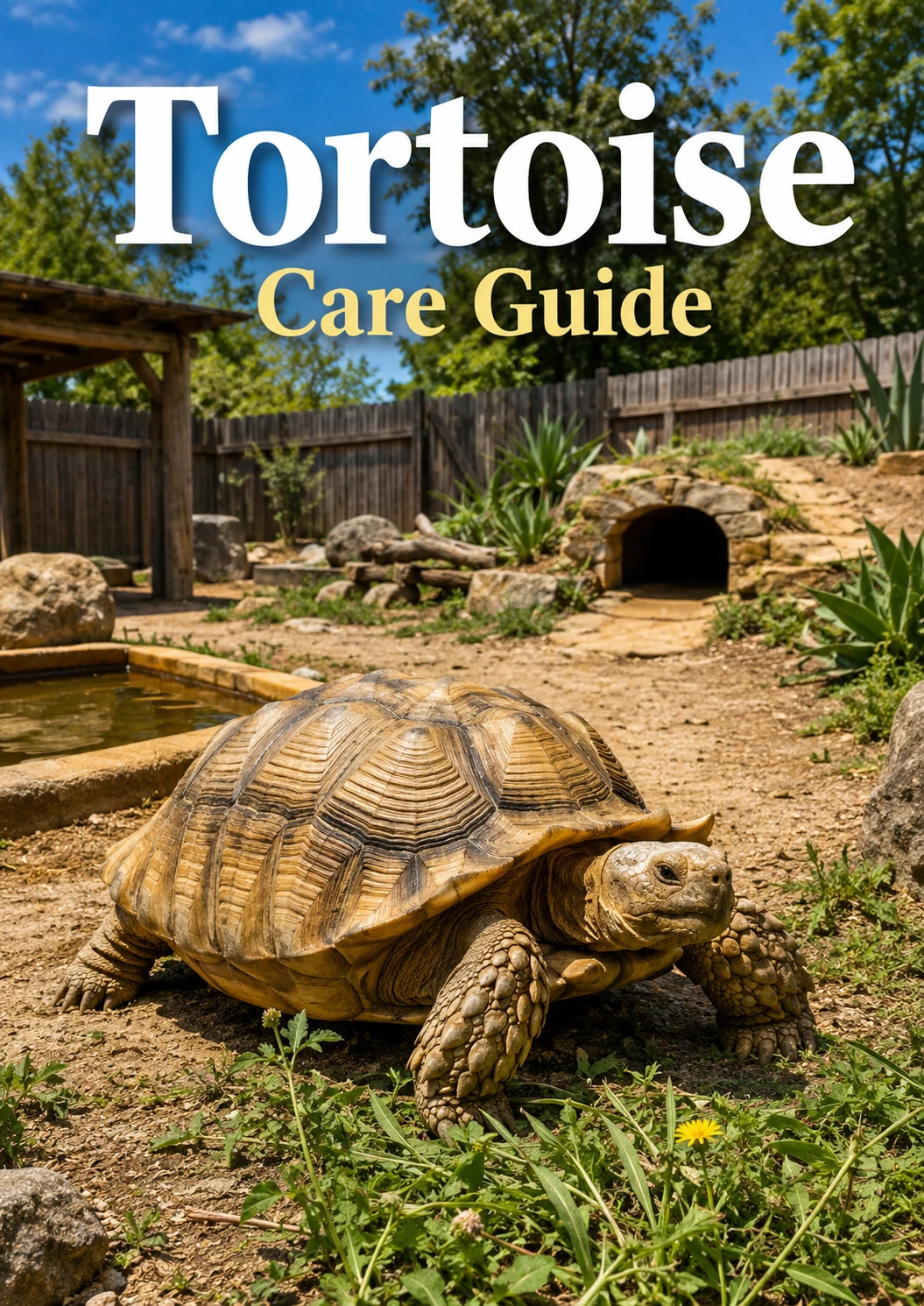
Tortoise Care Guide
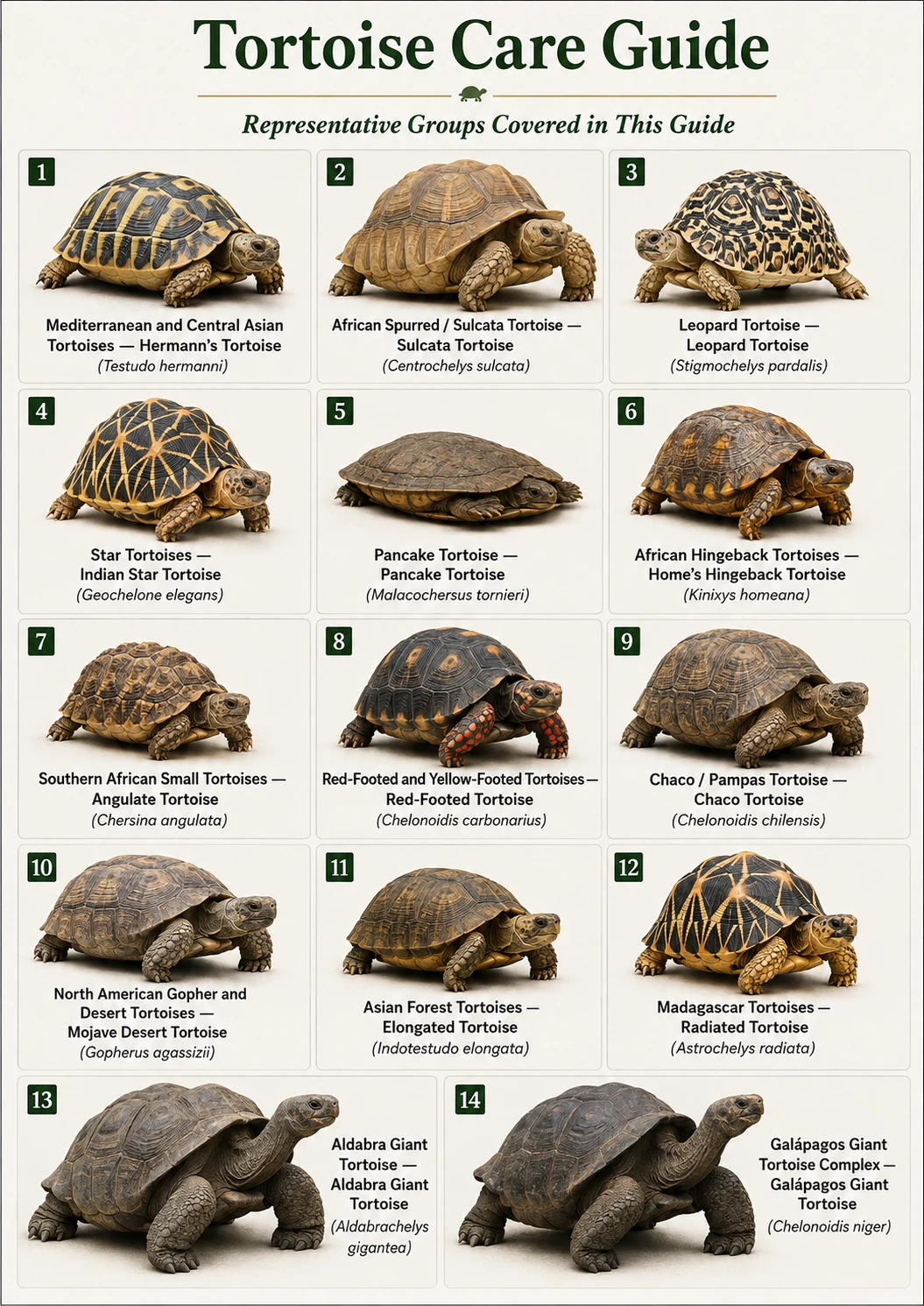
A comprehensive husbandry and preventive-care guide for terrestrial tortoises, organized by the same 14 ecological and taxonomic groups used in the companion Tortoise Diet Guide. The guide emphasizes large usable floor area, outdoor grazing and browsing pens, secure boundaries and burrows, temperature gradients, UVB and daylight, species-appropriate humidity, water and hydration, shell growth, seasonal dormancy, reproduction, biosecurity, and the major differences between Mediterranean, desert, savanna, tropical-forest, island-giant, and conservation-specialist tortoises.
Quick Care Guide
A tortoise is not simply a dry box turtle. Tortoises range from tiny winter-rainfall padlopers to 550 lb (250 kg) Aldabra giants, from humid rainforest hingebacks to Sahelian burrowers, and from temperate hibernating Testudo to tropical species that should never be chilled. Correct identification comes before enclosure design.
| Care area | Practical starting principle | Important qualification |
|---|---|---|
| Space | Provide the largest possible floor area with real thermal, moisture, shade, and foraging choices. | Adult sulcata, leopard, Manouria, Aldabra, and Galápagos tortoises require paddock-scale rather than aquarium-scale housing. |
| Outdoor housing | Use secure outdoor pens whenever species, climate, health, and law permit. | Provide sun and deep shade, predator protection, buried escape barriers, water, shelters, and safe seasonal heating. |
| Temperature | Use a broad overhead basking zone plus a substantially cooler retreat. | Forest, montane, Mediterranean, desert, and giant-island tortoises require different gradients. Surface basking temperature is not the same as whole-enclosure air temperature. |
| UVB / daylight | Open-habitat tortoises generally benefit from UVI around 3–4 at the basking zone, with shade. | Forest species typically use lower/filtered exposure. Natural outdoor sunlight is excellent when overheating is prevented. |
| Humidity | Create species- and age-appropriate microclimates rather than one uniform humidity. | Juvenile sulcata, leopard, star, Russian, and other supposedly “dry” species still require humid retreats; forest tortoises require much higher overall humidity. |
| Substrate | Use deep, safe, diggable natural soil matched to the species. | Burrowers need enough depth and wall security to express normal digging. Loose dry sand alone is rarely appropriate. |
| Water | Provide clean shallow water that the tortoise can enter and exit safely. | Tropical forest and giant species may use larger pools/wallows. Scheduled soaking can support juveniles or patients but should not replace correct habitat hydration. |
| Social housing | One tortoise per enclosure is the safest default. | Males may ram, bite, overturn, and harass; breeding groups require much more space and active management. |
| Seasonality | Respect natural changes in day length, rainfall, temperature, and activity. | Only certain temperate species/localities should hibernate. Tropical tortoises should not be cooled using Mediterranean protocols. |
| Nutrition | Use the companion Tortoise Diet Guide. | Grassland grazers, forest omnivores, star tortoises, hingebacks, and giant tortoises have different feeding ecology. |
Tortoise Diversity, Taxonomy, and Terminology
Tortoises are terrestrial members of the family Testudinidae. Unlike the informal word “turtle,” which can refer broadly to Testudines, “tortoise” is appropriately used for Testudinidae. Box turtles are emydids or geoemydids and are not tortoises despite their terrestrial lifestyle.
The current site Tortoise Diet Guide uses 14 practical ecological/taxonomic groups to keep husbandry and nutrition aligned. This is a clinical and educational framework, not a proposal for new taxonomy.
Because current taxonomic sources now recognize more Testudinidae species than the site guide's 47-species framework, scientific names and conservation status should be checked against the current IUCN/SSC TFTSG checklist when unusual or conservation-sensitive animals are encountered.
Natural History and Ecological Husbandry Types
- Temperate Mediterranean/steppe tortoises: Testudo use strong seasonal temperature and rainfall cycles, open basking, burrows, and winter dormancy in appropriate populations.
- Large African arid savanna tortoises: sulcata and leopard tortoises need enormous ground area, intense daylight, high-fiber grazing habitat, and protected microclimates.
- Monsoon grassland/star tortoises: Indian and Burmese star tortoises combine high heat with pronounced seasonal humidity/rainfall changes.
- Rock-crevice specialists: pancake tortoises use narrow stable rock fissures and climb more than typical tortoises.
- African forest and woodland hingebacks: Kinixys range from humid rainforest-floor animals to savanna forms and require species-level humidity planning.
- Southern African localized specialists: padlopers, tent tortoises, and geometric tortoises reflect winter-rainfall, Karoo, Kalahari, and highland climates and are often conservation-sensitive.
- Tropical South American forest tortoises: red- and yellow-footed tortoises need warm humid, shaded environments with leaf litter and water.
- North American burrowing tortoises: Gopherus rely on burrows for thermal and moisture buffering and are often legally protected.
- Asian forest tortoises: Indotestudo and Manouria use moist forest floor, leaf litter, streams, and shaded cooler microclimates.
- Madagascar dry-forest/spiny-forest tortoises: Astrochelys and Pyxis combine heat with strong rainfall seasonality and serious conservation restrictions.
- Island giants: Aldabra and Galápagos tortoises require zoo-scale landscapes, wallows, pools, shade, browse, and cooperative-care training.
Shell Anatomy, Growth, and Pyramiding
The shell is living skeleton. The carapace and plastron are integrated with the vertebral column and ribs and contain blood vessels and nerves. Shell injury can be painful and can open the coelomic cavity.
Pyramiding is abnormal raised growth of individual scutes. It is multifactorial and is associated with inappropriate growth rate, nutrition, hydration/humidity, UVB/calcium physiology, and general husbandry. The practical preventive approach is not simply “add calcium”: provide species-appropriate humidity, hydration, UVB, temperature, exercise, and a high-fiber diet that does not drive excessively rapid juvenile growth.
Juveniles of arid-adapted species should not be raised in chronically desiccating conditions. Burrows and soil microclimates in nature are often far more humid than exposed daytime air.
Before the Tortoise Arrives
- Confirm exact species, locality/subspecies where relevant, sex if known, age, captive-bred versus wild-caught origin, and prior hibernation history.
- Ask about previous temperatures, UVB, humidity, substrate, outdoor access, diet, water, growth rate, reproductive history, and recent weight trend.
- Ask about nasal discharge, oral plaques, swollen eyes, shell lesions, prolapse, bladder stones, previous antibiotics, herpesvirus/Mycoplasma testing, and unexplained deaths in the source collection.
- Set up and run the enclosure before arrival. Measure basking surface, cool side, nighttime minimum, humidity, and UVI.
- Locate a reptile-experienced veterinarian before an emergency occurs.
Captive Origin, Conservation, and Legal Possession
Many tortoises are threatened by habitat loss and illegal collection. Madagascar tortoises, several Asian forest species, star tortoises, Gopherus, and many southern African species have substantial legal or conservation restrictions.
- Prefer documented captive-bred animals with traceable origin.
- Do not collect native tortoises from the wild.
- Verify CITES, federal, state/provincial, and local rules before acquisition, breeding, sale, transport, or interstate movement.
- Never release a long-term captive tortoise to the wild. Captive animals can carry herpesvirus, Mycoplasma, ranavirus, adenovirus, parasites, and other pathogens.
- Protected native species such as U.S. desert and gopher tortoises should be managed under the applicable wildlife-authority program rather than ordinary pet trade.
Housing Philosophy and Enclosure Size
Tortoises are walking, grazing, digging terrestrial reptiles. Long-term housing should be designed as a landscape, not a glass display box.
A useful modern planning formula for many non-giant tortoises is approximately 8 times adult shell length for enclosure length and 4 times adult shell length for width, with more space strongly preferred. This is a starting rule, not a target. Outdoor pens should generally exceed it substantially.
Large tortoises rapidly make formula-based indoor cages impractical. Adult sulcatas, leopard tortoises, Manouria, Aldabras, and Galápagos tortoises need rooms, barns, greenhouses, paddocks, or zoo-scale yards rather than furniture-sized enclosures.
Outdoor Pens and Grazing Yards
- Use opaque or solid lower barriers to reduce pacing and prevent climbing.
- Burrowers require fencing extending underground; sulcatas and Gopherus can excavate far beyond expectations.
- Provide full sun, dappled shade, and deep shade throughout the hottest part of the day.
- Provide multiple shelters and, where relevant, a structurally safe burrow or heated house.
- Protect from dogs, coyotes, foxes, raccoons, rats, corvids, and theft.
- Avoid pesticides, herbicides, snail/slug bait, rodenticides, treated lumber residues, and toxic ornamental plants.
- Never allow free unsupervised yard roaming around pools, gates, mowers, vehicles, compost piles, fire pits, or dogs.
- Ensure irrigation and rainfall cannot flood a sleeping or hibernating burrow.
Indoor Enclosures and Winter Housing
Open-top tortoise tables or large floor pens work well for many Mediterranean and arid species when humidity can be maintained. Humid forest tortoises often require partially enclosed, well-ventilated rooms or vivarium-style systems to retain moisture.
Provide multiple heat/UV zones in large enclosures rather than one lamp at one end of a room. Opaque lower walls can reduce pacing. Glass is not prohibited, but conventional aquaria are usually too small and may create confusing transparent boundaries.
Indoor winter housing for giant species should be planned like livestock housing: insulated walls, safe overhead heat, thermostats, non-slip floors with deep bedding/soil areas, wide doors, drains, and enough room to turn and walk normally.
Burrows, Shelters, and Heated Houses
Burrows are not optional decoration for species such as Russian, sulcata, Gopherus, and several southern African tortoises. They are central to thermoregulation, hydration, predator avoidance, and seasonal dormancy.
- Natural burrows must not undermine buildings, patios, perimeter walls, irrigation, or electrical lines.
- Artificial burrows should be wide enough to turn safely, gently sloped, dry from flooding, and accessible for inspection.
- Heated shelters for tropical/large species should use protected radiant or overhead heat controlled by thermostats; avoid exposed heat lamps at shell height.
- Do not use hot rocks.
- Hibernation shelters need independent temperature monitoring and protection from freezing, flooding, rodents, and premature warming.
Substrate, Digging, Drainage, and Nesting
Natural soil is preferred for most healthy tortoises because it permits normal walking traction, digging, moisture gradients, nesting, and wear. A soil/sand/clay mix should match the native ecology rather than using loose sand alone.
Provide at least several inches of diggable substrate indoors; burrowers and nesting females need substantially more. Heavy rocks must rest on a stable base so digging cannot cause collapse.
Females of every tortoise species require appropriate nesting substrate even when no male is present. A mature female that cannot locate a suitable nest site may retain eggs.
Water, Soaking, Hydration, and Wallows
Provide clean shallow drinking water at all times unless a highly specialized managed-care protocol dictates otherwise. The dish should be large enough for the tortoise to enter but shallow enough for easy head clearance and exit.
Routine forced soaking is not a substitute for correct habitat hydration, but shallow warm soaks can be useful for hatchlings, newly acquired animals, dehydrated patients, and selected species under veterinary guidance.
Red-/yellow-footed tortoises, hingebacks, Manouria, and giant tortoises often use larger pools or wallows. Water features must have textured, gently sloped exits.
Temperature and Basking Heat
Provide a broad overhead basking zone large enough to warm the whole tortoise evenly, not a pinpoint beam that overheats one scute while the rest of the body remains cool. Large animals often need a cluster of lamps or radiant panels.
Current Merck husbandry guidance lists broad air-temperature zones of about 68–82°F (20–28°C) for Greek tortoises, 77–86°F (25–30°C) for leopard tortoises, and 77–86°F (25–30°C) for red-footed tortoises, with basking areas warmer than ambient. Species chapters below provide more useful practical ranges.
Measuring Temperature Correctly
| Tool | Best use | Common limitation |
|---|---|---|
| Digital probe thermometer | Basking surface, cool-side air, hide/burrow, heated shelter. | One probe represents one microclimate. |
| Infrared temperature gun | Rapid mapping of soil, rock, basking surface, shell-level surfaces. | Does not measure air temperature. |
| Maximum/minimum thermometer | Tracks overnight lows and daytime highs in pens/shelters. | Must be positioned at tortoise level. |
| Thermostat | Controls background/heated-shelter equipment. | Controls equipment, not the animal's actual temperature. |
UVB, UVA, Visible Light, and Natural Sunlight
Tortoises are diurnal and should receive a bright daytime environment. Heat, visible light, UVA, and UVB should overlap in the main basking zone while shade and lower-UVI areas remain available.
For most open-habitat basking tortoises, a measured basking UVI around 3–4 is a reasonable modern target. Forest-floor species such as hingebacks, red-/yellow-footed tortoises, and Asian forest tortoises generally use lower/filtered exposure, often around UVI 1–2 with strong shade.
Natural outdoor sunlight is excellent when temperature and predator safety are appropriate. Ordinary window glass blocks most useful UVB.
UV Cards and UV Index Meters
UV-sensitive cards are qualitative checks: they can show that some ultraviolet energy is present but cannot tell you whether a tortoise receives UVI 1, 2, 3, or 4.
A reptile-appropriate UV Index meter such as a Solarmeter 6.5/6.5R or equivalent is preferred. Measure at the height of the top of the tortoise's shell with normal screen or mesh in place.
Humidity, Juvenile Hydration, and Microclimates
“Desert tortoise” should never be interpreted as “keep every life stage bone dry.” Young tortoises have a high surface-area-to-volume ratio and can dehydrate rapidly. In nature, many juveniles spend long periods beneath plants, litter, soil crusts, or in burrows with much higher humidity than open air.
- Mediterranean/arid adults: generally low-moderate ambient humidity with humid hides/burrows.
- Sulcata/leopard/star juveniles: maintain warm humid retreats and avoid chronic desiccation while preserving dry basking surfaces and ventilation.
- Forest tortoises: 60–90% humidity may be appropriate depending on species, combined with airflow and clean substrate.
- Montane Manouria impressa: high humidity plus cool temperatures; heat and humidity cannot be considered independently.
Furnishings, Terrain, Forage, and Environmental Enrichment
- Low mounds, slopes, safe rocks, logs, shrubs, and plant clumps that create different sight lines and footing.
- Edible pesticide-free grasses, weeds, shrubs, cactus, or browse appropriate to the companion diet guide.
- Multiple hides and shaded retreats.
- Natural soil deep enough to dig.
- Large shallow water pans or wallows as appropriate.
- Rock-crevice networks for pancake tortoises.
- Leaf litter and forest-floor complexity for hingebacks, red/yellow-footed tortoises, and Asian forest species.
- Target training and voluntary stationing for giant tortoises.
Handling, Lifting, and Cooperative Care
Support smaller tortoises with two hands under the shell and keep them horizontal and close to the ground. Never lift by a limb or tail.
Large sulcatas, leopard tortoises, Manouria, Aldabras, and Galápagos tortoises can injure people and themselves if lifted manually. Use trained shifting, target training, protected contact, ramps, crates, and mechanical assistance when necessary.
Do not drill the shell or attach decorative objects. Research telemetry attachment is a specialized wildlife procedure.
Normal Behavior and Communication
- Basking: open-habitat tortoises often warm in the morning and retreat during peak heat.
- Burrowing: normal for Russian, sulcata, Gopherus, and several small southern African species.
- Rain response: many star, hingeback, Chaco, southern African, and tropical tortoises increase activity after rainfall.
- Wallowing: normal in humid forest and giant tortoises and useful for cooling.
- Ramming: common male territorial/courtship behavior in many species.
- Seasonal appetite: may fall with natural seasonal change; disease should not automatically be labeled dormancy.
Sex Identification
Sexual characters vary by species and often appear only after maturity. Males commonly have longer thicker tails with the cloaca farther from the body, a more concave plastron, and species-specific shell or anal-scute differences. Females often have shorter tails and broader posterior openings for egg passage.
Giant tortoises may not be reliably sexed until many years old. Juveniles should not be subjected to forceful probing or manipulation.
Reproductive Considerations
Females may produce follicles and eggs without a male. Provide deep species-appropriate nesting soil before persistent pacing or digging begins.
- Dystocia may follow inadequate nest substrate, dehydration, low temperature, hypocalcemia, malformed/oversized eggs, pelvic obstruction, stress, or systemic disease.
- Radiographs and ultrasound help distinguish normal gravidity from egg retention or follicular disease.
- Preovulatory follicular stasis, postovulatory egg stasis, ectopic eggs, and yolk coelomitis are recognized surgical problems in reptiles.
- Do not breed conservation-sensitive species without legal documentation, genetic/record management, and a responsible placement/conservation plan.
Species-Group Husbandry Comparison
The table below gives practical starting ranges. It intentionally labels poorly standardized groups rather than inventing exact numbers. Individual chapters then explain the important species differences.
| Group | Typical ecology | Temperature starting point | Humidity / water | Major caution |
|---|---|---|---|---|
| Testudo | Mediterranean/steppe | Bask ~95°F (35°C); cool 68–77°F (20–25°C) | Adult ~30–50%, humid retreat | Locality determines hibernation |
| Sulcata | Sahel burrower | Day 80–85°F (27–29°C); bask 90–95°F (32–35°C) | Adult drier; juveniles need high-humidity microclimates | Huge, destructive burrower; no hibernation |
| Leopard | African grassland | Bask 95–104°F (35–40°C); cool ~77°F (25°C) | Adult <50% typical; juveniles more humid | Large; cold/wet sensitive |
| Star | Monsoon scrub/grassland | Bask 95–104°F (35–40°C); cool ~77°F (25°C) | Low-moderate with seasonal humid/rainy period | No temperate hibernation |
| Pancake | Rock crevice | Bask 95–100°F (35–38°C) | Low-moderate; humid crevice | Climbing/escape and rock-collapse risk |
| Kinixys | Forest to savanna | Forest bask 85–90°F; savanna 90–95°F (29–35°C) | ~50–90% species dependent | Forest and savanna species are not interchangeable |
| Southern African small | Fynbos/Karoo/Kalahari | Species/locality specific | Strong seasonal rainfall cycles | Mostly specialist/conservation species |
| Red/yellow-footed | Tropical forest/savanna | Bask ~90–95°F (32–35°C); ambient 75–85°F (24–29°C) | ~60–90% | Need shade and humidity; no hibernation |
| Chaco | Dry Chaco/Monte | Provisional bask 90–95°F (32–35°C) | Dry surface + humid burrow | Seasonality/locality important |
| Gopherus | Desert/thornscrub/sandy uplands | Outdoor seasonal management preferred | Burrow humidity is essential | Legal protection and disease biosecurity |
| Asian forest | Humid forest | Ambient 75–82°F (24–28°C); modest warm zone | ~70–90% | Manouria impressa is cooler |
| Madagascar | Spiny/dry forest | Bask ~90–95°F (32–35°C) for larger open-habitat forms | Strong dry/wet seasonality | Highly protected conservation species |
| Aldabra giant | Atoll grassland/scrub | Zoo-scale outdoor management | Pools/wallows, shade | Up to ~550 lb (250 kg) |
| Galápagos giant | Arid lowland to humid highland | Professional outdoor landscape | Water/wallows and climate refuges | Conservation-program species |
1. Mediterranean and Central Asian Tortoises — Testudo
Group ecology: Dry Mediterranean scrub, steppe, rocky slopes, open woodland, and semi-desert. Most need strong seasonal cycling; hibernation suitability depends on exact species and locality.
Environmental starting point: For most temperate Testudo, use a broad basking area around 95°F (35°C), a cool zone around 68–77°F (20–25°C), and nights around 64–68°F (18–20°C) when indoors. Adult ambient humidity is usually low-moderate (roughly 30–50%), but deep humid retreats are important, especially for juveniles.
Greek / spur-thighed tortoise — Testudo graeca
Approximate adult size: ~5–10 in (13–25 cm)
Natural habitat: Mediterranean scrub, dry grassland, rocky hillsides, open woodland, and semi-arid steppe across North Africa, southeastern Europe, and western Asia.
Care emphasis: The species complex spans very different climates. European and some western Asian forms may hibernate; many North African and southeastern Mediterranean forms should not be cooled as if they were northern Hermann's tortoises. Locality is essential.
Hermann's tortoise — Testudo hermanni
Approximate adult size: ~5–8 in (13–20 cm)
Natural habitat: Mediterranean scrub, maquis, open oak woodland, grassy clearings, and rocky hillsides in southern Europe.
Care emphasis: A classic temperate Mediterranean tortoise. Provide strong daylight, open basking, deep soil and cover. Healthy adults of appropriate origin normally experience winter dormancy; captive hibernation should be planned rather than improvised.
Russian / Horsfield's / Central Asian tortoise — Testudo horsfieldii
Approximate adult size: ~5–10 in (13–25 cm)
Natural habitat: Arid and semi-arid steppe, clay and sandy deserts, foothills, and sparse scrub of Central Asia, often using deep burrows.
Care emphasis: This species is an exceptional digger and seasonal burrower. Provide unusually deep compactable substrate and very secure buried boundaries. Dry surface conditions should be paired with a humid burrow/hide, particularly for juveniles.
Egyptian tortoise — Testudo kleinmanni
Approximate adult size: ~4–5 in (10–13 cm)
Natural habitat: Extremely arid coastal desert and semi-desert with sparse low shrubs, annual plants, and sandy or gravelly soils in Egypt and Libya.
Care emphasis: Small, heat- and drought-adapted but vulnerable to chronic cool damp conditions. Do not extrapolate deep temperate hibernation protocols. Because the species is highly conservation-sensitive, documented legal captive origin is critical.
Marginated tortoise — Testudo marginata
Approximate adult size: ~10–14 in (25–35 cm)
Natural habitat: Dry rocky hillsides, scrub, open woodland, maquis, and agricultural edges in Greece and nearby Mediterranean regions.
Care emphasis: The largest common Testudo and therefore needs substantially more floor area than Hermann's or Russian tortoises. Temperate outdoor housing and seasonal dormancy are appropriate when climate and health permit.
2. African Spurred / Sulcata Tortoise — Centrochelys sulcata
Group ecology: Huge burrowing grass-and-forb tortoise of the African Sahel. Adult housing is a livestock-scale commitment rather than an aquarium or ordinary vivarium.
Environmental starting point: Veterinary guidance supports daytime ambient about 80–85°F (27–29°C), basking about 90–95°F (32–35°C), and nights around 70–75°F (21–24°C). Modern husbandry often provides a somewhat warmer basking surface when a broad gradient is available. Juveniles require substantially more humidity than the word 'desert' implies.
African spurred / sulcata / Sahel tortoise — Centrochelys sulcata
Approximate adult size: commonly 24–30+ in (61–76+ cm); often 85–110+ lb (39–50+ kg)
Natural habitat: Hot, arid Sahelian savanna and semi-desert from the southern Sahara belt, with seasonal grasses, sparse shrubs, and extensive burrowing habitat.
Care emphasis: Adults should live primarily outdoors in suitable climates with heavy fencing and a heated shelter for cold weather. Their burrows can be several feet long and undermine walls, patios, or foundations. Hatchlings and juveniles need warm, humid microclimates to support hydration and healthy shell growth. Sulcatas do not hibernate.
3. Leopard Tortoise — Stigmochelys pardalis
Group ecology: Large eastern and southern African grazer-browser of grassland, savanna, thorn scrub, semi-arid shrubland, and Karoo habitats.
Environmental starting point: RVC guidance uses a 95–104°F (35–40°C) basking zone, cool end near 77°F (25°C), night not below about 68°F (20°C), and adult humidity below roughly 50%. Juveniles benefit from more humid retreats and should not be raised in chronically desiccating conditions.
Leopard tortoise — Stigmochelys pardalis
Approximate adult size: commonly 10–18 in (25–46 cm); some populations larger
Natural habitat: Grassland, savanna, thorn scrub, semi-arid shrubland, and Karoo habitats from eastern to southern Africa; local rainfall strongly affects vegetation.
Care emphasis: Large floor area and outdoor grazing are strongly preferred for adults. Leopard tortoises do not hibernate. Protect them from cold wet weather, and provide a heated shelter where climates fall below the species' safe range.
4. Star Tortoises — Geochelone
Group ecology: Seasonally dry South and Southeast Asian grassland and scrub tortoises whose activity and humidity change markedly with monsoon cycles.
Environmental starting point: RVC Indian-star guidance uses basking 95–104°F (35–40°C), cool end around 77°F (25°C), and night not below about 68°F (20°C), with low-moderate humidity that rises seasonally. These species do not undergo temperate hibernation.
Indian star tortoise — Geochelone elegans
Approximate adult size: ~7–12 in (18–30 cm), females typically larger
Natural habitat: Dry scrub, thorn forest, grassland, and semi-arid agricultural mosaics in India, Pakistan, and Sri Lanka, with activity increasing during monsoon rains.
Care emphasis: Sensitive to cold, chronically wet conditions, and poor thermal gradients. Provide seasonal increases in humidity and rainfall simulation rather than keeping the animal uniformly dry throughout the year.
Burmese star tortoise — Geochelone platynota
Approximate adult size: ~10–12 in (25–30 cm), females generally larger
Natural habitat: Seasonally dry deciduous forest, open woodland, scrub, and grassland in central Myanmar.
Care emphasis: Use a warm open enclosure with significant seasonal humidity/rainfall variation. This is a highly threatened species; legally documented captive origin and responsible breeding records are important.
5. Pancake Tortoise — Malacochersus tornieri
Group ecology: Rock-crevice specialist of East African kopjes. Its flattened flexible shell and climbing ability make enclosure architecture unlike that of most tortoises.
Environmental starting point: A practical current starting range is basking around 95–100°F (35–38°C), cool zone around 75–82°F (24–28°C), cooler nights around 68–75°F (20–24°C), low-moderate ambient humidity, and a more humid protected crevice.
Pancake / crevice tortoise — Malacochersus tornieri
Approximate adult size: ~5–7 in (13–18 cm)
Natural habitat: Rocky outcrops, kopjes, and hillsides in dry savanna and thorn scrub of Kenya and Tanzania, where animals shelter deep in narrow crevices.
Care emphasis: Build a stable three-dimensional rock habitat with narrow horizontal crevices that cannot collapse. Pancake tortoises climb surprisingly well, so walls and lids must be secure. The shell is deliberately flexible and should not be mistaken for metabolic softening without veterinary assessment.
6. African Hingeback Tortoises — Kinixys
Group ecology: Eight species spanning humid rainforest, coastal thicket, woodland, bushveld, and savanna. Forest and savanna hingebacks should never be given one generic humidity prescription.
Environmental starting point: Forest species generally need warm but not extreme temperatures, roughly 75–82°F (24–28°C) ambient with a modest 85–90°F (29–32°C) basking option and humidity commonly 70–90%. Savanna/woodland forms can use warmer basking around 90–95°F (32–35°C), humidity more often 50–75%, and strong wet/dry-season cycling. No Kinixys should undergo temperate hibernation.
Bell's hingeback — Kinixys belliana
Approximate adult size: ~6–9 in (15–23 cm)
Natural habitat: Savanna, open woodland, scrub, and seasonally dry grassland in parts of central and eastern Africa.
Care emphasis: Savanna-oriented; provide deep cover, seasonal humidity, shallow water, and warmer open basking than rainforest species.
Forest / serrated hingeback — Kinixys erosa
Approximate adult size: ~10–14 in (25–35 cm)
Natural habitat: Humid lowland rainforest, swamp forest, dense secondary forest, and shaded forest floor of western and central Africa.
Care emphasis: Large humid forest species. Use deep leaf litter, high humidity, heavy shade, and only a modest warm basking zone; chronic dry open-tortoise-table housing is inappropriate.
Home's hingeback — Kinixys homeana
Approximate adult size: ~7–10 in (18–25 cm)
Natural habitat: Humid tropical forest and moist secondary growth in western Africa, usually in deep leaf litter and shaded understory.
Care emphasis: A true humid-forest tortoise requiring leaf litter, visual cover, high humidity, and a lower-intensity heat/UV environment than open grassland species.
Lobatse hingeback — Kinixys lobatsiana
Approximate adult size: ~6–8 in (15–20 cm)
Natural habitat: Rocky bushveld, wooded savanna, and dry thorn scrub in southern Africa, often associated with broken rocky terrain.
Care emphasis: Provide rocky shelter, seasonal humidity, and drier surface conditions than forest Kinixys, while retaining humid retreats.
Natal hingeback — Kinixys natalensis
Approximate adult size: ~6–8 in (15–20 cm)
Natural habitat: Rocky grassland, wooded slopes, and bushveld in eastern South Africa, Eswatini, and nearby areas.
Care emphasis: Cooler southern African nights and strong seasonality are normal. Avoid year-round hot tropical forest conditions.
Western hingeback — Kinixys nogueyi
Approximate adult size: ~7–10 in (18–25 cm)
Natural habitat: Savanna, woodland, and seasonal dry forest in western Africa, generally in more open habitats than rainforest hingebacks.
Care emphasis: Intermediate savanna/woodland husbandry with seasonal rainfall and abundant ground cover.
Speke's hingeback — Kinixys spekii
Approximate adult size: ~6–8 in (15–20 cm)
Natural habitat: Miombo and other seasonal woodland, savanna, and bushland in eastern and southern Africa; often active after rains.
Care emphasis: Strong seasonal rainfall response; maintain a dry-wet cycle without allowing chronic dehydration.
Southeastern hingeback — Kinixys zombensis
Approximate adult size: ~7–10 in (18–25 cm)
Natural habitat: Moist to seasonally dry woodland, coastal thicket, and savanna in southeastern Africa.
Care emphasis: Intermediate humidity and abundant cover are appropriate; use locality and observed behavior to refine the general Kinixys range.
7. Southern African Small Tortoises
Group ecology: Nine often highly localized species from fynbos, renosterveld, Karoo, Namaqualand, highland grassland, and Kalahari ecosystems. Many are conservation specialists and poor choices for casual private keeping.
Environmental starting point: There is no defensible universal temperature/humidity range for this group. Mediterranean-climate species generally need warm dry days, cool nights, and seasonal winter rainfall; Karoo/Kalahari species need hot days, cool nights, dry surfaces, humid refuges, and rain-driven activity. Husbandry should follow exact locality and institutional experience.
Angulate / bowsprit tortoise — Chersina angulata
Approximate adult size: ~7–12 in (18–30 cm)
Natural habitat: Mediterranean-type fynbos, renosterveld, coastal scrub, dune vegetation, and semi-arid shrubland of southern Africa.
Care emphasis: Relatively robust compared with dwarf species, but still strongly seasonal. Outdoor Mediterranean-type climates can be useful when secure and not excessively wet.
Karoo dwarf tortoise / Karoo padloper — Chersobius boulengeri
Approximate adult size: ~4–5 in (10–13 cm)
Natural habitat: Rocky and gravelly Nama Karoo and succulent shrubland, typically in arid inland South Africa.
Care emphasis: Specialist arid-rocky husbandry; avoid simplistic hot/dry desert boxes and provide crevices, cool retreats, and rainfall-season cues.
Speckled dwarf tortoise / speckled padloper — Chersobius signatus
Approximate adult size: ~3–4 in (8–10 cm)
Natural habitat: Rocky granite outcrops and succulent Karoo vegetation of Namaqualand in western South Africa.
Care emphasis: Tiny, highly specialized and conservation-sensitive. Provide rocky crevices and seasonal rainfall/humidity matched to Namaqualand; not a beginner species.
Nama tortoise / Nama padloper — Chersobius solus
Approximate adult size: ~4–5 in (10–13 cm)
Natural habitat: Very arid rocky desert and succulent shrubland of southern Namibia, often among stones and sparse low vegetation.
Care emphasis: Extremely arid specialist with important cool/refuge microclimates. Husbandry should be institutionally guided.
Parrot-beaked dwarf tortoise / common padloper — Homopus areolatus
Approximate adult size: ~4–5 in (10–13 cm)
Natural habitat: Lowland fynbos, renosterveld, coastal shrub, and sandy plains of the southwestern Cape region.
Care emphasis: Mediterranean-climate seasonality and winter-rainfall biology distinguish it from desert tortoises.
Greater padloper / greater dwarf tortoise — Homopus femoralis
Approximate adult size: ~5–7 in (13–18 cm)
Natural habitat: Highland grassland, Karoo shrubland, and rocky plateaus of South Africa, including cooler upland environments.
Care emphasis: Needs cooler nights and seasonal temperature changes; chronic tropical heat is inappropriate.
Geometric tortoise — Psammobates geometricus
Approximate adult size: ~5–6 in (13–15 cm)
Natural habitat: Critically restricted lowland renosterveld and Mediterranean-type shrubland of the southwestern Cape.
Care emphasis: Critically threatened conservation species. Managed-care protocols should be coordinated with conservation institutions rather than generic pet advice.
Kalahari / serrated tent tortoise — Psammobates oculifer
Approximate adult size: ~5–7 in (13–18 cm)
Natural habitat: Kalahari thornveld, dry savanna, sandy shrubland, and grassland across parts of Botswana, Namibia, and South Africa.
Care emphasis: Hot seasonal savanna with rain-driven activity. Provide deep shade, cooler retreats, and seasonal humidity changes.
Tent tortoise — Psammobates tentorius
Approximate adult size: ~4–6 in (10–15 cm)
Natural habitat: Arid and semi-arid Karoo, Namaqualand, rocky shrubland, and dry grassland of southern Africa.
Care emphasis: Taxon/locality variation is important. Use seasonal rather than static heat/humidity management.
8. Red-Footed and Yellow-Footed Tortoises — Chelonoidis
Group ecology: Warm South American tortoises of tropical forest, savanna, gallery forest, and woodland. They require far more humidity and shade than Mediterranean or African grassland tortoises.
Environmental starting point: For red-footed tortoises, current veterinary guidance uses basking about 95°F (35°C), cool area about 77°F (25°C), nights roughly 70–77°F (21–25°C), and moderately high humidity. Modern spacious husbandry commonly uses 60–80% humidity with humid retreats. Yellow-footed tortoises generally need still higher forest humidity and heavier shade.
Red-footed tortoise — Chelonoidis carbonarius
Approximate adult size: commonly 12–18 in (30–46 cm), occasionally ~24 in (61 cm)
Natural habitat: Tropical and subtropical savanna, dry forest, gallery forest, woodland edges, and humid seasonal forest across northern and central South America.
Care emphasis: Provide a large humid tropical floor enclosure or outdoor pen with dense cover, a warm basking area, shaded cool zones, deep soil/leaf litter, and easy water access. This species does not hibernate.
Yellow-footed tortoise — Chelonoidis denticulatus
Approximate adult size: ~14–24 in (35–61 cm)
Natural habitat: Humid lowland tropical rainforest, riverine forest, and dense moist woodland of the Amazon and Guiana regions.
Care emphasis: More rainforest-associated than red-footed tortoises. Use heavy shade, high humidity, deep leaf litter, warm stable temperatures, and large soaking/wallow opportunities; avoid open arid tortoise-table husbandry.
9. Chaco / Pampas Tortoise — Chelonoidis chilensis
Group ecology: Dry southern South American tortoise of Chaco woodland, Monte scrub, thorn scrub, and semi-arid grassland.
Environmental starting point: High-quality modern captive data are limited. A cautious active-season starting range is basking around 90–95°F (32–35°C), cool area around 70–80°F (21–27°C), cooler nights, low-moderate surface humidity, and a humid burrow. Strong seasonality is biologically important.
Chaco / Pampas / Argentine tortoise — Chelonoidis chilensis
Approximate adult size: ~8–12 in (20–30 cm)
Natural habitat: Dry Chaco woodland, Monte desert scrub, sandy thorn scrub, and semi-arid grassland of Argentina, Paraguay, and nearby regions.
Care emphasis: Use deep diggable soil, abundant shade, a humid retreat, and seasonal temperature/rainfall variation. Captive winter cooling should be matched to known locality and health, not imposed automatically.
10. North American Gopher and Desert Tortoises — Gopherus
Group ecology: Six burrowing North American tortoises of deserts, thornscrub, grassland, pine-oak uplands, and sandy coastal plain. Legal protection and conservation status are central husbandry issues.
Environmental starting point: Outdoor naturalistic pens are generally preferred where legal and climatic conditions permit. Use broad sun/shade choice, native soil, deep burrows, and seasonal temperatures. A generic indoor '95°F basking / 75°F cool side' can be used only for temporary active-season holding; long-term care must reproduce species/locality seasonality and safe burrow microclimates.
Mojave desert tortoise — Gopherus agassizii
Approximate adult size: ~8–15 in (20–38 cm)
Natural habitat: Mojave Desert valleys, alluvial fans, creosote scrub, and rocky foothills north and west of the Colorado River.
Care emphasis: Protected native species in the U.S. Burrows are essential for summer heat and winter cold. Do not relocate wild animals or mix captive desert tortoises with unrelated tortoise species because of disease risk.
Texas tortoise — Gopherus berlandieri
Approximate adult size: ~6–9 in (15–23 cm)
Natural habitat: Tamaulipan thornscrub, mesquite-prickly pear brushland, and semi-arid grassland of southern Texas and northeastern Mexico.
Care emphasis: Warm thornscrub specialist with shallow forms/burrows and summer heat avoidance. Native-possession laws apply.
Goode's thornscrub tortoise — Gopherus evgoodei
Approximate adult size: ~10–14 in (25–35 cm)
Natural habitat: Tropical deciduous thornscrub, foothill woodland, and rocky slopes of southwestern Sonora, Mexico.
Care emphasis: Warm Sonoran thornscrub species; managed care should emphasize outdoor seasonal heat, monsoon activity, and cool refuges.
Bolson tortoise — Gopherus flavomarginatus
Approximate adult size: ~12–18 in (30–46 cm)
Natural habitat: Desert grassland and shrub-steppe of the Bolsón de Mapimí in north-central Mexico, where deep burrows are central to survival.
Care emphasis: Large, highly conservation-sensitive burrower. Institutional/conservation managed care is more appropriate than generic private-pet husbandry.
Sonoran desert tortoise — Gopherus morafkai
Approximate adult size: ~8–15 in (20–38 cm)
Natural habitat: Rocky bajadas, desert mountain slopes, washes, and Sonoran Desert scrub primarily east and south of the Colorado River.
Care emphasis: Rock-slope and burrow/shelter ecology differs from Mojave populations. Do not transfer Mojave hibernation assumptions without locality-specific planning.
Gopher tortoise — Gopherus polyphemus
Approximate adult size: ~9–15 in (23–38 cm)
Natural habitat: Dry sandy uplands, longleaf pine-wiregrass communities, scrub, dunes, and open coastal plain habitats of the southeastern United States.
Care emphasis: Deep sandy burrows are essential. This is a protected ecosystem-engineering species across much of its range and generally belongs in licensed conservation rather than private acquisition.
11. Asian Forest Tortoises — Indotestudo and Manouria
Group ecology: Humid tropical and subtropical forest tortoises. These animals need deep leaf litter, high humidity, ventilation, shade, and moderate rather than desert-level heat.
Environmental starting point: For many Indotestudo, use roughly 75–82°F (24–28°C) ambient, a localized 85–90°F (29–32°C) warm area, 68–75°F (20–24°C) nights when appropriate, and 70–90% humidity with ventilation. Manouria emys uses similarly humid conditions; Manouria impressa is a cooler montane specialist and should not be kept at persistent low-80s°F temperatures.
Elongated / yellow-headed tortoise — Indotestudo elongata
Approximate adult size: up to ~14.2 in (36 cm)
Natural habitat: Tropical and subtropical deciduous forest, bamboo forest, scrub, and forest-edge habitats across mainland Southeast Asia.
Care emphasis: Generalist forest tortoise with rainy-season activity. Maintain warm humid conditions, heavy leaf litter, water access, and shade; no temperate hibernation.
Forsten's / Sulawesi tortoise — Indotestudo forstenii
Approximate adult size: ~9–12 in (23–30 cm)
Natural habitat: Seasonal tropical forest, scrub, and forest-edge habitats on Sulawesi and nearby Indonesian islands.
Care emphasis: Poorly represented in mainstream care literature. Use warm humid forest husbandry based on provenance and institutional experience rather than assuming identical care to elongated tortoises.
Travancore tortoise — Indotestudo travancorica
Approximate adult size: up to ~13 in (33 cm)
Natural habitat: Moist and semi-evergreen forest, bamboo thickets, and shaded hill forest of the Western Ghats in India.
Care emphasis: Often associated with streams and moist forest. Provide high humidity, shade, deep litter, shallow water, and seasonal rainfall cues.
Asian giant forest / Burmese mountain tortoise — Manouria emys
Approximate adult size: ~18–24 in (46–61 cm)
Natural habitat: Wet evergreen and semi-evergreen hill forest, bamboo, stream valleys, muddy ground, and dense humid understory in South and Southeast Asia.
Care emphasis: Large, powerful forest tortoise. Needs huge humid outdoor/greenhouse-style space, deep leaf litter, mud/wallow areas, shade, and reliable water. Avoid dry open pens.
Impressed tortoise — Manouria impressa
Approximate adult size: ~12–14 in (30–36 cm)
Natural habitat: Cool moist montane forest, bamboo, steep leaf-littered slopes, and cloud-forest-like habitats in mainland Southeast Asia and southern China.
Care emphasis: Cool, humidity-sensitive montane specialist. Chronic high heat is dangerous; use lower ambient temperatures, cooler nights, deep shade, and very high humidity with airflow.
12. Madagascar Tortoises — Astrochelys and Pyxis
Group ecology: Highly threatened tortoises of Madagascar's spiny forest, dry forest, scrub, and strongly seasonal western habitats. Legal origin and conservation management are critical.
Environmental starting point: Radiated and ploughshare tortoises generally need warm active-season conditions with basking around 90–95°F (32–35°C), cooler areas in the mid-70s to low-80s°F (24–28°C), strong daylight/UVB, and seasonal rainfall/humidity. Pyxis are smaller, more seasonal, and should be managed according to specialist breeding protocols rather than generic dry-tortoise rules.
Radiated tortoise — Astrochelys radiata
Approximate adult size: ~12–16 in (30–40 cm)
Natural habitat: Spiny forest, xeric scrub, coastal bush, and dry thicket of southern Madagascar.
Care emphasis: Warm open-spiny-forest husbandry with shade, deep soil, rainfall-season humidity, and large grazing/browsing area. Highly protected and frequently trafficked.
Ploughshare / angonoka tortoise — Astrochelys yniphora
Approximate adult size: ~14–18 in (36–46 cm)
Natural habitat: Bamboo-scrub mosaic, open savanna, dry deciduous forest edge, and low scrub around Baly Bay in northwestern Madagascar.
Care emphasis: Among the world's rarest tortoises. Husbandry should be coordinated with accredited conservation programs; inclusion here is educational, not a recommendation for private acquisition.
Spider tortoise — Pyxis arachnoides
Approximate adult size: ~5–6 in (13–15 cm)
Natural habitat: Coastal and inland spiny forest, sandy scrub, and seasonally dry thorn thicket of southwestern Madagascar.
Care emphasis: Small seasonal specialist with pronounced wet/dry activity cycles. Maintain according to provenance and professional breeding protocols.
Flat-tailed / flat-shelled spider tortoise — Pyxis planicauda
Approximate adult size: ~5–6 in (13–15 cm)
Natural habitat: Highly seasonal dry deciduous forest on sandy soils in a restricted area of western Madagascar.
Care emphasis: Extremely restricted conservation species. Requires seasonal dry-forest cycling and specialist institutional care.
13. Aldabra Giant Tortoise — Aldabrachelys gigantea
Group ecology: Giant island grazer-browser requiring zoo-scale outdoor paddocks, shelter, pools/wallows, and long-term structural planning.
Environmental starting point: No household enclosure range is appropriate. Managed-care facilities should provide broad sun/shade choice, protected warm housing in cool climates, pools/wallows, and large grazing/browse paddocks. A warm shelter in the upper 70s to low 80s°F (mid-to-upper 20s°C) with localized basking warmth can be used when outdoor climate is unsuitable.
Aldabra giant tortoise — Aldabrachelys gigantea
Approximate adult size: males up to ~4 ft (1.22 m) and ~550 lb (250 kg); females ~3 ft (91 cm) and ~350 lb (159 kg)
Natural habitat: Coral atoll grassland, coastal scrub, mangrove margins, open woodland, and dense low tortoise-turf vegetation on Aldabra Atoll.
Care emphasis: Adults require secure paddocks measured in hundreds to thousands of square feet, not indoor cages. Provide deep shade, mud/wallow areas, water, grazing, browse, robust gates, and cooperative-care/target training because adults may be impossible to lift safely.
14. Galápagos Giant Tortoise Complex — Chelonoidis niger
Group ecology: Giant island tortoise complex with arid lowland, humid highland, and migratory ecotypes. The current site guide treats the complex as one species-level entry for its 47-species framework.
Environmental starting point: Professional conservation/zoological husbandry is required. Provide huge outdoor landscapes with sun, shade, wallows/pools, grazing/browse, topographic variation, and climate-appropriate shelters. Activity shifts toward mornings/evenings in hot seasons and midday in cooler conditions.
Galápagos giant tortoise complex — Chelonoidis niger
Approximate adult size: commonly ~3–5 ft (0.9–1.5 m) shell/body scale; hundreds of pounds depending on lineage
Natural habitat: Galápagos Islands, where lineages occupy habitats ranging from arid cactus scrub and volcanic slopes to humid highland grassland, shrubland, woodland, ponds, and seasonal migration corridors.
Care emphasis: This guide follows the current site's species-level treatment for consistency. Island lineages differ in shell shape, body size, rainfall, food availability, migration, and thermal environment. Long-term captive management belongs in accredited zoological/conservation programs.
Shell, Skin, Beak, Nails, Eyes, and Respiratory Tract
- Shell: deep pits, soft areas, fractures, discharge, foul odor, bleeding, or unstable scutes are abnormal.
- Beak: chronic overgrowth may reflect diet, lack of wear, trauma, metabolic disease, or systemic illness. Severe trimming should be professionally performed.
- Nails: deep soil, stone, and walking usually provide wear; severe overgrowth suggests chronic soft-floor housing or abnormal gait.
- Eyes/nose: swollen eyelids, conjunctivitis, nasal discharge, bubbles, or oral plaques require veterinary evaluation; they may occur with Mycoplasma, herpesvirus, other infections, environmental disease, or nutritional problems.
- Skin: burns, dog bites, pressure sores, myiasis, and fungal/bacterial dermatitis can occur in outdoor or poorly designed housing.
Seasonality, Hibernation/Brumation, and Aestivation
Seasonality is one of the greatest differences among tortoise groups. Healthy temperate Hermann's, Russian, many Greek, marginated, Gopherus, and some Chaco tortoises experience winter dormancy in nature. Sulcata, leopard, star, hingeback, red/yellow-footed, most Asian forest, Aldabra, and Galápagos tortoises should not be placed into a temperate hibernation protocol.
Intentional hibernation should be used only when species/locality is known, the animal is healthy and adequately conditioned, pre-hibernation hydration is correct, and a stable monitored temperature range is available. Some tropical/arid species undergo dry-season aestivation rather than cold hibernation; this is not interchangeable with temperate winter dormancy.
Cleaning and Sanitation
- Remove feces, urates, spoiled food, and contaminated substrate daily.
- Wash water dishes frequently and whenever soiled.
- Maintain deep naturalistic substrate by spot cleaning and periodic replacement rather than sterilizing the entire habitat daily.
- Use reptile-safe disinfectants at correct contact time and rinse where required.
- Do not share cleaning tools among quarantined or unrelated tortoises.
- Dispose of porous furnishings after serious contagious disease when reliable disinfection is not possible.
Salmonella and Household Hygiene
Healthy tortoises can carry Salmonella without appearing ill.
- Wash hands after handling the tortoise, feces, water dishes, substrate, or enclosure equipment.
- Keep reptile equipment out of kitchens and human food-preparation sinks.
- Do not kiss tortoises or hold them close to the face.
- Children younger than 5 years, adults 65 years and older, and immunocompromised people have greater risk of severe reptile-associated infection.
Quarantine and Biosecurity
Tortoises deserve strict quarantine because herpesviruses and Mycoplasma can cause severe disease and can be carried among collections. A practical minimum is 90 days; 3–6 months is preferable for imported, wild-caught, conservation, or mixed-source tortoises.
- House new animals separately with dedicated food/water dishes, tools, and cleaning equipment.
- Do not mix species during quarantine—or afterward as routine husbandry.
- Record body weight, appetite, urates, feces, respiratory signs, oral cavity, shell, and activity.
- Discuss fecal examination and risk-based PCR testing with a reptile veterinarian.
- For respiratory disease, oral lesions, or valuable breeding/conservation animals, testing may include Mycoplasma agassizii, M. testudineum, consensus/testudinid herpesvirus PCR, ranavirus, adenovirus, and other tests based on species and presentation.
Routine Health Monitoring
| Monitor | Suggested approach | Why it matters |
|---|---|---|
| Weight | Weekly during quarantine/growth/illness; monthly for stable adults. | Detects subtle disease, obesity, and seasonal change. |
| Body condition | Assess limb musculature and soft tissue around shell openings. | Obesity may prevent normal shell retraction and increase reproductive/locomotor risk. |
| Shell growth | Photograph juvenile shell from consistent angles. | Tracks pyramiding, trauma, and abnormal growth. |
| Urates/feces | Watch quantity, color, consistency, and frequency. | Useful for hydration, renal/GI disease, parasites, and diet. |
| Respiratory/oral | Check nose, eyes, mouth, and breathing. | Early Mycoplasma/herpesvirus or bacterial disease may be subtle. |
| Environment | Log basking surface, cool zone, night minimum, humidity, and UVI. | Seasonal room/weather changes and lamp aging alter husbandry. |
Common Diseases and Health Problems
| Problem | Common signs / contributors | Prevention and response |
|---|---|---|
| Pyramiding / abnormal shell growth | Raised scutes, abnormal contour; multifactorial effects of growth rate, humidity/hydration, nutrition, UVB, temperature, exercise. | Correct the full husbandry system rather than adding calcium alone. |
| Nutritional secondary hyperparathyroidism | Soft/deformed shell, weakness, fractures; low calcium/UVB and poor diet. | Correct UVB, temperature and diet; veterinary imaging/labs in clinical disease. |
| Upper respiratory disease / Mycoplasma | Nasal discharge, conjunctivitis, bubbles, lethargy; chronic/intermittent disease possible. | Strict quarantine, PCR/diagnostics when indicated, species-appropriate temperature and targeted treatment. |
| Herpesvirus disease | Oral necrosis/plaques, anorexia, regurgitation, ocular/oral discharge; potentially severe outbreaks. | Isolation and PCR testing; collection-level biosecurity. |
| Stomatitis | Oral plaques, swelling, odor, reluctance to eat. | Veterinary debridement/diagnostics and correction of underlying husbandry. |
| Renal disease / dehydration / urate problems | Poor appetite, weight loss, abnormal urates, weakness; chronic dehydration, inappropriate diet or systemic disease. | Correct hydration, humidity, water access and diet; bloodwork/imaging as indicated. |
| Urolithiasis / bladder stones | Straining, prolapse, hind-limb weakness, reduced appetite; sometimes incidental. | Hydration and diet management; radiographs/ultrasound; surgery may be required. |
| Dystocia / follicular disease | Persistent digging, straining, anorexia, weakness, abnormal eggs/follicles. | Deep nesting soil, correct calcium/UVB/hydration; imaging and medical/surgical care. |
| Shell trauma / dog attack | Cracks, punctures, missing shell, coelomic exposure. | Predator-proof housing; urgent veterinary stabilization. |
| Shell/skin infection | Pitting, ulceration, discharge, odor; trauma, damp cold substrate, burns, systemic disease. | Correct environment and obtain culture/cytology/biopsy when appropriate. |
| Parasites | Wild-caught/imported history, weight loss, diarrhea or no signs. | Fecal testing and species-appropriate treatment; avoid blind repeated deworming. |
| Prolapse | Cloaca, colon, bladder or phallus visible; causes include dystocia, calculi, infection, metabolic disease. | Keep tissue clean/moist and seek prompt veterinary care. |
| Burns / heat injury | Shell/skin lesions or collapse after heater/sun exposure. | Guard heaters, measure surface temperatures, provide deep shade and cool refuge. |
| Myiasis / fly strike | Maggots in wounds or body openings, especially debilitated outdoor tortoises. | Daily inspection, wound care, prompt veterinary treatment. |
Warning Signs Requiring Veterinary Attention
- progressive weight loss or prolonged anorexia at correct temperatures;
- nasal discharge, bubbles, swollen eyes, wheezing, or open-mouth breathing;
- oral plaques, severe drooling, regurgitation, or difficulty swallowing;
- soft shell, fracture, deep pits, discharge, or foul odor;
- persistent straining, repeated nest digging without laying, or prolapse;
- marked weakness, tremors, dragging limbs, or inability to walk normally;
- very abnormal urates, prolonged absence of urination/defecation, or severe dehydration;
- dog/predator injury, mower injury, burn, or shell puncture;
- acute illness or death in more than one tortoise in a collection.
Safe Transport
Transport small/medium tortoises in a secure ventilated container lined with towel or paper. Keep the animal horizontal and prevent sliding. Do not transport loose in a vehicle.
Large tortoises require crates, ramps, trained shifting, and sometimes mechanical lifting. Never lift a giant tortoise by the shell margins or limbs.
Control temperature during transport. Heat packs must not contact the animal directly, and vehicles can overheat rapidly in sun.
Recommended Equipment Checklist
- large species-appropriate floor enclosure or secure outdoor pen;
- buried escape barrier and predator protection where needed;
- deep natural soil/substrate;
- multiple hides, shade structures, and species-appropriate burrow/shelter;
- wide shallow water pan or pool/wallow as appropriate;
- overhead basking lamps or safe radiant heating;
- thermostatic controls for background/heated shelters;
- digital probe and max/min thermometers;
- infrared thermometer;
- linear UVB system and UV Index meter when possible;
- bright visible daylight/plant lighting indoors;
- digital hygrometer;
- gram/kilogram scale appropriate to body size;
- dedicated quarantine tools;
- secure transport container/crate.
Feeding and Nutrition — Companion Article
Use the Tortoise Diet Guide for detailed species-group nutrition, grazing and browse plants, food preparation, fruit/omnivory differences, supplementation, hydration, seasonal feeding, and body-condition management.
Selected References and Source Material
- Tortoise Diet Guide. Dr. Bob's Pet Health Information. Current 14-group nutrition framework.
- Living Tortoise Species Guide. Dr. Bob's Pet Health Information. Current site identification framework and species/habitat list.
- Reptile Resources — Tortoises. Dr. Bob's Pet Health Information. Curated veterinary, zoological, herpetological, scientific, conservation, and historical sources.
- Turtle Taxonomy Working Group. Turtles of the World: Annotated Checklist and Atlas, 10th ed. IUCN/SSC TFTSG. 2025.
- Divers SJ, Comolli JR. Management and Husbandry of Reptiles. Merck Veterinary Manual. Reviewed 2025.
- Reproductive Diseases of Reptiles. Merck Veterinary Manual. Reviewed 2025.
- Bacterial Diseases of Reptiles. Merck Veterinary Manual. Includes chelonian mycoplasmosis.
- Viral Diseases of Reptiles. Merck Veterinary Manual. Includes tortoise herpesvirus disease.
- Mediterranean Tortoise Care. Royal Veterinary College. Reviewed 2024.
- Leopard Tortoise Care. Royal Veterinary College.
- Red-Footed Tortoise Care. Royal Veterinary College. Reviewed 2024.
- Hinge-Back Tortoise Care. Royal Veterinary College.
- Indian Star Tortoise Care. Royal Veterinary College.
- Care of the Sulcata or African Spurred Tortoise. LafeberVet / veterinary handout.
- Russian Tortoise Care Sheet. ReptiFiles.
- Sulcata Tortoise Care Sheet. ReptiFiles.
- Pancake Tortoise Care Sheet. ReptiFiles.
- Red-Footed Tortoise Care Sheet. ReptiFiles.
- Indotestudo elongata Species Account. IUCN/SSC TFTSG.
- Indotestudo travancorica Species Account. IUCN/SSC TFTSG.
- Mojave Desert Tortoise. U.S. National Park Service.
- Aldabra Tortoise. Smithsonian's National Zoo.
- Giant Tortoise Restoration. Galápagos Conservancy.
- Reptiles and Amphibians — Healthy Pets, Healthy People. U.S. Centers for Disease Control and Prevention.
- Divers SJ, Stahl SJ, eds. Mader's Reptile and Amphibian Medicine and Surgery. 3rd ed. Elsevier; 2019.
Social Housing, Male Aggression, and Mating Pressure
Tortoises do not require a companion for psychological wellbeing. Single housing is the safest routine approach.
Males may ram, bite, chase, mount, and overturn rivals. Females can be chronically harassed by males and may lose access to food, shade, water, or preferred resting areas. Mixed-species housing is especially discouraged because of incompatible climate, parasite, herpesvirus, and Mycoplasma risks.
Professional breeding groups need very large areas, visual barriers, multiple shelters/resources, and immediate separation capacity.