Snake Husbandry & Preventive Care
Python and Related Snake Care Guide
A comprehensive husbandry and preventive-care guide for Pythonidae, combining general python biology with detailed habitat plans for ball pythons, giant Asian and African pythons, carpet and tree pythons, blood and short-tailed pythons, Australian Antaresia, Aspidites and Liasis, and Simalia. The emphasis is on measurable environmental gradients, usable space, species-appropriate climbing or burrowing, lighting, hydration, enrichment, safe handling, quarantine, reproduction, and early recognition of disease.
Quick Care Principles
| Area | Best-practice principle | Why it matters |
|---|---|---|
| Space | At minimum, create a usable path that allows full extension; active, arboreal, and giant species need substantially more floor area/height. | Movement, muscle condition, behavioral choice, thermoregulation, and enrichment. |
| Heat | Use a broad thermostat-controlled warm/basking zone plus cooler retreat; measure surfaces and air separately. | One “tank temperature” prevents behavioral thermoregulation. |
| Light | Provide a predictable day/night cycle and bright daytime illumination. Low/moderate UVB may be provided with measured exposure and shade. | Supports circadian/seasonal cues and environmental complexity. |
| Humidity | Match species and locality; combine humidity with ventilation and drying cycles. | Both chronic dryness and stagnant wet housing cause disease. |
| Structure | Provide tight hides, visual barriers, rough shedding surfaces, and ecology-specific branches, shelves, burrowing substrate, or water. | Security is created by habitat, not by making the enclosure too small. |
| Social | House singly except controlled breeding introductions. | Prevents competition and permits individual health records. |
| Monitoring | Record temperatures, humidity, weight/body condition, meals, sheds, feces, behavior, and equipment changes. | Trends often identify husbandry or disease before a crisis. |
Scope and Taxonomy
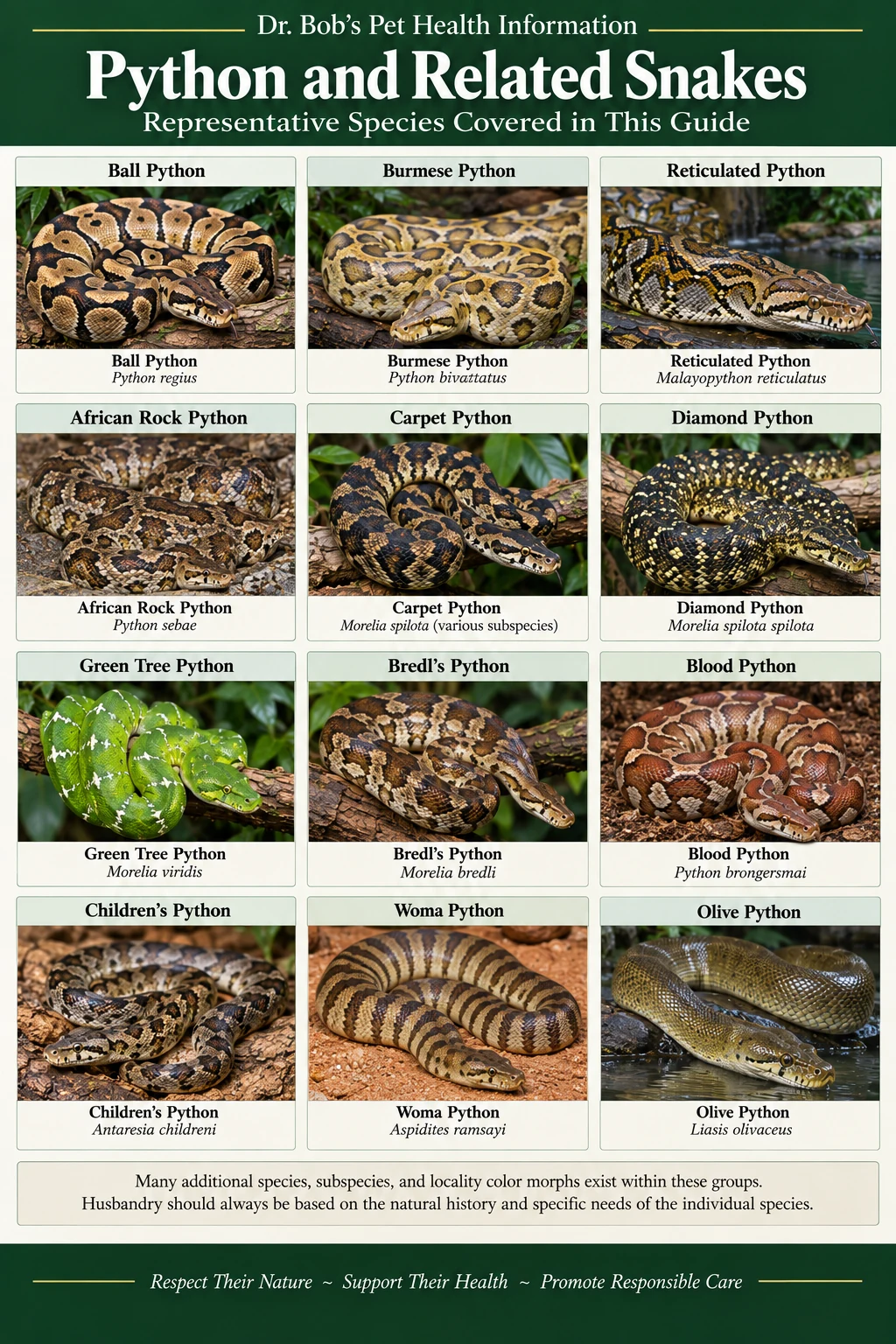
This guide covers the principal python groups commonly represented in zoological and private collections: Python, Malayopython, Morelia, Antaresia, Aspidites, Liasis, and Simalia. Taxonomy changes as phylogenetic work progresses, so older references may place reticulated, amethystine, Boelen's, or other pythons under different genera. Preserve locality and breeder records even when names change.
The species framework intentionally parallels the existing Python Diet Guide so the husbandry and nutrition articles can be used together.
Planning Before Acquisition
- Identify species and locality. “Carpet python,” “scrub python,” and “short-tail” can encompass very different adult sizes and climates.
- Plan for adult size before buying a juvenile. Giant pythons can outgrow ordinary commercial cages rapidly.
- Run the habitat empty for several days. Confirm warm/cool air, basking surface, humidity cycle, night temperature, thermostat behavior, and lighting.
- Verify legality. Large constrictor rules vary by jurisdiction; Australian native species are tightly regulated in their country of origin, and international movement may involve CITES.
- Prefer documented captive-bred animals. This is especially important for species historically affected by wild collection.
- Locate an experienced reptile veterinarian before an emergency.
Housing and Usable Space
Enclosure recommendations should be based on the adult snake, not gallon volume. A useful minimum concept for many terrestrial/semi-arboreal pythons is enclosure length approximately equal to snake length and width approximately half snake length, with height determined by climbing ecology. This is a starting welfare framework, not a reason to avoid larger housing. Ball pythons commonly need at least 4 × 2 × 2 ft; a typical carpet python may need 7 × 3 × 3 ft or more; standard Burmese and reticulated pythons can require dedicated rooms.
Large spaces do not inherently stress snakes. Barren exposure does. A large enclosure becomes secure when it contains multiple tight retreats, foliage/visual barriers, branches, substrate, and travel routes.
Security and Heat Safety
Pythons are strong escape artists. Use front-opening doors with positive locks; giant species need redundant locks and service procedures. Cable holes and ventilation openings must be smaller than the snake's head. Never use adhesive tape inside an occupied enclosure.
All heat sources require thermostatic control. Internal bulbs and ceramic emitters require rigid guards. Avoid heat rocks. Large basking snakes require a body-sized heat field, usually produced by multiple overhead lamps or a broad radiant panel rather than one intense small spot.
Thermoregulation and Environmental Measurement
Measure air temperature with digital probes and surface temperature with an infrared thermometer. Place permanent probes at the warm retreat and cool zone. Recheck after substrate, ventilation, lamp, branch, room-temperature, or seasonal changes. Merck's current veterinary table lists ball python air POTZ at 77–86°F (25–30°C) with 50–80% humidity, while noting basking areas are generally warmer and nighttime temperatures lower.
Measuring Devices and Environmental Monitoring Procedures
Environmental recommendations are useful only when the keeper can measure the conditions the snake actually experiences. The temperature printed on a thermostat, the setting on a misting controller, the wattage printed on a lamp, or the room thermostat is not a measurement of the python's enclosure. Each habitat should be mapped with independent instruments positioned where the snake actually rests, climbs, hides, basks, burrows, and drinks. This is especially important in large or tall habitats, where the conditions at the floor, an elevated perch, and the cool retreat may differ markedly.
Essential measuring devices
| Device | What it measures or controls | How it should be used |
|---|---|---|
| Digital thermometer with remote probe | Air temperature at a defined location | Maintain at least one probe at the warm retreat/basking level and a second at the cool retreat. Tall or arboreal habitats need additional probes at upper and lower perches. |
| Infrared thermometer (“temperature gun”) | Surface temperature | Survey basking shelves, branches, rock, substrate, hide roofs, and pool edges. It does not accurately measure air temperature. |
| Thermostat | Controls a heat source according to its probe | Use an appropriate dimming, pulse-proportional, or on/off controller for the heater. Secure the probe so the snake cannot move it and independently verify the result. |
| Digital hygrometer | Relative humidity | Place at snake level away from direct mist or wet substrate. Large/tall habitats benefit from more than one unit. A maximum/minimum memory function is useful. |
| Temperature/humidity data logger | Conditions over hours or days | Useful for validating a new habitat, detecting overnight lows and afternoon highs, and documenting seasonal room-HVAC effects. |
| UV Index meter (Solarmeter 6.5 or equivalent) | Biologically relevant UVB exposure | Measure at the height and orientation of the snake's dorsal surface in the basking position. Verify that shaded retreats approach UVI 0. |
| Timer / smart timer | Photoperiod and scheduled equipment | Use for visible light and UVB. Record deliberate seasonal changes; do not alter day length randomly. |
| Gram/kilogram scale | Body mass | Use a container/tare function for small snakes and a platform or veterinary scale for giants. Follow trends rather than single readings. |
| Water thermometer | Pool or soaking-water temperature | Recommended for giant pythons and water-associated species with large pools. Do not infer pool temperature from room air. |
| Water-quality tests | Sanitation of large permanent pools | Where a filtered pool is too large to empty daily, use an aquatic-maintenance plan appropriate to the system and monitor water quality; visible clarity alone does not prove hygienic water. |
Minimum monitoring kit by enclosure type
| Habitat | Minimum useful monitoring | Additional measurements |
|---|---|---|
| Small/medium terrestrial python | Warm and cool digital probes, IR thermometer, hygrometer, thermostat, scale | UVI meter when UVB is used; max/min logger during setup |
| Arboreal/semi-arboreal python | Floor and perch-level temperature probes, IR thermometer, at least two humidity locations, thermostat | UVI meter at warm perch and shaded perch; data logger at upper and lower levels |
| Large/giant terrestrial python | Multiple air probes across the enclosure, IR surface mapping, multiple hygrometers, redundant thermostatic control | Data logger, platform scale, electrical/GFCI checks, water thermometer |
| Large pool / water-python system | Air probes, IR thermometer, hygrometer, pool thermometer | Drain/filtration inspection and appropriate water-quality testing |
Instrument verification before use
- Compare thermometers. Place two digital thermometers side by side in a stable room for 30–60 minutes before installation. A large unexplained disagreement suggests that one should be replaced or checked against a trusted reference.
- Verify hygrometers. Compare two units side by side and periodically recheck them. A manufacturer-approved calibration procedure or a standard saturated-salt check can identify substantial drift. Replace units that cannot be brought into reasonable agreement.
- Inspect probes and cables. Heat probes must be securely fastened outside the snake's ability to pull, wrap, or dislodge them. Damaged insulation, loose suction cups, or probes buried under substrate can create unsafe readings.
- Know the IR thermometer's distance-to-spot ratio. The measured spot must be smaller than the target. A reading taken from several feet away may average a hot branch with cooler surrounding material.
- Recheck UV meters and lamp age. UVB output changes with distance, screen, reflector, lamp type, and aging. Measure the installed system rather than relying only on the manufacturer's distance chart.
Step-by-step environmental mapping procedure
- Complete the enclosure before the snake arrives. Install substrate, hides, branches, water, heat, lighting, ventilation, and any misting or pool equipment.
- Run the habitat empty for several normal day/night cycles. A 24–72 hour trial is particularly useful for a new build or a giant-python room.
- Measure warm-side air. Place a digital probe where the snake's body will rest in or immediately beside the warm hide.
- Map the entire basking surface. With an IR thermometer, take multiple readings across the branch, shelf, stone, or floor zone. A giant snake needs a broad safe warm area; one tiny hot spot cannot warm a large coil and increases burn risk.
- Measure the cool retreat. A second probe in or just beside the cool hide confirms that the animal can escape heat.
- Measure intermediate and elevated locations. In long habitats take readings near the one-quarter, midpoint, and three-quarter positions. In arboreal habitats repeat at upper, middle, and lower perch levels.
- Measure humidity where the snake lives. Record ambient humidity near the cool half and, when relevant, at an elevated perch. Also check the humid hide separately rather than trying to make the whole enclosure equally humid.
- Check nighttime conditions. Confirm the intended temperature decline and overnight humidity rise after daytime lighting shuts off.
- When UVB is used, measure UVI at dorsal height. Measure the warm basking/perch position, intermediate exposure, and deep shade. The animal must be able to leave UV exposure completely.
- Record the results and make one change at a time. Change heater output, ventilation, lamp distance, substrate moisture, or misting schedule only after identifying which measurement is outside the desired range.
Correct use of an infrared thermometer
An infrared thermometer measures the temperature of a surface within its field of view. It does not replace air-temperature probes. Aim perpendicular to the target when possible, remain within the manufacturer's useful distance, and sample several points. Glossy water, reflective metal, or glass can give misleading readings. For a large python, map enough of the basking zone to know whether the whole resting coil can warm without contacting an excessively hot surface.
Measuring humidity correctly
Relative humidity changes with temperature and location. A sensor pressed against damp substrate or directly beneath a fogger will overstate what the rest of the enclosure experiences. Measure at the height of the snake in the cool half, then check separate microclimates such as a humid hide. For green tree pythons and other arboreal taxa, monitor perch-level humidity because the floor reading may not represent the canopy zone. A useful humid habitat should show a cycle—for example, a rise after misting followed by partial drying—rather than remaining wet and stagnant.
Thermostat probe placement and heater safety
The probe must control the heat source before the snake can experience an unsafe temperature. For overhead heat, secure the probe near the principal basking surface according to the controller manufacturer's instructions; for radiant panels, position it where it responds predictably to the warmed zone. Never leave a movable probe loose inside a powerful constrictor's enclosure. Guard lamps and ceramic heaters so the snake cannot contact them, and independently confirm surface and air temperatures.
UVB measurement procedure
- Warm the lamp for the manufacturer's recommended stabilization period.
- Hold the UVI meter at the height of the snake's back on the basking branch/shelf, pointing toward the UVB source.
- Measure several nearby locations because screen, reflector geometry, foliage, and distance can create sharp gradients.
- Confirm an adjacent shaded route and secure retreat measure approximately UVI 0.
- Repeat after changing lamp height, screen, fixture, enclosure furnishings, or bulb; recheck output periodically as the lamp ages.
Routine monitoring schedule
- Daily: confirm thermostat operation, view warm/cool temperatures, humidity, water condition, heat-source safety, and snake behavior.
- Weekly: perform an IR surface survey, examine probes and guards, and review maximum/minimum readings.
- Monthly: compare instruments for drift; inspect electrical components, timers, fasteners, branches, pool drains, and enclosure seals.
- Seasonally: repeat a full environmental map when room heating/air-conditioning patterns change or when photoperiod/seasonal cycling is altered.
- After any major change: revalidate the habitat after replacing a heater, UVB lamp, thermostat, substrate type, screen top, ventilation panel, or major furnishing.
Habitat records
Keep a husbandry log with body weight, feeding, sheds, feces/urates, medications, reproductive events, temperature and humidity trends, equipment changes, and unusual behavior. Serial records often reveal a gradual environmental problem before a single examination does. For giant pythons, record handler-safety procedures and equipment inspections as part of routine care.
Lighting, Photoperiod, and UVB
All pythons benefit from an unambiguous light/dark cycle. A 12-hour day is a useful general baseline; Australian temperate/subtropical species can receive greater seasonal variation. Use bright white/full-spectrum visible lighting during the day and darkness at night—do not use red/blue “night bulbs.”
Python survival does not depend on UVB in the same way as many diurnal lizards, but modern evidence-oriented husbandry increasingly provides low/moderate UVB as an optional welfare resource. When used, measure UV Index at the snake's back with a Solarmeter 6.5. Most species in this guide are assigned conservative basking targets around UVI 1–3 with extensive shade; these are practical husbandry targets rather than established species-specific medical requirements.
Humidity, Ventilation, and Hydration
Relative humidity is not a single number to chase. Natural microclimates vary between exposed surfaces, burrows, tree hollows, leaf litter, and nighttime air. Provide a species-appropriate ambient range plus humid refuges. Brief misting/rainfall peaks followed by drying are generally preferable to permanently wet surfaces. Merck specifically cautions that reducing ventilation to retain heat/humidity can contribute to skin and respiratory disease.
Substrate Choices, Depth, and Drainage
Substrate should be selected according to the python's natural history, humidity requirement, burrowing behavior, enclosure ventilation and drainage, and the keeper's ability to clean it. There is no universal “python substrate.” A useful long-term substrate should be non-toxic, low-dust, resistant to rapid molding, physically appropriate for the species, and capable of supporting a moisture gradient without becoming waterlogged.
Species/group substrate matrix
| Python/group | Practical long-term substrate | Typical useful depth | Moisture strategy |
|---|---|---|---|
| Ball / Royal Python | Coconut husk/coir, additive-free topsoil blend, cypress-type mulch, leaf litter | 4–6 in (10–15 cm) | Moderately moist lower layers with a drier surface plus humid hide; never continuously wet |
| Burmese / Reticulated / African Rock | Durable tropical soil or topsoil/coir blend; coarse coconut husk; clean mulch in very large systems | 3–6 in (8–15 cm), deeper where practical | Moisture-buffering substrate with excellent ventilation and drainage; large wet areas should be designed as pools, not accidental swampy substrate |
| Blood / Short-Tailed Pythons | Deep coconut husk/coir/topsoil with leaf litter | 4–6+ in (10–15+ cm) | Humid, secure microclimate with a surface that is not saturated; these snakes should not be kept on hot, dry substrate |
| Green Tree Python | Tropical soil/coir/coconut husk with leaf litter | 2–4 in (5–10 cm) | Substrate buffers humidity but must drain and dry between misting cycles; perch-level humidity matters more than floor dampness |
| Carpet Python — humid/coastal forms | Topsoil/coir blend, coconut husk, leaf litter | 2–4 in (5–10 cm) | Moderate moisture with drying cycles |
| Carpet Python — inland/diamond forms | Well-drained topsoil/sand mix with leaf litter | 2–4 in (5–10 cm) | Drier surface; locality-specific humid retreat rather than uniformly high enclosure humidity |
| Bredl's Python | Topsoil/play-sand mix with some clay and rock/cork cover | 3–5 in (8–13 cm) | Dry surface, slightly more humid lower layers, separate humid hide |
| Antaresia | Sandy topsoil mix, optional clay; leaf litter/cork | 3–5 in (8–13 cm) | Generally dry to moderately dry with localized shed hide |
| Woma / Black-Headed Python | Deep sandy topsoil with some clay; structured burrowing medium | 4–6+ in (10–15+ cm) | Dry upper layer with a localized humid retreat; do not use chronically wet tropical mulch |
| Olive Python | Well-drained soil/coconut blend or sandy soil according to locality | 3–5 in (8–13 cm) | Moderate humidity with dry resting surfaces and a large water source |
| Water Python | Moisture-tolerant topsoil/coir/coconut blend | 3–5 in (8–13 cm) | Humid air and large water access, but land substrate must remain drained rather than swampy |
| Lowland Simalia | Tropical soil/coir/coconut blend with leaf litter | 3–5 in (8–13 cm) | Humidity cycling, rapid drainage, strong ventilation |
| Boelen's Python | Deep forest-style topsoil/coir/leaf-litter mix with excellent drainage | 4–6 in (10–15 cm) | Cool, humid forest conditions; never hot, stagnant, or waterlogged |
Substrate materials and their uses
| Material | Advantages | Limitations / best use |
|---|---|---|
| Coconut husk/chips | Good moisture retention, durable, useful for large humid-tropical snakes | Can remain too wet if heavily misted; remove contaminated pieces promptly |
| Coconut fiber/coir | Excellent moisture buffering and useful in soil blends | Fine material can become dusty when bone-dry or muddy when saturated |
| Additive-free topsoil | Natural texture, supports digging, plants, and bioactive systems | Must contain no fertilizer, manure pellets, pesticide, perlite, or wetting agents |
| Washed play sand | Improves drainage and structure in arid/semi-arid blends | Usually better mixed with soil than used alone |
| Natural clay / excavator-style clay | Adds structure to Australian arid mixes and can help maintain stable burrow contours | Use as part of a blend; avoid hard cement-like surfaces or sharp collapsed edges |
| Cypress-type mulch | Useful humidity retention and coarse surface texture | Quality varies; avoid aromatic or chemically treated wood products |
| Leaf litter | Creates cover, texture, scent enrichment, and humid microclimates | Use clean pesticide-free material; replace contaminated/decomposed litter |
| Paper / paper towel | Excellent for quarantine, hospitalization, mite treatment, and monitoring feces/urates | Poor long-term behavioral substrate and little humidity buffering |
| Aspen | Dry, lightweight, permits tunneling | Useful primarily for dry species; molds rapidly when repeatedly wet and is poorly suited to humid tropical systems |
Practical soil mixtures
Commercial reptile substrates are convenient but not required. Examples of useful starting mixtures include:
- Humid tropical terrestrial: about 40% additive-free topsoil, 40% coconut fiber/coir, and 20% washed play sand, topped with leaf litter. Adjust to ventilation and local room humidity.
- Large tropical python: coarse coconut husk plus topsoil/coir in traffic areas, with sealed easily cleaned flooring beneath water stations and along doors.
- Arid/semi-arid Australian: approximately 50–60% additive-free topsoil and 40–50% washed play sand, with a modest clay component when greater structure is needed.
- Cool forest / Boelen's: topsoil/coir plus leaf litter over a well-drained base; moisture should be retained below the surface while air movement prevents stagnation.
Moisture gradients rather than uniformly wet substrate
Do not create “high humidity” by saturating the entire enclosure. In most python habitats, a better design is a drier upper surface, slightly moister lower substrate, one dedicated humid retreat, and adequate ventilation. This lets the snake choose among microclimates and reduces persistent skin contact with wet organic material. If condensation remains heavy all day, the substrate feels wet when squeezed, or the habitat develops a sour/musty odor, reduce water input and improve drainage/ventilation.
Drainage for humid habitats
Large tropical enclosures should be designed so excess water can leave the land area. Options include a removable waterproof substrate tray, sealed floor with drain, or a properly constructed drainage layer separated from the soil by mesh/geotextile. A false-bottom/bioactive system is only useful if accumulated water can be removed. A drainage layer is not a reservoir that should remain full of stagnant water.
Heavy furnishings and burrowing safety
Womas, black-headed pythons, Antaresia, and other snakes that excavate beneath décor can undermine heavy rock or wood. Set heavy objects directly on the enclosure base or mechanically secure them before adding loose substrate. Artificial rock stacks should not be capable of shifting onto the animal. Branches for giant pythons must be engineered for the snake's adult mass rather than simply wedged between enclosure walls.
Bioactive systems
A mature bioactive enclosure can provide deep soil, leaf litter, plants, microclimates, and behavioral opportunity, but it is not “maintenance-free.” Establish the system before occupancy, verify drainage and plant safety, remove large fecal/urate deposits promptly, and continue routine environmental and parasite monitoring. Do not use a bioactive system as the primary quarantine enclosure for a newly acquired python because it makes parasite, mite, and fecal monitoring more difficult.
Substrate sanitation and replacement
- Remove feces, urates, regurgitated material, shed fragments, and visibly contaminated substrate promptly.
- Replace a wider surrounding area after significant fecal or water-bowl contamination.
- Stir/inspect deep substrate periodically for anaerobic wet pockets, mold, or insects.
- Replace or refresh substrate when odor, contamination load, texture breakdown, or persistent wetness indicates loss of function.
- Disinfect the waterproof enclosure beneath the substrate during scheduled full cleanouts and whenever infectious disease is suspected.
Materials to avoid
- Cedar and strongly aromatic softwoods or chemically treated landscape mulch.
- Soil containing fertilizer, pesticide, manure pellets, moisture-retaining crystals, perlite, or unknown additives.
- Crushed walnut shell, sharp gravel, glassy/abrasive material, or products that can injure the mouth, skin, or gastrointestinal tract.
- Calcium sand or other ingestible mineral particulate marketed as a dietary supplement.
- Chronically wet moss as the entire enclosure floor. Moss is better confined to a humid hide or limited microhabitat.
- Loose substrate placed directly over exposed under-tank heat without a thermostat and safe floor-temperature design.
Feeding safely over loose substrate
Whole prey may be offered in the normal enclosure; routine relocation to a separate feeding container can add handling stress and is not necessary. Present thawed prey with long forceps over a clean tile, feeding tray, cork flat, or other relatively particle-free surface and remove adherent substrate from the prey. A small incidental amount of appropriate substrate is not equivalent to intentionally allowing a prey item to become heavily coated with soil or wood fragments.
Signs that the substrate system needs correction
Persistent ventral redness, scale pitting, blister-like lesions, recurrent retained shed, repeated respiratory signs, substrate stuck around the mouth, visible mold, fungus gnats, sour odor, or chronically wet hides should trigger a complete review of substrate depth, moisture, drainage, ventilation, temperature, and sanitation rather than simply changing one brand of bedding.
Hides, Climbing, Burrowing, and Enrichment
Provide at least two snug hides for ground species. Arboreal and semi-arboreal pythons need horizontal and diagonal branches thick enough to support the full animal, plus elevated shelves/hides. Fossorial species need deep substrate and buried cover. Rotate safe scent, texture, branch, and foliage opportunities without repeatedly dismantling the snake's core security. Furnishings must be anchored against the strength of the adult animal.
Water
Fresh potable water should be continuously available. Use a heavy container that cannot tip. Giant tropical pythons benefit from large drainable soaking basins; reticulated and Burmese pythons are strong swimmers. Water features must be designed around sanitation—large snakes rapidly contaminate small pools.
Handling and Giant-Python Safety
Allow new snakes to establish feeding and normal behavior before routine handling. Support the body and avoid pulling by the tail. Use a hook or target/tap cue to distinguish husbandry from feeding, particularly in strong-feeding species. Do not handle immediately after feeding.
Large Burmese, reticulated, African rock, scrub/amethystine, and large olive pythons require formal safety planning. Use another capable adult once the snake's size/strength makes solo handling unsafe; never allow a large python to wrap around the neck. Design enclosures so water, waste, and furnishings can be serviced with minimal direct restraint.
Reproduction and Neonatal Care
Pythons are oviparous. Females of many species coil around eggs and may behaviorally thermoregulate the clutch; Burmese pythons can generate heat by muscular shivering. Captive breeding requires species-specific seasonal cues, adequate female body condition, and a plan for incubation, neonate housing, and placement of offspring. Do not cool compromised animals for breeding. Record egg dates, incubation conditions, hatch dates, first shed, mass, first meal, and subsequent growth.
Detailed Species and Group Care
The profiles below are intended to convert natural history into practical captive design. Each begins with adult size and native range, then describes a step-by-step habitat build, measured environmental targets, and ongoing husbandry priorities. Numeric values are evidence-informed starting targets, not immutable limits; locality, sex, age, body condition, reproductive state, enclosure construction, and room climate can justify adjustment.
Adult size and native range quick reference
| Species / group | Typical adult size | Native range and ecological emphasis |
|---|---|---|
| Ball / Royal Python Python regius | Usually 3–5 ft (0.9–1.5 m); females commonly larger | West and Central Africa; savanna, open woodland, farmland margins, and mammal burrows |
| Burmese Python Python bivittatus | Average about 10–16 ft (3–4.9 m); females often larger | Southern China through much of mainland Southeast Asia and parts of Indonesia; forest, wetland, marsh, grassland, foothills, and water margins |
| African Rock Python Python sebae | Commonly about 10–16 ft (3–5 m) in large adults | Broad sub-Saharan range in western, central, and eastern Africa; savanna, forest edge, rocky refuges, wetlands, and river systems |
| Southern African Rock Python Python natalensis | Often 9–13 ft (2.8–4 m), with larger females possible | Eastern and southern Africa; savanna/woodland, rocky country, thickets, reedbeds, and water-associated habitat |
| Reticulated Python Malayopython reticulatus | Standard mainland/locality animals often 14–20 ft (4.3–6.1 m); dwarf and super-dwarf island lineages are smaller | South and Southeast Asia through Indonesia and the Philippines; tropical forest, river systems, wetlands, agricultural and peri-urban habitat |
| Carpet / Diamond Python complex Morelia spilota | Most captive forms about 5–8 ft (1.5–2.4 m), locality dependent | Australia and southern New Guinea; rainforest, woodland, savanna, rocky country, and temperate forest depending locality |
| Bredl's / Centralian Python Morelia bredli | About 6.5–7 ft (2–2.1 m) average; 8+ ft possible | Central Australia around rocky ranges/gorges and dry woodland/shrubland |
| Green Tree Python Morelia viridis | Average about 5 ft (1.5 m); large animals near 7 ft (2.2 m) | New Guinea and nearby islands plus Cape York, Australia; lowland to lower montane rainforest, secondary forest, and canopy/edge habitats |
| Blood Python Python brongersmai | Usually 4–6 ft (1.2–1.8 m), very heavy-bodied | Malay Peninsula, southern Thailand and parts of Sumatra/Southeast Asia; humid lowland forest, swamp margins, and plantations |
| Sumatran Short-Tailed Python Python curtus | Often 3–5 ft (0.9–1.5 m), very heavy-bodied | Sumatra and nearby Bangka; humid lowland forest and wetland-associated ground habitat |
| Bornean Short-Tailed Python Python breitensteini | Often 4–6 ft (1.2–1.8 m) | Borneo; humid rainforest, swamp/river margins, and disturbed lowland habitat |
| Children's Python Antaresia childreni | Usually 2–3 ft (0.6–0.9 m); some exceed 1 m | Northern Australia; woodland, rocky country, caves/crevices, termite mounds, and hollow timber |
| Spotted Python Antaresia maculosa | Usually around 3 ft (0.9 m); northern/locality animals may be larger | Eastern and northeastern Australia; eucalypt woodland, rocky habitat, caves, and rainforest margins |
| Stimson's Python Antaresia stimsoni | Usually 2.3–3.5 ft (0.7–1.1 m) | Wide arid/semi-arid Australian range; rocky outcrops, sandy plains, dry watercourses, spinifex, and termite mounds |
| Pygmy Python Antaresia perthensis | Usually 1.3–2 ft (0.4–0.6 m) | Pilbara and adjacent midwestern Western Australia; hot rocky country and termite-mound refuges |
| Woma Python Aspidites ramsayi | Often 4.5–6 ft (1.4–1.8 m); some locality forms much larger | Arid and semi-arid inland Australia; sandy plains, dunefields, shrubland, grassland, woodland, and burrows |
| Black-Headed Python Aspidites melanocephalus | Usually 5–7 ft (1.5–2.1 m); large females may exceed this | Northern third of Australia; dry woodland, savanna, scrub, rocky country, and burrows |
| Olive Python Liasis olivaceus | Commonly 6.5–10+ ft (2–3+ m); very large animals occur | Northern/western Australia; rocky ranges, savanna, escarpments, and watercourses |
| Water Python Liasis fuscus | Often 6.5–10 ft (2–3 m) | Northern Australia and parts of New Guinea; wetlands, floodplains, swamps, rivers, and water margins |
| Scrub/Amethystine complex Simalia spp. | Roughly 6–15+ ft (1.8–4.5+ m) depending species; S. nauta is much smaller than giant scrub forms | New Guinea, Moluccas/Tanimbar/Halmahera, Torres Strait, and northeastern Australia depending species; lowland tropical forest to montane forest |
| Boelen's Python Simalia boeleni | Often about 6–10 ft (1.8–3 m) in captive literature | New Guinea central highlands, often around 1,500–2,000 m; cool humid montane forest |
Adult sizes are practical husbandry ranges, not maximum-record claims. Locality genetics, sex, nutrition, and individual variation matter. For dwarf/super-dwarf reticulated pythons and locality-specific carpet/scrub pythons, verify documented ancestry before using a smaller adult enclosure plan.
Ball / Royal Python — Python regius
Adult size and native range: Most adults are about 3–5 ft (0.9–1.5 m), with females usually larger and heavier than males. The species is native to West and Central Africa, where it uses savanna, open woodland, agricultural edges, termite mounds, and mammal burrows. It is primarily terrestrial and secretive, but climbing—particularly by some males—is normal and should be possible in captivity.
Habitat setup — step by step
- Select the adult enclosure first. Use at least about 48 × 24 × 24 in (122 × 61 × 61 cm) for most adults and increase length when the snake exceeds 4 ft so it can extend fully. Front-opening PVC/wood/composite vivaria are efficient at retaining heat and humidity while allowing controlled ventilation.
- Install overhead heat at one end. A radiant heat panel, guarded ceramic heater, or guarded basking lamp should be thermostat controlled. Create a broad warm zone rather than a single tiny hot point.
- Add 4–6 in (10–15 cm) of moisture-buffering substrate. Coconut husk/coir or a topsoil/coir/sand blend works well. Keep the surface mostly dry while maintaining moisture below and in a dedicated humid retreat.
- Provide three security zones. Place a snug warm hide, a similar cool hide, and a humid hide on the middle/cool half. The snake should fit closely enough to contact the hide walls.
- Add usable structure. Include sturdy low branches, cork, leaf litter, visual barriers, and a flat basking shelf/stone over or beside the warm hide. Do not leave large open barren floor areas.
- Place a stable water bowl on the cool half. It should be large enough for drinking and optional soaking without creating a constantly wet warm hide.
- Run and map the habitat before occupancy. Verify the warm hide, cool hide, substrate surface, nighttime low, humidity, and any UVB zone independently.
Environmental targets
- Warm hide/air: about 86–90°F (30–32°C).
- Cool retreat: about 75–80°F (24–27°C); brief lower nighttime values in a healthy adult are preferable to a cage that never offers a cool choice.
- Night: generally mid-70s°F (about 23–26°C), avoiding prolonged chilling.
- Humidity: commonly about 55–75% ambient with a higher-humidity retreat; Merck's veterinary reference range for the species is 50–80%.
- Lighting: a regular 12-hour day is practical. Low-level UVB can be offered; when used, measure a gentle basking exposure (approximately UVI 0.5–1.5) with UVI 0 shade. Light-sensitive morphs may require lower exposure and especially good shade.
Extensive ongoing care
Ball pythons often become inactive when kept in sparse housing; provide cover and low climbing opportunities rather than assuming inactivity is normal. Record weight and body condition because chronic overfeeding can produce obesity without obvious visual change. During shed, increase the humidity of the dedicated retreat rather than saturating the entire enclosure. Spot-clean promptly and replace wet substrate beneath overturned water bowls.
Appetite may vary seasonally and reproductively. Persistent food refusal should trigger a review of body condition, environmental measurements, hiding security, disturbance, prey presentation, oral health, parasitism, and systemic disease rather than automatic escalation of prey size or feeding frequency. Repeated soaking, wheezing, open-mouth breathing, oral plaques, progressive weight loss, abnormal neurologic behavior, or incomplete sheds warrant veterinary assessment.
Burmese Python — Python bivittatus
Adult size and native range: Burmese pythons average roughly 10–16 ft (3–4.9 m), and lengths over 15 ft are common; females are typically the larger sex. They are native to parts of southern China and mainland Southeast Asia—including Myanmar, Laos, Vietnam, Cambodia, Thailand, and Malaysia—and parts of Indonesia. Natural habitats include rainforest, grassland, swamp, marsh, rocky foothills, and other water-associated environments.
Habitat setup — step by step
- Design for projected adult length and mass. A welfare-oriented target is an enclosure approximately the snake's length with width around half its length, plus usable height. An 8 × 4 × 4 ft habitat is appropriate only for a young animal or genuinely small/dwarf lineage under about 8 ft—not a 14–16 ft adult.
- Use waterproof, structurally reinforced construction. Sealed PVC/composite panels, fiberglass, masonry, or other washable surfaces are preferable. Doors need redundant escape-resistant latches.
- Create a broad thermostatically controlled warm zone. Overhead radiant panels or protected commercial heaters should warm a body-sized area. Multiple heaters may be required in room-scale habitats; each should be guarded from direct contact and independently monitored.
- Provide 3–6 in of durable substrate. Use tropical soil/coir/coconut husk in land areas, with sealed cleanable flooring around the pool and door threshold.
- Build warm and cool retreats large enough for the whole snake. Large removable hide boxes, low shelves, or partitioned alcoves work better than decorative pet-store hides.
- Add robust enrichment. Juveniles climb readily; adults still benefit from low platforms, logs, visual barriers, different textures, and route choice. Every branch/shelf must support the snake's adult weight.
- Provide a large drainable water source. The snake should be able to drink readily and, when practical, soak substantially. Very large pools need a drain/filtration and sanitation plan so water does not become a reservoir of fecal organisms.
- Run the completed room/enclosure for several days. Map air and surface temperatures over the entire coil-sized warm zone, cool retreat, pool, humidity, nighttime minimums, and lighting before introducing the animal.
Environmental targets
- Basking/warm surface: approximately 90–92°F (32–33°C), broad enough for a large coil.
- Warm ambient: mid-80s°F (about 29–30°C).
- Cool zone: approximately 78–82°F (26–28°C).
- Night: modest decline into the mid-to-upper 70s°F (about 24–27°C) for healthy adults.
- Humidity: generally 60–80% with strong ventilation and dry resting surfaces.
- Lighting: regular visible-light cycle; measured low-to-moderate UVB can be provided with extensive shade.
Extensive ongoing care
Daily inspection should include locks, heater guards, water sanitation, feces/urates, skin, respiration, and behavioral state before entering the enclosure. Giant pythons should be conditioned to predictable routines such as target/tap training so feeding cues are distinct from routine maintenance. Never rely on free handling of a large hungry animal as the primary management method.
Monitor body weight and muscle condition because overfeeding produces exceptionally large, obese adults and worsens the difficulty of handling and transport. Maintain an adult-rated transport crate on site. For examinations, shedding problems, injections, radiographs, or enclosure moves, use a planned team rather than improvising. Respiratory disease, stomatitis, skin infection, burns, trauma, parasitism, reproductive disease, and obesity are important clinical concerns.
African Rock Pythons — Python sebae and Python natalensis
The northern/central African rock python (P. sebae) and Southern African rock python (P. natalensis) are separate species. Both are giant, powerful snakes associated with savanna/woodland mosaics, rocky refuges, and water, but their native ranges and seasonal climates differ. Husbandry should therefore be based on identified species and origin rather than the label “African rock python.”
African Rock Python — Python sebae
Adult size and native range: Large adults commonly fall around 10–16 ft (3–5 m). The species occurs broadly through western, central, and parts of eastern sub-Saharan Africa in savanna, forest edge, rocky outcrops, wetland margins, river systems, and mammal burrows.
Habitat setup
- Plan a reinforced giant-python enclosure approximately the snake's adult length with generous width and enough height for low climbing.
- Install a broad guarded overhead warm zone at one end and large warm/cool retreats.
- Use 3–6 in of durable soil/coir/coconut substrate with dry walking surfaces and a humid retreat.
- Add heavy logs, low platforms, visual cover, and a very large secured water basin; water access is especially important for this species.
- Use redundant locks and a service design that allows water and waste removal without placing the keeper in the same confined space with an aroused feeding animal.
Targets: basking/warm surfaces roughly 90–94°F (32–34°C), cool zone about 76–82°F (24–28°C), humidity generally 55–75% with local higher-humidity refuge, and a regular tropical/subtropical photoperiod. Avoid chronic overheating.
Care priorities: treat as a giant constrictor with formal handling protocols. Provide exercise opportunities and avoid rapid growth/obesity. Monitor water hygiene, respiratory signs, oral disease, skin injury, burns, and reproductive condition. Individuals can have exceptionally strong feeding and defensive responses.
Southern African Rock Python — Python natalensis
Adult size and native range: Adults are often about 9–13 ft (2.8–4 m), with large females capable of greater size. The species occurs in eastern and southern Africa from parts of Kenya/Tanzania south through Zambia, Zimbabwe, Mozambique, Botswana, Namibia, South Africa, and adjacent regions. It uses savanna, woodland, thicket, reedbeds, rocky crevices, burrows, and waterways.
Habitat setup
- Use the same giant-python space and containment standards as for P. sebae.
- Create a broad sun-warmed-style basking zone and a noticeably cooler retreat so the snake can use a stronger day/night and seasonal gradient.
- Use well-drained soil/coconut substrate; do not keep the enclosure as uniformly wet tropical rainforest.
- Add rock/cork retreats, large logs, low climbing, and a large water basin.
- Where deliberate seasonal breeding cycles are used, adjust photoperiod and nighttime temperature gradually and only for healthy mature animals.
Targets: warm surface about 90–94°F (32–34°C), cool zone approximately 74–80°F (23–27°C), moderate nighttime decline, and humidity roughly 45–65% with a humid refuge. Locality and season can justify broader variation than in equatorial populations.
Care priorities: provide strong air exchange, dry resting surfaces, and ample floor area. Avoid applying year-round equatorial heat/humidity to southern animals. Use multiple trained handlers for substantial adults and maintain secure transport equipment.
Reticulated Python — Malayopython reticulatus
Adult size and native range: Standard mainland and large-island animals commonly reach about 14–20 ft (4.3–6.1 m); the species includes island populations with genetically smaller “dwarf” and “super-dwarf” adult size. It ranges from Bangladesh/Myanmar through mainland Southeast Asia and Indonesia to the Philippines, occupying tropical forest, river and wetland systems, agricultural landscapes, and sometimes peri-urban areas. It is an athletic climber and capable swimmer, not simply a ground-dwelling heavy-bodied python.
Habitat setup — step by step
- Verify lineage before planning size. “Dwarf” should mean documented ancestry, not a seller's prediction. Standard adults require room-scale or equivalent giant-python housing.
- Provide full usable length plus height. Build approximately the snake's length × at least half its length in floor dimensions, with substantial vertical space. Large adults benefit from 4–6 ft or more usable height where structurally practical.
- Engineer climbing surfaces. Install massive horizontal/diagonal branches, shelves, and elevated resting platforms attached to framing. They must support the full adult mass without rotating or collapsing.
- Create a broad radiant warm zone. Use protected overhead heat under thermostat control and large cool retreats on the opposite side.
- Use 3–6 in of drained tropical substrate. Soil/coir/coconut blends work; include leaf litter and visual cover.
- Provide a large soaking/drinking pool. Design it for easy drain/refill and prevent water from saturating the land substrate.
- Use redundant locks and keeper-service access. A maintenance panel or protected service area can reduce the need to enter the enclosure for every water or substrate task.
Environmental targets
- Warm/basking surface: about 88–92°F (31–33°C).
- Cool zone: about 76–80°F (24–27°C).
- Night: generally mid-70s°F (about 24–26°C) for lowland forms.
- Humidity: roughly 60–80% with good airflow and drying cycles.
- Lighting: bright visible-light day cycle; low-to-moderate measured UVB can be offered at an upper warm perch with deep shade elsewhere.
Extensive ongoing care
Reticulated pythons are inquisitive and highly food-motivated. Use target/tap training, long feeding tools, and consistent cues. Enrichment should include multiple travel routes, elevated/resting choices, scent exploration, and periodic changes that do not compromise security. Large adults should never be handled alone. Maintain a written plan for escape, bite/constriction emergencies, power failure, fire evacuation, and transport.
Obesity is common when a naturally active species is fed heavily in a small enclosure. Monitor body condition, not only body weight. Check the mouth and rostrum for trauma, the ventral scales for pressure/wet-substrate injury, and the respiratory tract for early signs of disease. A persistent desire to push doors or rub the snout often indicates enclosure, enrichment, temperature, or disturbance problems that need correction.
Carpet and Diamond Pythons — Morelia spilota Complex
Adult size and native range: Most captive carpet/diamond pythons are about 5–8 ft (1.5–2.4 m), but adult size and climate vary with locality. The complex occupies much of Australia and southern New Guinea, ranging from tropical rainforest and monsoonal woodland to dry inland country and cool temperate forest. Taxonomic treatment of locality/subspecies forms changes over time, so husbandry should follow documented geographic ancestry.
Common captive forms and locality differences
| Form | Approximate adult size | Native-climate emphasis |
|---|---|---|
| Coastal carpet | Often 6–8 ft | Eastern/northeastern Australian coastal woodland/forest; warm with moderate humidity |
| Jungle carpet | Often 5–7 ft | Northeastern Queensland rainforest; warmer and more humid |
| Darwin / northern carpet | Often 5–7 ft | Northern monsoonal Australia; strong wet/dry seasonality |
| Inland / Murray-Darling-type carpet | Often 5–7 ft | More continental, drier environments with stronger day/night and seasonal variation |
| Diamond python | Often 6–8 ft | Temperate southeastern/coastal New South Wales; substantially cooler and more seasonal than tropical carpet forms |
Habitat setup — step by step
- For most adults, begin around 6 × 2.5–3 × 3–4 ft and increase length for large individuals; large coastal/diamond forms may need 7–8 ft or more.
- Install a warm elevated shelf/branch at one end under guarded thermostatically controlled heat, plus lower and cooler routes.
- Provide at least two long horizontal branches, diagonal connectors, and an elevated hide in addition to warm/cool ground hides.
- Use 2–4 in of substrate matched to locality: more moisture-buffering tropical soil for humid forms, more freely draining sandy soil for inland forms.
- Add leaf litter, cork, and foliage to break sight lines. These active pythons should be able to travel without always crossing open floor.
- Place a stable water bowl on the cool half and leave enough clear space for full-body extension.
Environmental targets and locality adjustment
- Tropical/coastal forms: basking surface about 88–92°F (31–33°C), cool zone 76–80°F (24–27°C), humidity often 50–70% with seasonal peaks.
- Inland forms: similar basking opportunity but drier average humidity (about 40–55%) and a larger nighttime decline.
- Diamond pythons: provide a cooler temperate regime and marked seasonality; chronic tropical heat is inappropriate. Breeding-oriented winter cooling requires verified locality, healthy condition, and careful planning.
- UVB: measured low-to-moderate exposure can be offered on the warm elevated branch (often around UVI 1–2, sometimes higher for strongly sun-exposed localities) with UVI 0 shade.
Extensive ongoing care
Carpet pythons are active and benefit from vertical choice, not merely an empty tall cage. Inspect climbing structure regularly because a loosening branch can injure the spine or trap the snake. Younger animals may be defensive; repeated calm, brief handling after acclimation is preferable to forceful restraint. Adults are often confident feeders, so use feeding cues and long tongs.
Seasonal cycling should follow locality rather than a generic “winter brumation.” Monitor weight through any reduced-feeding period. Persistent wheezing, nasal discharge, oral plaques, regurgitation, abnormal basking, or unexplained prolonged inactivity should prompt medical and husbandry review.
Bredl's / Centralian Python — Morelia bredli
Adult size and native range: Adults average roughly 6.5–7 ft (2–2.1 m), with individuals over 8 ft possible. The species is native to central Australia, particularly the ranges and gorges around the Alice Springs region, where it uses rocky crevices, cliffs, dry woodland, shrubland, and trees. It is a capable climber despite the arid setting.
Habitat setup — step by step
- Provide approximately 7 × 3 × 3 ft for a typical adult when possible, increasing length for larger animals.
- Create a broad elevated basking shelf/branch with guarded overhead heat. A second cooler elevated route allows thermoregulation without descending.
- Use 3–5 in of well-drained sandy topsoil, optionally with clay, and keep the upper surface predominantly dry.
- Build secure rock/cork crevices at warm and cool ends. All heavy stone must rest on the enclosure base, not loose substrate.
- Add multiple heavy branches and ledges, sparse plant cover, and a separate humid hide for shedding.
- Position the water bowl on the cool half and avoid using constant misting to raise humidity.
Environmental targets
- Basking surface: approximately 98–104°F (37–40°C) over a limited, safely measured area.
- Warm air: upper 80s°F (about 30–32°C).
- Cool zone: about 78–84°F (26–29°C) by day with a substantial night decline.
- Night: often 73–77°F (23–25°C), with seasonal/locality variation.
- Humidity: usually below 50% ambient with a more humid retreat available during shed.
- UVB: a measured basking target around UVI 2–3 can be offered with extensive shade.
Extensive ongoing care
Bredl's pythons are active and often use every level of a well-designed enclosure. Rotate safe branches, cork, and scent-enrichment items periodically. Do not confuse a dry climate with dehydration: provide clean water continuously and a humid retreat. Avoid chronic cool dampness, which is particularly inappropriate for this central Australian species.
Seasonal appetite changes can occur, especially in mature males. Track body weight rather than assuming every winter fast is normal. Examine for retained spectacles, rostral abrasion, respiratory disease, and heat injury. A basking surface capable of exceeding 100°F must be controlled and mapped carefully so the animal cannot become trapped against an overheated surface.
Green Tree Python — Morelia viridis
Adult size and native range: Green tree pythons average about 5 ft (1.5 m); large animals may approach 7 ft (2.2 m). They occur through New Guinea and surrounding islands (excluding the Bismarck Archipelago in the Animal Diversity Web account) and on Cape York Peninsula, Queensland. They inhabit lowland to lower-montane rainforest, secondary forest, and regrowth from sea level to about 2,000 m. Juveniles often use brighter forest edges/gaps, while adults are strongly associated with closed-canopy forest.
Habitat setup — step by step
- Prioritize horizontal space as well as height. A 3 × 2 × 2 ft habitat is a minimal adult starting point; 4 × 2 × 3 ft or larger offers better full extension, perch choice, and thermal separation.
- Install removable horizontal perches. Provide at least three secure perches of slightly different diameters, plus diagonal connectors. One warm perch should pass through the heat/light zone; another should be cooler and shaded.
- Add foliage and visual security around resting perches. The snake should be able to remain concealed without being forced to the floor.
- Use 2–4 in of drained tropical substrate. Soil/coir/coconut with leaf litter buffers humidity and can support plants. Do not use a waterlogged floor.
- Provide both floor and optional elevated water. A secured elevated cup can be useful for some individuals, but a clean floor bowl should remain available.
- Place sensors at perch height. Floor temperature/humidity measurements alone do not represent the animal's microclimate.
Environmental targets
- Warm perch air: about 82–86°F (28–30°C); keep the actual contact surface safely below burn-inducing temperatures.
- Cool/lower zone: about 74–80°F (23–27°C).
- Night: approximately 70–75°F (21–24°C), with cooler highland-locality adjustment when appropriate.
- Humidity: cycle roughly 50–80%, rising after misting and then partially drying. Constant saturation is inappropriate.
- UVB: low measured exposure around UVI 1–2 at the warm perch with dense UVI 0 shade is a conservative starting point.
Extensive ongoing care
Green tree pythons should not be peeled forcefully from a perch. Use removable perch sections or a snake hook and allow the snake to uncoil. Excessive handling, dehydration, overheating, and poorly planned feeding can contribute to regurgitation and stress. Juveniles deserve especially close hydration and weight monitoring.
Inspect the mouth, nares, tail tip, and ventral scales during routine handling. Persistent low-perch/floor dwelling, abnormal head posture, repeated soaking, wheezing, retained shed, or prolonged refusal to perch normally can be an early sign of environmental or medical disease. Locality lineages differ in size and climate; documented origin should influence nighttime temperatures and overall humidity.
Blood and Short-Tailed Pythons — Python brongersmai, P. curtus, P. breitensteini
These are three distinct heavy-bodied ground pythons. They share a lowland, humid ecological theme but differ geographically and somewhat in average size. None should be kept excessively hot simply because they are tropical.
Blood Python — Python brongersmai
Adult size and origin: Usually about 4–6 ft (1.2–1.8 m), with females often extremely heavy. Native to the Malay Peninsula, southern Thailand and parts of Sumatra/Southeast Asia in humid lowland forest, swamp margins, and plantations.
Habitat setup: Use at least 4 × 2 × 2 ft for moderate adults and 5–6 ft of length for large females. Provide 4–6 in of deep coconut/soil substrate, broad warm and cool hides, leaf litter/cork cover, a large water bowl, and a broad overhead warm zone rather than a tiny hot spot.
Targets: warm zone about 82–86°F (28–30°C), cool zone 75–80°F (24–27°C), night 72–78°F (22–26°C), humidity generally 60–80% with strong ventilation.
Care: Keep visually secure and avoid constant enclosure traffic. Use objective body-condition and weight records because obesity is easy to miss in this naturally thick snake. Well-housed captive-bred blood pythons are often much calmer than their historical reputation suggests.
Sumatran Short-Tailed Python — Python curtus
Adult size and origin: Often 3–5 ft (0.9–1.5 m). Native principally to Sumatra and Bangka in humid forest and wetland-associated lowlands.
Habitat setup: A 4 × 2 × 2 ft habitat provides useful floor area for most adults. Use the same deep humid-tropical substrate and low, secure hides as for blood pythons, but do not overheat the smaller animal. Dense leaf litter and cork flats encourage natural concealment.
Targets: warm side about 82–85°F (28–29°C), cool 74–79°F (23–26°C), humidity about 65–80% with drying of the upper substrate surface.
Care: Minimize unnecessary lifting of a heavy-bodied ambush snake. Monitor fecal/urate quality and hydration closely, and investigate repeated straining, cloacal swelling, respiratory signs, or progressive inactivity.
Bornean Short-Tailed Python — Python breitensteini
Adult size and origin: Commonly 4–6 ft (1.2–1.8 m). Native to Borneo (Kalimantan, Sabah, and Sarawak) in humid rainforest, swamp/river margins, and disturbed lowland habitat.
Habitat setup: Use 4 × 2 × 2 ft or larger, 4–6 in of moisture-buffering substrate, low hides at both ends, dense cover, and a cool-side water bowl. Larger animals benefit from 5 ft or more of length.
Targets: similar to P. curtus but with ambient humidity commonly 65–80%. Avoid a hot stagnant enclosure; strong air exchange is compatible with high humidity when substrate moisture is managed correctly.
Care: Maintain a predictable routine and allow the animal to remain grounded during handling when possible. Examine skin folds and ventral scales carefully because early moisture-associated dermatitis can be missed on dark, thick-bodied snakes.
Children's, Spotted, Stimson's, and Pygmy Pythons — Antaresia
Small Australian pythons are frequently marketed as “easy” snakes, but their natural histories are not identical. All benefit from secure crevices, burrowable substrate, low climbing, strong day/night cues, and a true thermal gradient.
Children's Python — Antaresia childreni
Adult size and origin: Usually 2–3 ft (0.6–0.9 m), with some individuals over 1 m. Native to northern Australia, where it uses woodland/forest, rocky escarpments, caves and crevices, hollow timber, termite mounds, and occasionally trees.
Habitat setup: Use about 36 × 18 × 18 in or larger, 3–4 in of sandy soil, snug warm/cool hides, cork crevices, a low climbing branch, and a humid hide. Provide a water bowl on the cool half.
Targets/care: basking surface around 90–93°F (32–34°C), cool retreat 75–79°F (24–26°C), humidity around 40–60%. Allow nighttime cooling into the low-to-mid 70s°F. Provide low-level UVB if desired with shade. Inspect narrow décor openings because small pythons can wedge into dangerous gaps.
Spotted Python — Antaresia maculosa
Adult size and origin: Commonly around 3 ft (0.9 m), though northern/locality animals can be larger. Native to eastern and northeastern Australia in eucalypt woodland, rocky country, caves, and rainforest margins.
Habitat setup: Use 36 × 18 × 18 in as a starting adult size; large localities benefit from 4 × 2 × 2 ft. Provide rock/cork crevices and substantial low climbing because wild animals use caves and rocky structure.
Targets/care: similar thermal range to Children's pythons, with humidity roughly 45–65% and a humid retreat. Avoid both chronically dry, dusty substrate and tropical saturation. Spotted pythons are often active at dusk and should have complex travel routes.
Stimson's Python — Antaresia stimsoni
Adult size and origin: Usually 2.3–3.5 ft (0.7–1.1 m). Widespread through arid/semi-arid western and central Australia in rocky outcrops, sandy plains/dunefields, dry watercourses, spinifex, trees, and termite mounds.
Habitat setup: Use 36 × 18 × 18 in or larger, with 3–5 in of sandy topsoil and clay, warm and cool crevices, low branches, and a localized humid hide rather than high ambient humidity.
Targets/care: basking surface about 90–95°F (32–35°C), cool zone about 74–80°F (23–27°C), ambient humidity generally 30–50%. A clear nighttime drop and seasonal photoperiod are appropriate. Ensure constant access to fresh water despite the arid origin.
Pygmy Python — Antaresia perthensis
Adult size and origin: Usually only 1.3–2 ft (0.4–0.6 m). Native to the Pilbara and adjacent midwestern Western Australia, where it uses very hot rocky country and termite-mound refuges.
Habitat setup: A smaller adult enclosure can be appropriate than for the other Antaresia, but it still must contain distinct warm/cool zones. A habitat around 24–30 in long with adequate depth/height can work for a small adult; larger is beneficial when the gradient remains stable. Use fine sandy soil with some clay, tiny secure crevices, low climbing, and a humid hide.
Targets/care: provide a small basking surface in the low-to-mid 90s°F (about 34–35°C) while retaining a cool retreat in the mid-to-upper 70s°F (24–26°C). Ambient humidity can remain low to moderate. Because the species is small, overheating and dehydration can occur faster than in a large python; use precise thermostat control and multiple measured zones.
Woma and Black-Headed Pythons — Aspidites ramsayi and A. melanocephalus
Aspidites are terrestrial Australian pythons with strong burrowing tendencies. They lack the prominent labial heat pits seen in many other pythons and should be provided deep structured substrate and secure subterranean-style retreats.
Woma Python — Aspidites ramsayi
Adult size and native range: Average adults are often about 4.5–6 ft (1.4–1.8 m), although large locality forms can exceed 8 ft. Womas occur in arid and semi-arid inland Australia, using sandy plains, dunefields, shrubland, grassland, woodland, hollow logs, and burrows.
Habitat setup
- Use about 4 × 2 × 2 ft for moderate adults and 5–6 ft length for large animals/localities.
- Provide 4–6+ in of sandy topsoil with some clay so the snake can push beneath and reshape the substrate.
- Place heavy rock/cork retreats directly on the enclosure base before adding substrate.
- Use a guarded overhead basking source at one end, multiple low hides, and a cool-side water bowl.
- Add low sturdy branches/logs and textured surfaces; “terrestrial” should not mean barren floor-only housing.
Targets: basking surface about 95–100°F (35–38°C), warm air 86–91°F (30–33°C), cool zone 75–82°F (24–28°C), nighttime decline 68–75°F (20–24°C), humidity generally 30–50% with a humid hide.
Care: Womas often have strong feeding responses and may investigate hands as food. Use long forceps and consistent cues. Keep substrate dry at the surface but provide water and a humid retreat. Monitor for rostral abrasion and heat injury in active burrowers.
Black-Headed Python — Aspidites melanocephalus
Adult size and native range: Typically 5–7 ft (1.5–2.1 m), with large females larger. Native to the northern third of Australia from Western Australia through the Northern Territory into Queensland, occupying dry scrub, savanna, woodland, rocky habitat, and burrows.
Habitat setup
- Use about 6 × 3 × 2–3 ft or larger for a substantial adult.
- Provide the same deep sandy/soil/clay burrowing base used for womas, but with more floor area and multiple large retreats.
- Create a broad warm ground/shelf zone under guarded heat and retain a cooler end with water.
- Include low branches/logs because the species can climb and explore despite its terrestrial reputation.
Targets: basking surface around 92–96°F (33–36°C), cool side 78–82°F (26–28°C), moderate nighttime decline, and ambient humidity roughly 40–55% with a humid retreat.
Care: Black-headed pythons are powerful and active. Maintain secure doors, inspect burrowing areas for trapped heat, and avoid stacking heavy décor over loose substrate. Seasonal appetite changes may occur; track weight and reproductive condition rather than force-feeding a healthy adult.
Olive and Water Pythons — Liasis
Olive and water pythons are large, active Australasian snakes often associated with water, but they are not maintained identically. Olive pythons commonly use rocky ranges and watercourses; water pythons are more strongly tied to wetlands, floodplains, and aquatic prey systems.
Olive Python — Liasis olivaceus
Adult size and native range: Common adults are roughly 6.5–10+ ft (2–3+ m); very large individuals occur. The species is native to northern and western Australia, especially rocky escarpments, savanna/woodland, gorges, and watercourses.
Habitat setup
- Plan adult floor length close to the snake's length with width around half its length. 8 × 4 × 4 ft is a starting point for smaller adults, not a universal endpoint.
- Install a broad overhead warm zone and large cool retreat.
- Use 3–5 in of well-drained soil/coconut or sandy-soil substrate matched to locality.
- Add massive anchored branches, rock/cork shelters, and elevated ledges; olive pythons are capable climbers.
- Provide a large stable water container, ideally drainable in large habitats.
Targets: warm air 84–88°F (29–31°C), basking surface 88–92°F (31–33°C), cool zone 76–80°F (24–27°C), humidity commonly 40–60% with shed-cycle/humid-retreat support.
Care: Olive pythons can have powerful feeding responses. Use target/tap training, long tools, and assistance for large animals. Provide exercise routes and monitor body condition. Check for respiratory disease after prolonged cool/damp conditions and for rostral injury in active animals.
Water Python — Liasis fuscus
Adult size and native range: Often 6.5–10 ft (2–3 m). Native to northern Australia and parts of New Guinea, where it is strongly associated with wetlands, floodplains, swamps, rivers, billabongs, and other water margins.
Habitat setup
- Provide adult length/width comparable to an olive python of the same size, with secure terrestrial retreats and robust climbing.
- Use 3–5 in of moisture-tolerant topsoil/coir/coconut substrate, but keep the land zone drained.
- Install a large drainable soaking pool. A permanent filtered water feature should have a sanitation and water-quality plan.
- Create a warm dry retreat at one end and a cooler humid retreat at the other so the snake is not forced to choose between warmth and dryness.
Targets: basking/warm surface around 88–92°F (31–33°C), cool retreat 76–80°F (24–27°C), humidity roughly 60–80% with substantial ventilation.
Care: Keep water exceptionally clean and inspect the skin after prolonged soaking. Repeated continuous soaking can reflect mites, overheating, dehydration, or disease rather than simple preference. Water-associated husbandry should increase aquatic opportunity without turning the entire enclosure into a damp, poorly ventilated environment.
Amethystine / Scrub and Related Pythons — Simalia
Current Reptile Database taxonomy recognizes six species in Simalia: S. amethistina, S. boeleni, S. clastolepis, S. kinghorni, S. nauta, and S. tracyae. They should not be treated as one generic “scrub python.” Five are lowland tropical to island forms with strong climbing ability; Boelen's python is a cooler New Guinea highland specialist.
Amethystine Python — Simalia amethistina
Adult size and native range: A large, slender python; many adults are roughly 8–13 ft (2.4–4 m), with larger individuals reported. Under the taxonomic treatment used here, S. amethistina centers on New Guinea and adjacent island populations; Australian scrub pythons are treated separately as S. kinghorni. Natural habitat is humid tropical forest and forest edge, and the snakes frequently use trees as well as the ground.
Habitat setup
- Provide an enclosure close to adult snake length with at least half that width and substantial usable height; large animals require giant-python scale housing.
- Install multiple massive horizontal and diagonal branches plus elevated shelves/hides, with one broad upper warm zone and cooler shaded routes.
- Use 3–5 in of drained tropical soil/coir/coconut substrate with leaf litter and strong ventilation.
- Provide a large drainable water basin and warm/cool ground retreats in addition to elevated cover.
- Use redundant locks and service access that minimizes entering the enclosure during feeding arousal.
Environmental targets: warm/basking surfaces about 88–92°F (31–33°C), cool zone 75–80°F (24–27°C), nights in the low-to-mid 70s°F (22–25°C), and humidity roughly 60–80% with drying cycles. Low-to-moderate measured UVB can be offered on a warm perch with deep shade.
Care priorities: preserve climbing exercise and avoid obesity in a naturally athletic snake. Verify locality because adult size and climatic details vary. Use target/tap training and never handle a substantial adult alone.
Australian Scrub Python — Simalia kinghorni
Adult size and native range: One of Australia's largest snakes. Australian Reptile Online Database lists an average total length around 3.5 m (11.5 ft) and a maximum around 5 m (16.4 ft); exceptional popular-zoo records may be larger. It occurs in northeastern Queensland/Cape York and Torres Strait islands, especially tropical rainforest and adjacent woodland/wetland mosaics. It is a powerful climber and swimmer.
Habitat setup
- Plan a room-scale enclosure for a normal adult, with floor length approximately the snake's length, generous width, and 4–6 ft or more of usable height when practical.
- Engineer branches and shelves directly into the enclosure frame; ordinary decorative branches are unsafe for the mass of an adult.
- Provide a broad upper warm zone plus several cooler elevated and ground retreats.
- Use deep drained tropical substrate, dense visual cover, and a very large water basin.
- Map temperatures at multiple branch levels because tall tropical habitats can stratify markedly.
Environmental targets: basking surface approximately 88–92°F (31–33°C), cool zone around 75–80°F (24–27°C), humidity 60–80% with good air exchange, and a tropical wet/dry seasonal rhythm rather than constant saturation.
Care priorities: provide daily opportunities for locomotion and climbing, use formal giant-python handling protocols, and maintain exceptionally secure doors and vents. Active rostral rubbing often reflects an enclosure or environmental problem rather than a personality trait.
Southern Moluccan Python — Simalia clastolepis
Adult size and native range: A large robust python documented by the Reptile Database to reach about 3.8 m (12.5 ft). Native to Ambon and Seram in the southern Moluccas of Indonesia, with possible occurrence on nearby islands. It is semi-arboreal in humid tropical habitat.
Habitat setup
- Use giant-python dimensions for large adults, with at least 3–4 ft of usable height and broad horizontal branches.
- Provide 3–5 in of tropical soil/coir/coconut substrate, leaf litter, warm and cool ground hides, and elevated resting shelves.
- Install a large drainable water source and strong cross-ventilation.
- Place a broad radiant warm zone over one upper shelf while preserving cooler shaded perches.
Environmental targets: warm surface 88–92°F (31–33°C), cool zone 75–80°F (24–27°C), humidity generally 65–80% with drying of exposed surfaces.
Care priorities: its robust build requires exceptionally strong branches and keeper-service equipment. Avoid constant wetness, monitor skin folds/ventral scales, and use giant-constrictor feeding and handling protocols.
Halmahera Python — Simalia tracyae
Adult size and native range: A large heavy-bodied scrub python documented to reach at least 4 m (13 ft). It is endemic to Halmahera Island in Indonesia and is partly arboreal.
Habitat setup
- Design adult housing to giant-python scale with full-body extension and substantial climbing height.
- Install heavy horizontal branches, diagonal routes, elevated shelves, and large secure hides at both warm and cool ends.
- Use drained tropical substrate and leaf litter with humidity supplied by substrate moisture/misting cycles rather than restricted ventilation.
- Provide a large water basin and multiple independent temperature/humidity sensors.
Environmental targets: use a lowland tropical starting range similar to S. clastolepis—basking surface 88–92°F (31–33°C), cool area 75–80°F (24–27°C), and humidity 65–80% with strong air movement.
Care priorities: treat as a powerful giant constrictor. Maintain a broad coil-sized warm area, not a small hot spot; inspect branch mounts and locks regularly and avoid excessive feeding in a restricted enclosure.
Tanimbar Python — Simalia nauta
Adult size and native range: The smallest of the scrub-python complex, with Reptile Database material documenting adults to about 2 m (6.5 ft). It is endemic to the Tanimbar Island group of Indonesia and is more gracile than the giant forms.
Habitat setup
- Although smaller, provide at least about 5–6 ft of length for a large adult plus 3 ft or more of usable height.
- Use multiple horizontal branches, an elevated warm shelf, elevated and ground hides, and dense foliage.
- Provide 3–4 in of drained tropical substrate with leaf litter and a stable water bowl.
- Maintain strong ventilation so the tropical enclosure is humid without being stagnant.
Environmental targets: basking surface about 86–90°F (30–32°C), cool zone 74–80°F (23–27°C), humidity about 60–80% with drying cycles.
Care priorities: do not assume the smaller adult size eliminates the need for arboreal complexity. Monitor hydration, climbing behavior, sheds, and body condition; provide extensive visual cover during acclimation.
Boelen's Python — Simalia boeleni
Adult size and native range: Often reported around 6–10 ft (1.8–3 m) in captive literature. It is a New Guinea highland species associated with cool, humid montane forest, with documented localities around 1,700–1,750 m elevation. It is partly arboreal but also uses the forest floor.
Habitat setup — step by step
- Provide a spacious enclosure with significant horizontal floor area and 3–4+ ft of usable climbing height; larger adults require more.
- Use multiple thick horizontal branches, elevated shelves, ground and elevated hides, and dense visual cover.
- Use 4–6 in of deep forest-style soil/coir/leaf-litter substrate with a true drain layer or drainable floor.
- Create gentle overhead warmth rather than a hot lowland basking lamp. Maximize air movement while retaining humidity.
- Provide clean water continuously and use misting primarily to produce humidity cycles, not permanent surface wetness.
- Place temperature and humidity loggers at both upper and lower levels because a tall montane habitat can stratify.
Environmental targets: a practical starting gradient is roughly 74–82°F (23–28°C) with a modest warm area around 84–86°F (29–30°C), nights about 68–74°F (20–23°C), and humidity roughly 70–80% with strong air exchange and partially drying surfaces. Low measured UVB (around UVI 1–2) can be provided with dense shade.
Extensive care: Boelen's pythons should not be managed like lowland scrub pythons. Chronic heat is a major conceptual husbandry error. Keep detailed environmental records, monitor weight closely, and obtain locality/breeder data when available. Because this species is uncommon and captive protocols vary, substantial departures from successful established programs should be made cautiously and with reptile-veterinary input.
Cleaning and Sanitation
- Remove feces, urates, shed, and prey remains promptly.
- Clean water containers whenever contaminated and prevent biofilm.
- Use reptile-safe veterinary disinfectants at correct dilution/contact time.
- Spot-replace contaminated loose substrate; periodically renovate or replace the entire substrate according to enclosure design.
- Do not share quarantine tools with established animals.
- Bioactive housing still requires waste removal, water sanitation, plant/substrate monitoring, and periodic corrective maintenance.
Quarantine and Biosecurity
Quarantine new pythons separately for a period measured in months rather than days, individualized to collection risk. Use simple substrate initially, separate tools, and a handling order that moves from established healthy animals to quarantine animals last. Record weight, meals, regurgitation, feces, sheds, respiratory signs, mites, and neurologic behavior. Fecal testing and additional infectious-disease testing should be selected based on origin, species, clinical findings, and collection risk.
Snake mites are a collection-level biosecurity problem. Viral diseases—including nidovirus-associated respiratory disease in pythons—should be considered when compatible signs occur, especially after introduction of new snakes.
Routine Health Monitoring
| Monitor | Record | Concern |
|---|---|---|
| Weight/body condition | Regular mass plus muscle/spinal/tail-base contour | Obesity, poor growth, progressive loss |
| Respiration | Quiet breathing, nostrils/oral cavity | Wheeze, bubbles, open-mouth breathing, excess saliva |
| Feeding | Date, prey, acceptance/refusal, regurgitation | Repeated regurgitation or weight-losing anorexia |
| Shedding | Completeness, spectacles, tail tip | Repeated dysecdysis |
| Feces/urates | Frequency/appearance | Blood, diarrhea, persistent abnormality |
| Behavior | Activity, climbing, hiding, righting | Neurologic change, persistent pushing, profound lethargy |
| Environment | Warm/cool air, basking surface, humidity, UVI if used | Loss of gradient or equipment failure |
Common Diseases and Preventive-Care Problems
Respiratory disease
Nasal/oral discharge, bubbles, wheezing, open-mouth breathing, abnormal head elevation, lethargy, and anorexia require evaluation. Temperature, humidity, ventilation, stress, mites, and recent introductions are important history points. Bacterial, viral, fungal, and parasitic causes are possible.
Nidovirus and collection respiratory disease
Python nidoviruses are important infectious differentials in chronic or severe respiratory disease. Affected collections require isolation, diagnostic testing, and veterinary-directed biosecurity rather than empiric repeated antibiotics alone.
Stomatitis
Oral redness, swelling, caseous debris, bleeding, excessive saliva, facial swelling, or failure to close the mouth normally warrants veterinary assessment.
Dysecdysis
Repeated retained shed suggests inadequate hydration/humidity, mites, scars, thermal problems, malnutrition, or systemic disease. Correct the cause rather than repeatedly peeling the snake.
Thermal burns
Any burn requires immediate correction of the heat source. Blisters, discoloration, ulceration, or deep injury need veterinary care.
Regurgitation
Review meal size, post-feeding disturbance, digestive temperature, parasites, obstruction, and systemic disease. Repeated regurgitation is clinically significant.
Obesity
Ball pythons, blood/short-tails, Burmese pythons, and other relatively sedentary captive snakes are easily overfed. Use the companion diet guide and objective body-condition records.
Mites and internal parasites
Mites can cause irritation/anemia and spread pathogens. Wild-caught/imported snakes warrant particular attention to internal parasites; treatment should be diagnosis-directed.
Reproductive disease
Preovulatory stasis, dystocia/egg retention, salpingitis, and post-oviposition complications can occur. Persistent straining, abnormal discharge, weakness, or unexplained distention requires evaluation.
Veterinary Warning Signs
- Open-mouth breathing, wheezing, bubbles, or nasal/oral discharge.
- Repeated regurgitation.
- Progressive weight loss or severe anorexia with declining condition.
- Neurologic signs, abnormal righting, tremor, corkscrewing, or loss of coordination.
- Burns, deep wounds, major swelling, or trauma.
- Stomatitis or inability to close the mouth.
- Severe/recurrent incomplete sheds or ocular swelling.
- Heavy mite infestation.
- Prolapse, persistent straining, or suspected retained eggs.
- Sudden profound lethargy or inability to use the thermal gradient normally.
Equipment Checklist
- Secure species-sized front-opening enclosure with positive locks.
- Thermostat-controlled overhead heat; guards for internal fixtures.
- At least two digital temperature probes and an infrared thermometer.
- Digital hygrometers; additional humid-hide probe when useful.
- Timer-controlled bright visible lighting.
- Appropriate T5-HO UVB if used, ideally verified with Solarmeter 6.5.
- At least two snug hides plus species-specific branches, shelves, burrowing substrate, or water.
- Safe substrate of appropriate depth and leaf litter/cover.
- Large stable water container; drainable pool for giant aquatic-associated species where appropriate.
- Scale capable of weighing the adult snake.
- Long feeding tongs, appropriately sized snake hook, secure transport bag and rigid carrier.
- Separate quarantine tools and veterinary disinfectant.
- For giant pythons: redundant locks, target/tap system, written handling plan, and trained assistance.
Selected References and Source Framework
This guide was expanded from the site's established Python Care article and cross-checked against the veterinarian-curated Python resources on the site's Reptile and Amphibian Species Resources page. Veterinary texts and current veterinary guidance are used for general husbandry principles; university, zoological, government, and Reptile Database sources are used for species distribution, ecology, and taxonomy; detailed herpetoculture resources are used as secondary practical references where consistent with those standards.
- Divers SJ, Comolli JR. Management and Husbandry of Reptiles. Merck Veterinary Manual. Full review July 2025. Veterinary enclosure, heating, humidity, lighting, quarantine, and recordkeeping framework.
- Divers SJ, Stahl SJ, eds. Mader's Reptile and Amphibian Medicine and Surgery, 3rd ed. Elsevier/Saunders. Comprehensive reptile medicine, welfare, husbandry, lighting, quarantine, and snake-management reference.
- Mader DR, ed. Reptile Medicine and Surgery, 2nd ed. Saunders Elsevier. Foundational reptile medicine and husbandry reference.
- Royal Veterinary College, Beaumont Sainsbury Animal Hospital. Reptile Veterinary Service and snake care sheets, including current Royal Python, heating, and lighting guidance.
- Warwick C, et al. Dropping the Ball? The Welfare of Ball Pythons Traded in the EU and North America. Peer-reviewed welfare study supporting full-body extension, shelter, substrate, water, and enriched housing.
- Animal Diversity Web, University of Michigan. Python regius. Range, size, habitat, and natural history.
- Animal Diversity Web, University of Michigan. Python sebae. African rock python habitat, behavior, reproduction, and adult size.
- Animal Diversity Web, University of Michigan. Morelia viridis. Green tree python distribution, rainforest ecology, activity, and adult size.
- Animal Diversity Web, University of Michigan. Aspidites melanocephalus. Black-headed python distribution and natural history.
- Smithsonian's National Zoo and Conservation Biology Institute. Burmese Python. Adult size, native range, habitat, reproduction, and natural history.
- The Reptile Database. Python, Antaresia, Aspidites, Liasis, and Simalia. Current taxonomy and distribution framework.
- Queensland Government / Australian wildlife resources. Species accounts for Children's, Spotted, and other Australian pythons; geographic and habitat context.
- Australian Museum. Species accounts for Diamond Python and Stimson's Python; range, habitat, size, and natural history.
- Western Australian Museum. Antaresia perthensis / Pygmy Python species information and distribution.
- Saint Louis Zoo. Boelen's Python. Montane New Guinea natural history and zoological context.
- San Diego Zoo Wildlife Alliance and other accredited zoological references. Woma Python range, adult size, arid habitat, and behavior.
- ReptiFiles. Ball Python Care Guide. Detailed natural-history-based enclosure, substrate, lighting, humidity, enrichment, and measurement guidance.
- ReptiFiles. Burmese Python Care Sheet and Reticulated Python Care Sheet. Giant-python space, heating, climbing, water, safety, and equipment planning.
- ReptiFiles. Carpet Python Care Sheet and Bredl's Python Care Sheet. Semi-arboreal Australian enclosure, seasonal, lighting, and thermal guidance.
- ReptiFiles. Green Tree Python Care Sheet. Perch design, temperature/humidity cycling, lighting, and arboreal husbandry.
- ReptiFiles. Stimson's Python and Spotted Python care sheets. Small Australian python husbandry and enrichment.
- Real Aussie Reptiles / Dr Laura Coughran. Aspidites Species Care Sheet. Woma and black-headed python practical husbandry.
- Sydney Exotics & Rabbit Vets, David Vella, BSc BVSc (Hons), Diplomate ABVP (ECM). Woma & Black-Headed Python Care. Veterinary husbandry reference.
The numeric environmental values in this guide are starting ranges synthesized from veterinary references, zoological/natural-history data, detailed husbandry sources, and the biology of the named taxon. They should be adjusted using direct measurement, locality information, seasonal biology, body condition, and clinical judgment rather than treated as immutable specifications.
Social Housing
House pythons singly. Permanent cohabitation makes feeding, shedding, fecal output, weight change, thermal-resource use, and early disease difficult to assign to an individual and can create competition even when overt fighting is absent. Temporary managed breeding introductions are different from routine cohabitation.