Understanding Flea Control
On-Pet Protection and Environmental Management
Effective flea control requires continuous protection of every pet in the household together with environmental management to reduce the immature flea population and achieve the fastest, most reliable control of an active infestation.
Robert L. Linville, DVM
1. On-Pet Flea Control
Dogs: Credelio Quattro®
Credelio Quattro® is a monthly oral combination parasiticide containing lotilaner, moxidectin, praziquantel, and pyrantel. Lotilaner is the isoxazoline component responsible for rapid flea and tick killing.
- Duration: Administered monthly for continuous protection when given on schedule.
- Administration: Give orally with food to ensure reliable absorption.
- Speed of flea kill: Flea killing begins within about 4 hours and exceeds 99% by approximately 8 hours.
- Mechanism: Lotilaner acts on parasite ligand-gated chloride channels, producing neurologic dysfunction and death after the flea feeds.
- Additional parasite coverage: Credelio Quattro also provides heartworm prevention and control of important intestinal parasites including roundworms, hookworms, and tapeworms.
Cats: Revolution® Plus
Revolution® Plus is a monthly topical parasiticide containing selamectin and sarolaner. Sarolaner is an isoxazoline that provides rapid flea and tick killing, while selamectin contributes broad systemic parasite protection.
- Duration: Applied topically every 30 days.
- Speed of flea kill: Begins killing an existing flea infestation within about 12 hours and kills more than 98% within 24 hours. After subsequent reinfestation, killing begins more rapidly.
- Additional parasite coverage: Provides heartworm prevention and control of selected ticks, ear mites, roundworms, and hookworms.
- Tapeworm prevention: By killing infected vector fleas, Revolution Plus is also labeled to help prevent Dipylidium caninum infection.
- Administration advantage: Monthly topical application is useful for cats in which oral dosing is difficult.
2. Why Consistent Monthly Treatment Matters
Credelio Quattro and Revolution Plus depend on regular monthly administration to maintain uninterrupted flea control. Missing or delaying a dose can create a gap in protection during which newly emerged fleas may survive long enough to reproduce.
- Rapid adult flea kill: Feeding fleas are killed quickly, reducing egg production and environmental contamination.
- Compliance is critical: Delayed or missed doses allow fleas emerging from protected pupae to re-establish the infestation.
- Broad-spectrum protection: Combination products improve compliance by treating multiple parasite risks with one monthly product.
- Flea Allergy Dermatitis: Even brief lapses in coverage may permit enough flea exposure to trigger severe pruritus in allergic animals.
3. The Flea Life Cycle
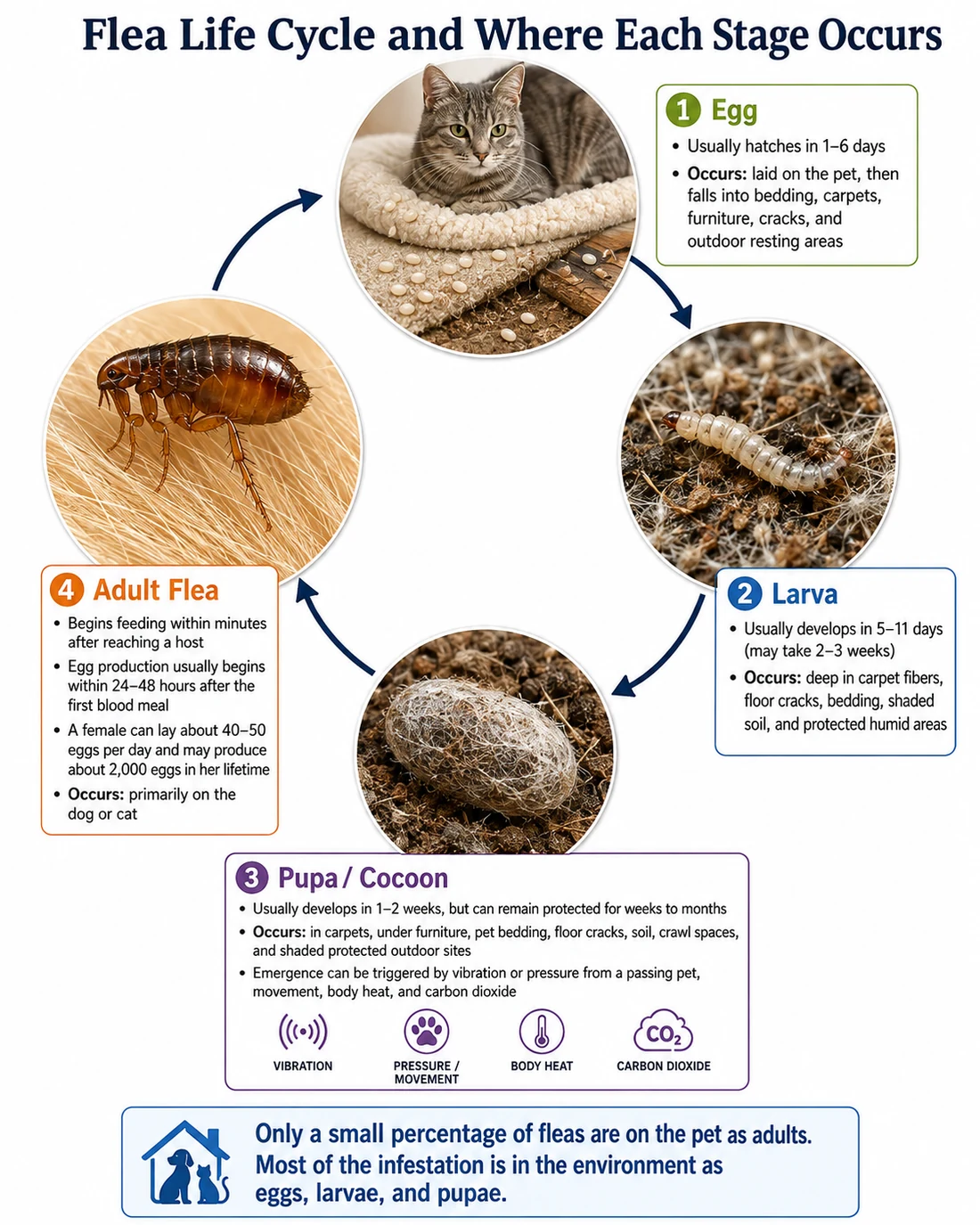
Understanding the flea life cycle is essential because the majority of the infestation is not present on the animal.
| Stage | Typical Development | Common Location | Important Control Measures |
|---|---|---|---|
| Egg | Usually 1–6 days to hatch; development may vary with temperature and humidity. | Laid on the pet but readily falls into bedding, carpets, furniture, cracks, soil, and pet resting areas. | Continuous on-pet flea control, frequent vacuuming, laundering, and insect growth regulators. |
| Larva | Usually about 5–11 days; may extend to approximately 2–3 weeks under less favorable conditions. | Deep in carpet fibers, floor cracks, bedding, shaded soil, beneath vegetation, and other dark protected areas. | Vacuuming, sanitation, IGRs, reduction of organic debris, and targeted environmental treatment. |
| Pupa / Cocoon | Usually about 1–2 weeks to complete pupal development. A fully developed adult can remain protected in the cocoon for weeks and, under favorable conditions, for many months. | Carpet, pet bedding, under furniture, floor cracks, soil, crawl spaces, and shaded protected outdoor sites. | The cocoon is relatively resistant to insecticides. Adult emergence is stimulated by host-associated cues including vibration or mechanical pressure from a passing pet, substrate movement, body heat, and exhaled carbon dioxide. Vacuuming can also stimulate emergence, after which the flea can jump onto a treated pet and be killed. |
| Adult | Begins feeding within minutes after reaching a host. Egg production generally begins within 24–48 hours after the female's first blood meal. Adult fleas commonly survive for 2–3 months on a suitable untreated host. | Primarily on the dog, cat, or other suitable mammalian host. | Credelio Quattro® for dogs; Revolution® Plus for cats; uninterrupted monthly treatment of every household pet. |
This host-triggered emergence explains why people may suddenly see fleas after entering a previously quiet room or why fleas appear as a dog or cat walks through an infested area. The vibration and mechanical pressure produced by a passing pet can trigger flea emergence, while body heat and exhaled carbon dioxide provide additional host cues. This behavior helps the newly emerged adult flea find a host quickly.
Only a small percentage of the total flea population is represented by adult fleas on the pet. Eggs, larvae, and pupae make up the much larger environmental reservoir.
4. Indoor Environmental Control
Environmental control should begin at the same time as on-pet treatment. This reduces the number of immature fleas developing in the household and helps achieve the fastest possible resolution.
Vacuuming
- Vacuum daily during the first 2-3 weeks of a significant infestation.
- Concentrate on carpets, rugs, upholstered furniture, baseboards, cracks, under furniture, and locations where pets rest.
- Empty the vacuum canister outdoors or discard the vacuum bag promptly after cleaning.
- After the initial intensive period, continue regular vacuuming until the infestation is fully controlled.
Laundering
- Wash pet bedding, blankets, removable furniture covers, and washable soft items at least weekly during an active infestation.
- Use the hottest water and dryer settings that are safe for the material.
Insect Growth Regulators
Insect growth regulators such as (S)-methoprene and pyriproxyfen interfere with development of immature flea stages and are valuable components of indoor control. They are available in both targeted spray formulations and whole-room foggers.
For most households, a targeted spray is generally preferred because it can be directed specifically to areas where eggs and larvae are most likely to accumulate, such as pet resting areas, carpets and rugs, upholstered furniture, floor cracks, baseboards, and underneath furniture.
Foggers are often easier to apply because they treat an entire room at once, but they also distribute pesticide over many surfaces where immature fleas are unlikely to be present. They may also penetrate poorly into protected sites such as beneath furniture, deep carpet fibers, and cracks where flea larvae actually develop. For that reason, targeted application generally provides more focused environmental treatment with less unnecessary pesticide exposure.
- Use an EPA-registered premise product labeled for indoor flea control.
- Apply only according to the product label.
- Repeat treatment only as directed by the label or when continuing infestation warrants retreatment.
- Keep pets and people out of treated areas for the labeled re-entry period.
Routine application of loose diatomaceous earth or other airborne desiccant dusts to household carpets is not recommended because inhaled dust can irritate the respiratory tract and more predictable flea-control options are available.
5. Outdoor Environmental Control
Outdoor flea control should focus on locations where flea larvae can survive: shaded, humid, protected areas frequented by pets or wildlife. Flea development is much less likely in exposed, dry, sunny lawn areas.
Target Areas
- Under decks, porches, and crawl spaces
- Shaded areas beneath shrubs and dense vegetation
- Pet resting areas, dog runs, kennels, and outdoor bedding
- Protected soil along fences or foundations
- Areas frequented by wildlife, feral cats, opossums, raccoons, or rodents
Environmental Management
- Remove leaf litter, accumulated organic debris, and unnecessary dense ground cover.
- Keep vegetation trimmed to improve sunlight and drying.
- Limit wildlife access to pet resting areas whenever practical.
- Keep outdoor bedding and shelters clean and dry.
Biological Control
Beneficial entomopathogenic nematodes may be useful as an adjunct in appropriate soil conditions. These microscopic insect-parasitic nematodes are commonly sold at garden centers, nurseries, and online garden suppliers because they are also marketed for control of plant and lawn pests. Products containing species such as Steinernema carpocapsae or Heterorhabditis bacteriophora may help reduce flea larvae in shaded, moist outdoor areas. Because nematodes are living organisms, effectiveness depends on species, storage, soil moisture, temperature, and correct application. Follow the product label carefully.
Outdoor Flea-Control Products
An EPA-registered outdoor premise product labeled for flea control may be applied to identified flea-development areas according to label directions. Treat the areas where fleas are actually developing rather than indiscriminately treating the entire lawn. Keep dogs and cats away from treated areas during application and for the full labeled re-entry period. Extra caution is required with pyrethroid-containing products in households with cats.
6. Flea Dermatitis and Flea Allergy Dermatitis
Two Different Ways Fleas Can Affect the Skin
Fleas can cause skin disease in pets in two distinct ways. Some dogs and cats develop flea dermatitis, which results from the irritation and inflammation produced by repeated flea bites. Other pets develop flea allergy dermatitis (FAD), an allergic hypersensitivity to proteins in flea saliva. In an allergic pet, even a very small number of bites—or sometimes a single bite—can trigger intense itching and significant skin disease.
The distinction is important because a pet with ordinary flea dermatitis generally improves as the number of flea bites is reduced, whereas a pet with FAD requires especially strict, uninterrupted flea control because minimal flea exposure may trigger a disproportionate allergic reaction.
| Condition | Cause | Typical Signs | Mechanism |
|---|---|---|---|
| Flea Dermatitis | Irritation and inflammation caused by repeated flea bites and flea saliva | Mild-to-moderate itching, red bumps, localized inflammation, and possible hair loss | Primarily a local inflammatory response to repeated bites |
| Flea Allergy Dermatitis (FAD) | Allergic hypersensitivity to flea salivary antigens | Often intense itching, hair loss, crusting or scabs, especially over the tail base and caudal body; secondary infection may occur | Allergic hypersensitivity; even very limited flea exposure can produce marked clinical signs |
In flea-allergic patients, even a small number of flea bites can trigger substantial itching. Strict, uninterrupted flea prevention is therefore essential.
Pruritus may continue after flea numbers have fallen because allergic inflammation and secondary bacterial or yeast infection can persist after the triggering bites. Persistent itching warrants veterinary reassessment.
Adjunctive Treatment for Itching
For dogs with substantial flea-allergy pruritus, a veterinarian may use adjunctive therapy such as Cytopoint® (lokivetmab) while flea control and skin healing are established. Cytopoint does not kill fleas.
7. Comprehensive Flea-Control Plan
| Area | Action | Recommended Frequency / Protocol |
|---|---|---|
| Dog | Credelio Quattro® orally with food | Every 30 days, year-round |
| Cat | Revolution® Plus topically | Every 30 days, year-round |
| All household pets | Treat every dog and cat simultaneously | Maintain uninterrupted protection |
| Indoor environment | Vacuum carpets, upholstery, baseboards, pet resting areas, and under furniture | Daily for the first 2-3 weeks of significant infestation, then regularly until controlled |
| Indoor environment | Wash bedding, blankets, and washable soft items | At least weekly during active infestation |
| Indoor environment | Apply an EPA-registered premise product containing an IGR when indicated | According to label directions |
| Outdoor environment | Clean and treat shaded flea-development areas when indicated | As needed according to label and infestation severity |
| Outdoor environment | Professional pest-control service when infestation is extensive or recurrent | As recommended by a licensed or certified pest-control professional |
| Follow-up | Veterinary reassessment | Approximately 4-6 weeks after initiation, or sooner if skin disease is severe |
Clinical Implementation
- Do not miss doses. Even a brief delay can allow newly emerged adult fleas to reproduce.
- Treat every pet. Untreated dogs or cats can maintain the infestation even if they show no obvious signs.
- Expect some flea emergence after treatment begins. Pupae are protected within cocoons and may continue producing adults for weeks.
- FAD patients require especially strict control. A small number of bites may trigger significant pruritus.
- Heavy infestations benefit from simultaneous on-pet therapy, indoor environmental control, and targeted outdoor management.
8. What to Expect After Treatment Begins
| Time Period | Expected Progress |
|---|---|
| First 24-48 hours | Rapid reduction in adult flea burden on treated pets. |
| First several weeks | New fleas may still emerge from environmental pupae. This does not necessarily indicate treatment failure. |
| Approximately 4-8 weeks | Marked reduction in household flea burden when all pets remain continuously protected and environmental control is performed. |
| Approximately 2-3 months | Many established infestations are eliminated with uninterrupted treatment and environmental management. Severe infestations can take longer. |
9. Key Principles
- Use Credelio Quattro® monthly for dogs and Revolution® Plus monthly for cats according to veterinary instructions.
- Treat every dog and cat in the household at the same time.
- Do not allow gaps between monthly doses.
- Begin indoor environmental control at the same time as on-pet treatment.
- Address shaded outdoor flea-development areas and use professional pest-control services when needed.
- Expect continued emergence of some fleas from protected pupae during the early control period.
- Maintain especially strict control in animals with flea allergy dermatitis.
Selected References and Trusted Resources
- U.S. Food and Drug Administration - Credelio Quattro Freedom of Information Summary
- U.S. Food and Drug Administration - Animal Drug Safety-Related Labeling Changes
- U.S. Food and Drug Administration - Isoxazoline Neurologic Safety Communication
- Companion Animal Parasite Council - Flea Guidelines
- Merck Veterinary Manual - Fleas in Dogs and Cats
- Merck Veterinary Manual - Flea Allergy Dermatitis in Dogs and Cats
- AAHA - Management of Allergic Skin Diseases in Dogs and Cats Guidelines
- U.S. Environmental Protection Agency - Controlling Fleas and Ticks Around Pets
Prepared by:
Robert L. Linville, DVM
Veterinary Internal Medicine & Parasitology
For client education purposes