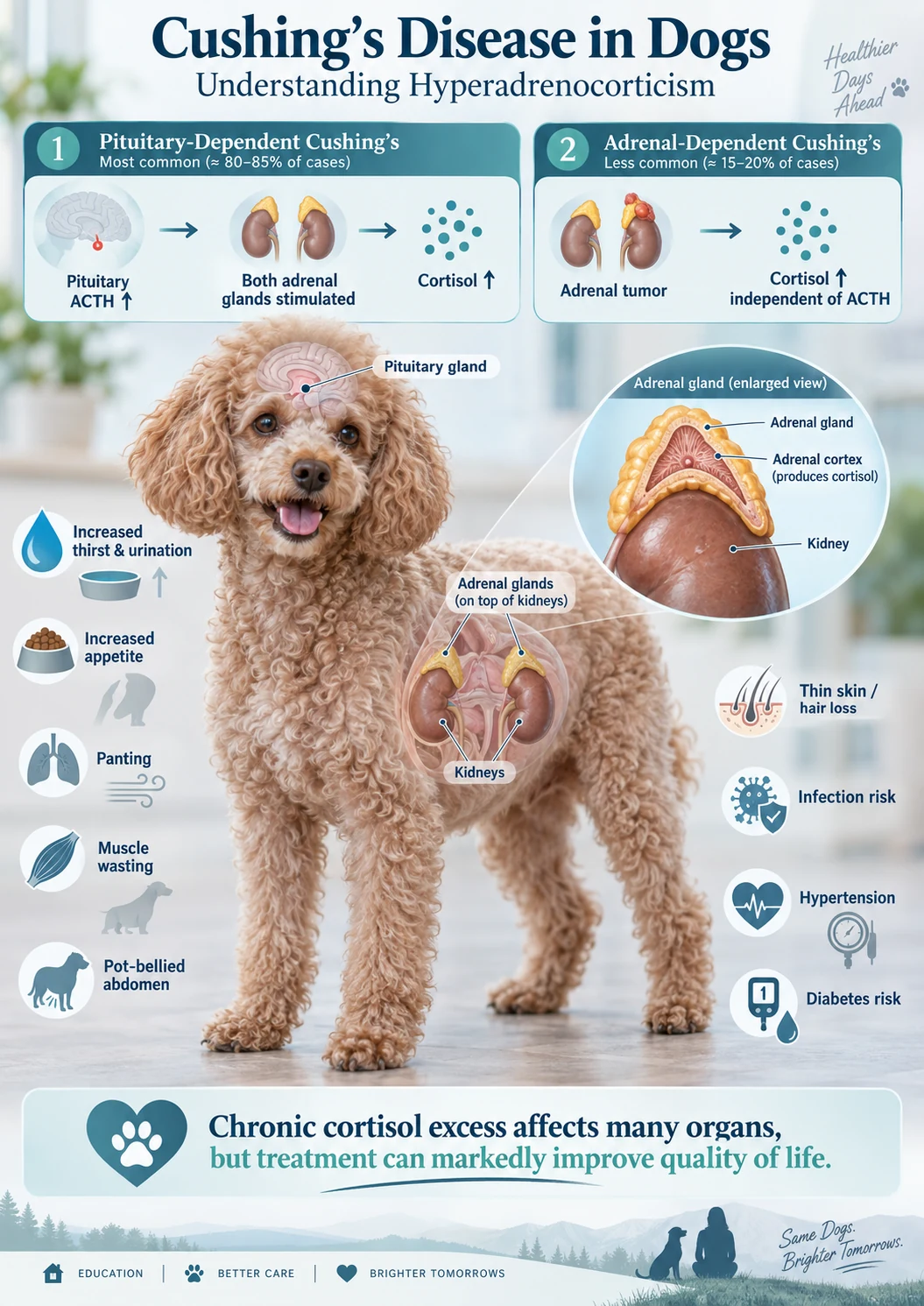
Cushing's Disease in Dogs
Understanding Hyperadrenocorticism
Cushing's disease is a hormonal disorder caused by prolonged exposure to excessive amounts of cortisol. The medical term hyperadrenocorticism describes excessive activity of the adrenal cortex and the resulting overproduction of adrenal hormones, particularly cortisol.
Cortisol is essential for normal life. It helps maintain blood pressure and circulation, supports blood glucose and energy metabolism, modifies inflammation and immune responses, and enables the body to respond appropriately to illness and stress. Problems develop when tissues are exposed to excessive cortisol continuously for months or years.
Cushing's disease usually develops gradually. Increased drinking, increased urination, excessive appetite, panting, thinning of the skin, hair loss, muscle weakness, and development of a pot-bellied appearance may evolve so slowly that they are initially mistaken for normal aging. Its importance lies in the progressive effects of chronic cortisol excess and the complications that can develop if the disease remains uncontrolled.
With appropriate diagnosis, individualized treatment, and regular monitoring, many affected dogs maintain a good quality of life for years.
The Adrenal Glands, Pituitary Gland, and Cortisol
Dogs have two adrenal glands located near the kidneys. The outer portion of each gland, the adrenal cortex, produces cortisol.
Under normal circumstances, cortisol production is controlled by a carefully regulated feedback system. The hypothalamus and pituitary gland in the brain monitor the body's needs. The pituitary releases adrenocorticotropic hormone, or ACTH, which travels through the bloodstream to the adrenal glands and stimulates them to produce cortisol. Rising cortisol concentrations then provide negative feedback to the pituitary and hypothalamus, reducing further ACTH secretion.
Cushing's disease develops when this regulatory system becomes persistently overactive or when an adrenal gland begins producing cortisol independently of normal pituitary control.
Chronic cortisol excess affects nearly every major organ system. It increases glucose production, changes fat distribution, promotes protein breakdown and muscle wasting, alters skin and hair growth, suppresses immune responses, influences kidney water balance, increases susceptibility to infection, and can contribute to hypertension, protein loss through the kidneys, gallbladder disease, diabetes mellitus, and thromboembolic complications.
The Major Forms of Cushing's Disease
Pituitary-Dependent Hyperadrenocorticism
Approximately 80%–85% of naturally occurring canine cases are pituitary-dependent. A usually benign tumor or abnormal population of ACTH-producing cells in the pituitary gland secretes excessive ACTH. Both adrenal glands are continually stimulated and consequently produce too much cortisol.
Most pituitary tumors remain small and cause problems primarily because of excessive hormone production. A smaller proportion enlarge sufficiently to compress surrounding brain tissue. Dogs with a large pituitary tumor may eventually develop neurologic abnormalities such as behavior changes, altered sleep patterns, pacing, circling, decreased responsiveness, vision abnormalities, seizures, or loss of appetite.
Adrenal-Dependent Hyperadrenocorticism
Approximately 10%–15% of naturally occurring cases result from a functional adrenal cortical tumor. In these dogs, one adrenal gland produces cortisol autonomously, without requiring stimulation from pituitary ACTH. The excess cortisol suppresses normal ACTH secretion, so the opposite adrenal gland often becomes smaller because it is no longer being stimulated.
Adrenal tumors may be benign adenomas or malignant adrenal cortical carcinomas. Their behavior, size, relationship to nearby blood vessels, and evidence of spread become particularly important when surgery is being considered.
Iatrogenic Cushing's Syndrome
Cushingoid changes can also result from prolonged administration of corticosteroid medications such as prednisone, prednisolone, dexamethasone, or other glucocorticoids.
Exposure is not limited to tablets and injections. Steroid-containing ear medications, ophthalmic preparations, inhaled products, dermatologic sprays and creams, and repeated injectable corticosteroids can contribute depending on potency, dose, frequency, duration, and absorption.
In these dogs, the external corticosteroid suppresses normal ACTH production, causing the adrenal glands themselves to become less active and often smaller. Treatment requires careful adjustment or withdrawal of the responsible medication when medically possible. Long-term corticosteroids should not be abruptly discontinued without veterinary guidance because the suppressed adrenal glands may be temporarily unable to produce sufficient cortisol.
Predisposition: Age, Breed, and Sex
Cushing's disease occurs primarily in middle-aged and older dogs, with many dogs diagnosed between approximately 7 and 12 years of age. It can, however, occur outside this range.
Pituitary-dependent disease is particularly common in small and medium-sized dogs. Reported predisposed breeds include the Miniature Poodle, Dachshund, Boston Terrier, Bichon Frise, Yorkshire Terrier, Miniature Schnauzer, Jack Russell Terrier, and several other terrier breeds. Miniature Poodles in particular are consistently identified among breeds at increased risk for pituitary-dependent Cushing's disease.
Adrenal-dependent hyperadrenocorticism occurs proportionally more often in medium and larger dogs than pituitary-dependent disease does. Some studies have reported a female predisposition, particularly for adrenal tumors, although sex associations are not consistent enough to use sex as a major diagnostic criterion.
Any breed or mixed-breed dog can develop Cushing's disease. Age, breed, and sex can increase suspicion but cannot establish or exclude the diagnosis.
Symptoms and Clinical Pattern
One of the earliest and most noticeable signs is often increased thirst and urination. Dogs may empty the water bowl more quickly, awaken during the night to drink, request more frequent trips outside, or begin having urinary accidents despite previously reliable house training.
Increased appetite is also common. Dogs may beg constantly, search for food, steal food, or appear unusually hungry shortly after eating. Excessive panting is another frequent complaint and may occur even when the dog is resting in a comfortable environment.
As muscle protein is progressively broken down, dogs can develop weakness and loss of muscle mass, particularly along the spine and limbs. At the same time, abdominal fat accumulates and weakened abdominal muscles allow the abdomen to become pendulous, producing the classic pot-bellied appearance.
The skin may become thin and fragile. Hair growth slows and symmetrical hair loss can develop, particularly over the trunk while the head and lower limbs remain relatively spared. The coat may become dull or fail to regrow normally after clipping.
Some dogs develop recurrent bacterial skin infections, blackheads, increased pigmentation, bruising, or mineral deposits within the skin known as calcinosis cutis. These changes frequently develop over many months, which is one reason Cushing's disease can initially be mistaken for normal aging.
When the Clinical Picture Does Not Fit
Cushing's disease should be diagnosed because a dog has a compatible clinical pattern—not simply because one laboratory value is abnormal.
An increased alkaline phosphatase activity is extremely common in dogs with Cushing's disease but is not specific for the disorder. Liver disease, medications, other endocrine disorders, and many unrelated conditions can also increase this enzyme.
Uncomplicated hypercortisolism generally does not cause acute vomiting, diarrhea, loss of appetite, profound depression, or sudden critical illness. When these signs occur, another illness or a complication of Cushing's disease should be investigated first. Endocrine testing performed during significant unrelated illness can also produce misleading results.
Routine Laboratory Findings
A complete blood count, serum chemistry profile, electrolytes, and urinalysis help determine whether the overall clinical picture supports hyperadrenocorticism and identify concurrent disease.
Common findings can include increased alkaline phosphatase, increased ALT, elevated cholesterol or triglycerides, mild hyperglycemia, and occasionally reduced blood urea nitrogen. The CBC frequently shows a stress leukogram, which may include mature neutrophilia, lymphopenia, eosinopenia, and sometimes monocytosis. Platelet numbers can also be increased.
Urine is frequently dilute because cortisol interferes with normal water conservation. Proteinuria can occur, and urinary tract infection may develop with surprisingly few outward symptoms because excessive cortisol suppresses inflammation. For that reason, selected dogs may benefit from urine culture even when the urine sediment does not appear dramatically inflammatory.
Blood pressure and a urine protein-to-creatinine ratio are also useful in many patients because systemic hypertension and renal protein loss are recognized complications of hypercortisolism.
Diagnosing Cushing's Disease
No single laboratory test diagnoses every dog with Cushing's disease correctly. Endocrine testing works best when it is performed in a dog that already has a convincing combination of clinical signs and supportive routine laboratory abnormalities. False-positive endocrine results become substantially more likely when testing dogs that are stressed, acutely ill, or have little clinical evidence of hypercortisolism.
ACTH Stimulation Test
The ACTH stimulation test evaluates how strongly the adrenal glands respond when they are given synthetic ACTH.
A baseline blood cortisol sample is collected. Synthetic ACTH, usually cosyntropin, is administered, and another cortisol sample is obtained at the laboratory-specified interval, commonly one hour later. A normal adrenal gland increases cortisol production after stimulation. Many dogs with naturally occurring Cushing's disease show an exaggerated cortisol response.
The ACTH stimulation test has several practical advantages. It is substantially shorter than a low-dose dexamethasone suppression test, is straightforward to perform, is the preferred test for identifying iatrogenic Cushing's syndrome, and is particularly useful later for monitoring treatment.
An Important Limitation
A normal ACTH stimulation test does not completely exclude naturally occurring Cushing's disease. The test is less sensitive than the low-dose dexamethasone suppression test, particularly in dogs with adrenal tumors. Therefore, when a dog has a strongly compatible clinical presentation but the ACTH response is not diagnostic, the evaluation should not necessarily stop. Additional endocrine testing—most commonly a low-dose dexamethasone suppression test—may be appropriate.
Abdominal Ultrasound: Determining Where the Disease Originates
Once hyperadrenocorticism has been established, abdominal ultrasound is particularly useful for distinguishing pituitary-dependent disease from an adrenal tumor and is the principal differentiating imaging procedure used in this diagnostic approach.
The ultrasonographer evaluates both adrenal glands carefully rather than looking only for a mass.
In pituitary-dependent disease, chronic ACTH stimulation commonly causes both adrenal glands to become enlarged or prominent while maintaining a relatively similar appearance.
In adrenal-dependent disease, ultrasound may reveal an enlarged or mass-like adrenal gland while the opposite gland is small or atrophied because excessive cortisol has suppressed pituitary ACTH production.
Thus, a dog with confirmed hypercortisolism and bilateral relatively symmetrical adrenal enlargement is more consistent with pituitary-dependent disease, whereas a unilateral adrenal mass accompanied by a small opposite adrenal gland strongly supports adrenal-dependent hyperadrenocorticism.
Ultrasound also provides valuable information beyond classification. The liver, gallbladder, kidneys, urinary bladder, pancreas, and other abdominal organs can be assessed for concurrent abnormalities. With adrenal tumors, the sonographer can look for enlargement of regional lymph nodes, liver lesions, invasion of nearby tissues, or extension of tumor into major vessels such as the caudal vena cava.
Imaging Must Be Interpreted With Endocrine Testing
An adrenal nodule does not automatically mean that an adrenal tumor is causing Cushing's disease. Incidental adrenal nodules and masses become increasingly common in older dogs. Some do not secrete cortisol at all. Conversely, a dog with pituitary-dependent disease can coincidentally have an unrelated adrenal nodule.
For this reason, ultrasound findings must be interpreted together with the dog's clinical signs, ACTH response, routine laboratory findings, and additional endocrine testing when necessary.
When Additional Testing Is Helpful
A low-dose dexamethasone suppression test (LDDST) is a highly sensitive routine screening test and is particularly useful when the ACTH stimulation test is negative despite strong clinical suspicion.
An endogenous ACTH concentration can also assist with differentiation. A dog with pituitary-dependent disease generally has normal or increased endogenous ACTH, whereas a cortisol-producing adrenal tumor suppresses pituitary ACTH and produces a very low concentration. Sample handling is critical because ACTH is unstable.
CT is particularly useful when an adrenal tumor is being considered for surgery because it defines tumor size, vascular invasion, local extension, and surgical anatomy more precisely than ultrasound. CT or MRI of the brain may be indicated in dogs with pituitary-dependent disease that develop neurologic abnormalities or when radiation therapy or pituitary surgery is being considered.
Diseases That Can Resemble Cushing's Disease
Diabetes mellitus may cause excessive drinking, urination, and appetite. Chronic liver disease can increase liver enzymes and alter abdominal appearance. Hypothyroidism can cause lethargy, weight gain, and dermatologic changes. Chronic kidney disease can produce increased drinking and urination. Urinary infection can contribute to inappropriate urination.
Obesity, aging, chronic skin disease, medications, and reduced physical activity can also mimic individual components of the syndrome. The goal is therefore not merely to obtain an abnormal cortisol test but to establish that persistent cortisol excess explains the dog as a whole.
Complications Associated With Cushing's Disease
Persistent cortisol excess can contribute to systemic hypertension and proteinuria, both of which may require specific treatment in addition to controlling the endocrine disease.
Dogs are predisposed to bacterial infections, especially urinary tract and skin infections, because cortisol alters normal immune responses. Some dogs develop insulin resistance and eventually diabetes mellitus. Diabetes can be particularly difficult to regulate until cortisol excess is brought under better control.
Gallbladder mucoceles occur with increased frequency in hypercortisolemic dogs and can occasionally progress to biliary obstruction or gallbladder rupture. Excess cortisol also creates a hypercoagulable state and increases the risk of abnormal blood-clot formation. Pulmonary thromboembolism is an uncommon but potentially life-threatening complication.
Muscle wasting, ligament weakness, poor wound healing, thin skin, and recurrent infections can substantially impair quality of life even when they are not immediately life-threatening.
Treating Pituitary-Dependent Cushing's Disease
Trilostane
Trilostane is currently the principal medical treatment for canine Cushing's disease. It inhibits an enzyme required for adrenal steroid synthesis, thereby reducing cortisol production.
The objective is not to eliminate cortisol. Dogs need cortisol for normal physiology and survival. Treatment aims to reduce excessive production while preserving enough adrenal function for normal circulation, metabolism, gastrointestinal function, and response to stress.
Clinical improvement usually occurs gradually. Excessive thirst and urination and abnormal appetite often improve first. Panting may decrease over subsequent weeks. Muscle mass, abdominal contour, skin thickness, and hair growth generally improve more slowly and may require several months.
Monitoring Trilostane Treatment
Successful treatment depends on balancing two risks: too little treatment, allowing continued damaging cortisol excess, and too much treatment, suppressing adrenal hormone production enough to create hypoadrenocorticism.
Clinical response remains extremely important. Owners should monitor changes in water consumption, urination, appetite, panting, energy, muscle strength, skin and coat, and overall quality of life.
In this monitoring approach, properly timed ACTH stimulation tests are used to assess adrenal response and help ensure that treatment has not become excessive while determining whether persistent clinical signs may reflect inadequate suppression.
Why Timing Should Be Consistent
Trilostane's effect varies during the hours after administration. The ACTH stimulation test should therefore be performed at a consistent, predetermined interval after trilostane administration, using the laboratory and clinician's established protocol. Commonly used protocols begin testing approximately 3–6 hours after medication.
An ACTH response test performed shortly after trilostane administration cannot be compared reliably with another test performed many hours later. Apparent changes in cortisol response may reflect differences in drug timing rather than a true change in adrenal suppression. The time the medication was given and the time testing begins should therefore be documented carefully at every monitoring visit.
Clinical Signs and ACTH Testing Must Be Considered Together
ACTH-stimulated cortisol does not correlate perfectly with the degree of clinical control in every trilostane-treated dog. Consequently, a dose should not be increased simply to force a cortisol concentration into a particular numerical range when the dog is already clinically well controlled.
The ACTH stimulation test is particularly useful for determining whether adrenal cortisol production has become too suppressed because it directly evaluates adrenal reserve. Conversely, a dog that still drinks excessively, urinates frequently, pants heavily, remains ravenously hungry, or shows little clinical improvement despite an adequate treatment period should be reassessed for persistent hypercortisolism, dose or dosing-interval issues, medication administration problems, or concurrent disease.
Early Rechecks
Early monitoring is particularly important after beginning trilostane or changing the dose. An initial reassessment is commonly performed at approximately two weeks, followed by another assessment several weeks later and then at progressively longer intervals once the dog is stable.
The earliest recheck is especially important for making certain that cortisol production has not become excessively suppressed. Persistent Cushingoid signs early in therapy do not automatically indicate that the dose should immediately be increased because many clinical manifestations take time to improve.
Once the patient is stable, periodic clinical examinations, consistently timed ACTH stimulation testing, serum chemistry and electrolytes, urinalysis, blood pressure, UPC, or other testing can be individualized according to the dog's disease and concurrent medical problems.
Warning Signs During Trilostane Therapy
Owners should understand the symptoms of excessive adrenal suppression.
Severe weakness, collapse, persistent vomiting or diarrhea, dehydration, abnormal heart rhythm, or signs of shock require urgent veterinary assessment.
Treating an Adrenal Tumor
For a dog with a functional adrenal tumor that appears surgically resectable and whose overall health makes surgery reasonable, adrenalectomy offers the possibility of definitive treatment and is generally considered the preferred treatment for appropriate adrenal-dependent cases.
Adrenal surgery is more technically demanding than many routine abdominal procedures because the adrenal glands lie near major blood vessels and other important structures. Some adrenal tumors invade or form thrombi within the caudal vena cava, substantially increasing surgical complexity.
Advanced imaging, particularly CT, is often used before surgery to define the tumor and determine whether vascular invasion or metastatic disease is present. Dogs that are not surgical candidates, whose owners decline surgery, or whose tumors cannot be removed may be managed medically with trilostane.
Pituitary Tumors and Neurologic Disease
Most dogs with pituitary-dependent Cushing's disease never develop neurologic signs from their pituitary tumor.
When a pituitary mass enlarges substantially, neurologic abnormalities may eventually become more important than cortisol excess itself. Changes can include altered behavior, pacing, disorientation, abnormal sleep patterns, decreased interaction, visual abnormalities, circling, seizures, or loss of appetite.
MRI or CT of the brain is indicated when a pituitary macrotumor is suspected. Radiation therapy can reduce or control pituitary tumor growth in selected dogs. Hypophysectomy—surgical removal of the pituitary gland—is available at a limited number of specialty centers and can be considered in carefully selected patients.
Iatrogenic Cushing's Disease
When Cushingoid changes result from corticosteroid administration, treatment differs fundamentally from naturally occurring disease.
The source of excessive glucocorticoid exposure must be identified. This includes reviewing oral and injectable medications as well as ear, eye, skin, and inhaled products.
The medication may need to be gradually reduced or replaced when medically possible. Abrupt withdrawal after prolonged adrenal suppression can cause dangerous cortisol deficiency.
The ACTH stimulation test is particularly useful in suspected iatrogenic Cushing's disease because prolonged exogenous steroid exposure suppresses adrenal responsiveness, often producing low baseline and stimulated cortisol concentrations.
Monitoring at Home
Owners provide some of the most valuable information in determining whether treatment is working.
Water consumption should gradually approach normal. Urinary accidents or nighttime urination should decrease. Appetite should become less excessive. Panting often improves. Activity and muscle strength may gradually return.
Skin and hair changes take substantially longer. New hair growth may require several months, and improvement may be uneven initially.
Keeping a simple record of water intake, appetite, urination, panting, activity, medication administration, and unusual gastrointestinal signs can make follow-up visits considerably more informative.
Dogs should receive trilostane consistently according to veterinary instructions, including recommendations regarding administration with food. Medication should never be increased, decreased, stopped, or restarted solely on the basis of an owner's interpretation of symptoms or a single cortisol value without veterinary guidance.
Prognosis
The prognosis for Cushing's disease varies with the form of disease, the patient's age, concurrent conditions, and treatment response.
Many dogs with pituitary-dependent disease respond well to trilostane and maintain a good quality of life for years. Treatment controls the consequences of excessive cortisol but does not usually eliminate the underlying pituitary tumor.
Dogs with successfully removed benign adrenal tumors may potentially be cured of hypercortisolism. Prognosis for malignant adrenal tumors depends on local invasion, completeness of removal, metastatic disease, and surgical complications.
Concurrent diabetes mellitus, kidney disease, hypertension, proteinuria, gallbladder disease, serious infection, thromboembolism, or a large pituitary tumor can significantly influence outcome.
Cushing's Disease in Cats
Hyperadrenocorticism occurs in cats but is far less common than in dogs. Affected cats frequently have concurrent diabetes mellitus, and one of the more characteristic manifestations of feline hypercortisolism is extremely thin, fragile skin that may tear with minimal trauma.
Because feline Cushing's disease is uncommon and diagnostic interpretation and treatment differ in several respects from canine disease, suspected feline cases generally require individualized endocrine evaluation and often benefit from internal-medicine consultation.
Additional Resources
Veterinary and Professional Resources
American Animal Hospital Association — Canine Hypercortisolism Guidelines
Professional guidance concerning recognition, endocrine testing, differentiation, trilostane treatment, and monitoring of canine hypercortisolism.
Cornell University College of Veterinary Medicine — Canine Adrenal and Pituitary Function Tests
Detailed laboratory protocols for ACTH response testing, dexamethasone suppression testing, endogenous ACTH measurement, and trilostane monitoring.
The Schwarzman Animal Medical Center — Cushing's Disease in Dogs
An owner-oriented review from a major veterinary specialty hospital covering the major forms of Cushing's syndrome, clinical signs, diagnosis, and therapy.
The Schwarzman Animal Medical Center — Internal Medicine
Board-certified internal medicine specialists managing diseases of the adrenal glands, pituitary gland, thyroid, pancreas, and other internal organ systems.
MSD Veterinary Manual — Cushing Syndrome (Hyperadrenocorticism)
Comprehensive professional review of pathophysiology, diagnosis, imaging, treatment, and prognosis.
Today's Veterinary Practice
Peer-reviewed veterinary information concerning diagnosis and treatment of canine hyperadrenocorticism.
Clinician's Brief
Professional clinical reviews addressing diagnosis, endocrine testing, trilostane therapy, monitoring, and complications of canine hyperadrenocorticism.
Current Cushing's Resources From the Pet Health Directory
Cornell University College of Veterinary Medicine — Cushing's Syndrome
A detailed university-based owner resource discussing causes, pituitary- and adrenal-dependent disease, breed predisposition, clinical signs, diagnostic testing, treatment, and prognosis.
Cushing's in Dogs — Canine Hyperadrenocorticism Information
An extensive owner-oriented informational site devoted specifically to canine Cushing's syndrome. This resource is supplementary to veterinary, university, and professional sources.
Mar Vista Animal Medical Center — Cushing's Disease Information Center
A detailed veterinary educational resource covering symptoms, laboratory findings, confirmation of Cushing's syndrome, differentiation of pituitary versus adrenal disease, trilostane and other treatments, pituitary macroadenomas, and adrenal tumors.
This article provides general educational information for pet owners and is not a substitute for examination, diagnosis, or treatment by a veterinarian. Cushing's disease should be diagnosed by interpreting the dog's history, clinical signs, physical examination, routine laboratory findings, endocrine testing, imaging, medications, and concurrent diseases together. Dogs receiving trilostane require regular veterinary monitoring. A treated dog that develops loss of appetite, vomiting, diarrhea, marked lethargy, weakness, trembling, collapse, or other significant illness should receive prompt veterinary evaluation because excessive adrenal suppression can become serious or life-threatening.