Chelonian Husbandry & Preventive Care
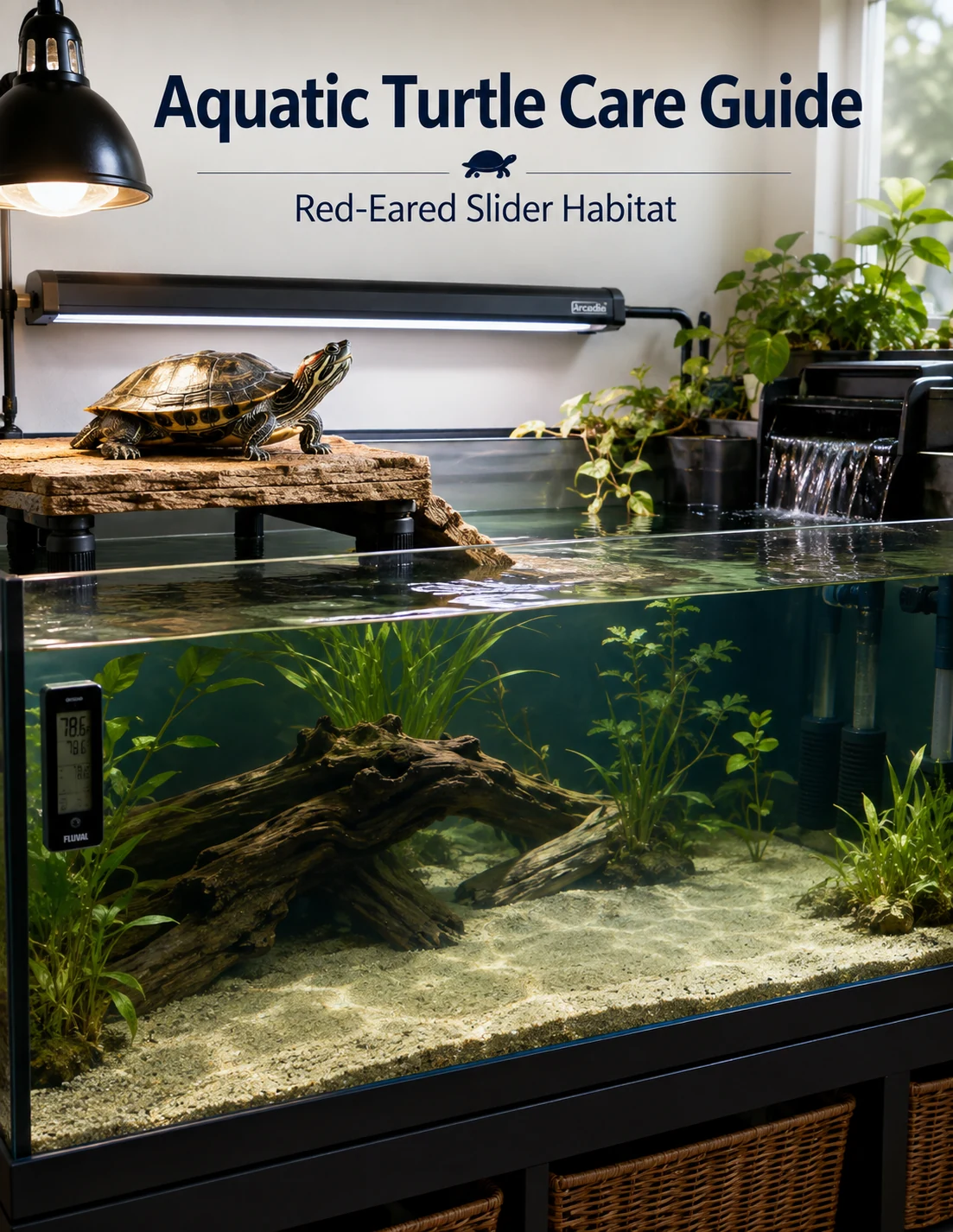
Aquatic Turtle Care Guide
Comprehensive husbandry guidance for freshwater and semi-aquatic turtles, organized around the same 17 ecological and taxonomic groups used in the companion Aquatic Turtle Diet Guide. The guide emphasizes usable water volume, species-appropriate depth, filtration and water chemistry, dry basking and shell drying where biologically appropriate, UVB and daylight, temperature, land and nesting access, drowning prevention, outdoor ponds, biosecurity, preventive care, and important species-specific differences.
Quick Care Guide
Start with species identification, then design the water. Water depth that is ideal for a slider may be dangerous for a weak-swimming mud turtle, inappropriate for a spotted turtle that requires extensive land, and physiologically irrelevant to a mata mata that normally walks the bottom of shallow water.
| Care area | Practical starting principle | Important qualification |
|---|---|---|
| Water volume | Use the largest practical body of water, with enough room for exercise and a stable thermal/water-quality environment. | The familiar “10 US gal per inch of shell” rule is only a rough minimum heuristic for strong-swimming pond turtles, not a universal rule. |
| Depth | Provide enough depth for normal swimming and easy righting, plus resting structures near the surface. | Musk, mud, spotted, bog, mata mata, hatchlings, debilitated turtles, and some semiterrestrial groups need shallower or more highly structured water. |
| Filtration | Use oversized mechanical and biological filtration and regular partial water changes. | Turtles produce substantially more solid and nitrogenous waste than an equivalently sized fish community. A filter never eliminates the need for water changes. |
| Water chemistry | Maintain ammonia at 0 and nitrite at 0; keep nitrate as low as practical and stable. | pH, hardness, salinity, and conductivity should be matched to species and source-water needs rather than forced to one universal number. |
| Basking | For basking species, provide a completely dry, easily accessible platform large enough for the entire turtle. | Highly aquatic species such as mata matas and pig-nosed turtles do not use a classic slider-style dry dock in the same way; egg-laying females still need nesting land. |
| UVB | Provide measured UVB and bright daylight over the principal basking/haul-out zone. | Open-basking emydids commonly use UVI ~3–4; cryptic/bottom-dwelling and forest species may require lower exposure. Avoid invented precision when species data are lacking. |
| Water heat | Use a protected aquarium heater only if room/climate conditions require one. | Temperate adults often benefit from cooler water than hatchlings; tropical side-necks and pig-nosed turtles require warmer water. |
| Electrical safety | Use GFCI/RCD protection, drip loops, grounded equipment, guarded heaters, and secure cords. | Water, large pumps, immersion heaters, and suspended lamps create serious electrical and burn hazards when installation is improvised. |
| Social housing | One turtle per enclosure is safest. | Aggression, food competition, mating trauma, and underwater pinning can cause severe injury or drowning even in species that aggregate in nature. |
| Nesting | Every mature female of an egg-laying species must have suitable nesting substrate. | A fully aquatic life does not eliminate the need for land at oviposition. |
| Nutrition | Use the Aquatic Turtle Diet Guide. | Diet varies from herbivore-leaning cooters and river turtles to molluscivorous terrapins/maps and strongly carnivorous softshells/long-necks. |
Diversity, Taxonomy, and Terminology
Aquatic and semi-aquatic turtles are members of Testudines from many unrelated families. The 17 groups in this guide include Emydidae, Kinosternidae, Chelydridae, Trionychidae, Geoemydidae, Pelomedusidae, Chelidae, Podocnemididae, and Carettochelyidae. Similar-looking turtles can therefore have very different physiology and habitat requirements.
Terrapin is a common-name term rather than a formal taxonomic category. The diamondback terrapin is included here because it is a brackish-water emydid. Side-neck turtles bend the neck sideways under the shell rather than retracting it vertically; African pelomedusids and Australasian/South American chelids are not husbandry equivalents despite sharing pleurodiran anatomy.
Sea turtles are not included. They require licensed wildlife rehabilitation or professional zoological facilities.
Natural History and Ecological Husbandry Types
- Open-basking pond swimmers: sliders, cooters, painted turtles, and many map turtles need large swimming volumes, a strong dry basking site, and abundant UV/daylight.
- Brackish estuarine turtles: diamondback terrapins require salinity and water-quality planning in addition to normal basking-turtle husbandry.
- Shallow-water bottom walkers: musk and mud turtles often use submerged logs, roots, ledges, and shallow wetlands more than featureless deep water.
- Large ambush predators: snapping turtles require very large custom systems, robust filtration, solitary housing, and safe handling plans.
- Soft-bodied river/lake turtles: softshells need pristine water, nonabrasive sand, huge swimming area, and minimal skin/shell trauma.
- Wetland mosaics: spotted, bog, Blanding’s, and wood turtles require substantial land or shallow marsh structure rather than a conventional deep aquarium.
- Tropical Asian pond/temple turtles: range from typical aquatic Mauremys to very large shoreline-using Heosemys; one “Asian pond turtle” setup is inappropriate.
- Semiterrestrial tropical wood turtles: many Rhinoclemmys need more land and forest-floor humidity than water volume.
- African seasonal-wetland side-necks: Pelomedusa and Pelusios differ in permanency of water and seasonal drying.
- South American chelids: range from active Phrynops to the highly specialized shallow-water mata mata.
- Large tropical river turtles: podocnemidids need zoo-scale water and nesting areas when adults.
- Australasian chelids: long-necked carnivores and short-necked omnivores/herbivores require different water structure and feeding ecology.
- Fully aquatic pig-nosed turtle: a giant tropical river turtle with flipper-like limbs, leathery skin, and almost no routine terrestrial activity except nesting.
Before the Turtle Arrives
- Confirm exact species, sex if known, age/size, geographic origin, captive-bred versus wild-caught history, and previous water chemistry.
- Ask for prior water temperature, depth, basking temperature, UVB, diet, filtration, salinity, hibernation/seasonal history, and reproductive history.
- Run the enclosure for several days before arrival so the nitrogen cycle, temperature, salinity where relevant, pumps, drains, and basking equipment can be checked.
- Have a quarantine system completely separate from established turtles. Aquatic quarantine means separate water, filters, nets, siphons, hoses, and buckets.
- Locate a veterinarian experienced with chelonians before an emergency.
Captive Origin, Conservation, and Legal Possession
Freshwater turtles are among the most threatened vertebrate groups. Prefer documented captive-bred animals. Do not remove healthy native turtles from the wild, and never release a long-term captive turtle into a natural waterway.
Red-eared sliders are invasive in many regions because of pet releases. Bog turtles, several Asian river turtles, pig-nosed turtles, multiple softshells, and large river turtles may be protected by national, state, provincial, or CITES regulations. Verify the law before purchase, transport, breeding, sale, or interstate/international movement.
The United States prohibits sale and distribution of turtles with a carapace shorter than 4 in (10.2 cm) as pets, although larger turtles can also carry Salmonella.
Aquatic Enclosure Design
For most aquatic turtles, the enclosure is best thought of as a small managed pond. It must provide enough water for normal locomotion, a reliable route to the surface, a species-appropriate haul-out or shoreline area, filtration, a thermal gradient, daylight/UVB, secure boundaries, and safe access for cleaning.
Enclosure types
- Glass aquarium: visually attractive but heavy and expensive at adult turtle sizes.
- Stock tank / Waterland-style tub: often more practical for large turtles, easier to plumb, and less visually stressful because of opaque walls.
- Custom fiberglass/PVC pond: excellent for large or species-specific systems when structurally supported.
- Outdoor pond: often best for large temperate pond turtles when climate and predator control are appropriate.
- Paludarium / wetland table: better than a deep tank for spotted turtles, bog-type wetland species, wood turtles, and semiterrestrial Rhinoclemmys.
Calculate structural load before placing hundreds of gallons indoors. One US gallon of fresh water weighs about 8.34 lb (3.78 kg per 3.78 L) before adding the enclosure, substrate, rocks, filter, stand, and turtle.
Water Volume, Depth, and Swimming Space
The older veterinary rule that a turtle should be able to swim four to five body lengths before turning remains a useful concept. Modern welfare-oriented husbandry generally provides much more water than older minimum aquarium sizes.
For a strong-swimming slider, the commonly used minimum heuristic is roughly 10 US gal (38 L) of water per inch (2.5 cm) of shell length. A 10 in (25 cm) adult therefore needs at least about 100 US gal (379 L) of actual water, with land area additional. This should not be applied blindly to all turtles.
- Strong swimmers: sliders, cooters, painted turtles, most maps, many river turtles — deep water is appropriate when surface resting sites are available.
- Bottom walkers / weaker vertical swimmers: musk and mud turtles — use moderate depth plus abundant submerged branches, ledges, plants, and ramps so the turtle can reach air without prolonged open-water swimming.
- Spotted/bog/wood turtles: shallow water plus substantial land or marsh structure.
- Mata mata: shallow enough that the adult can stand/walk and extend the neck to breathe; open deep swimming water is not its natural mode.
- Softshells: need generous open water but also fine sand and areas shallow enough for burying with the snout at/near the surface.
- Pig-nosed turtles: powerful open-water swimmers requiring zoo-scale volumes as adults.
Dry Basking Platforms, Shoreline, and Nesting Land
Most commonly kept pond turtles need a platform on which the entire turtle can leave the water, become completely dry, warm, and receive UVB. The platform must be stable and easy to climb onto without trapping the turtle underneath.
Heat and UVB should overlap over the main basking zone. Floating docks suitable for juveniles are often too small or unstable for adults. Above-tank basking lofts and integrated land sections preserve swimming volume while allowing large dry platforms.
Not every aquatic species uses a slider-style dock
Mata matas, some softshells, and pig-nosed turtles spend nearly all ordinary activity in water. Their enclosure should still provide appropriate shallow/resting structure and daylight, but a forced steep dry platform can be biologically irrelevant. Every mature female that lays eggs must nevertheless have access to species-appropriate nesting substrate.
Filtration and Circulation
Turtles generate large quantities of feces, urates, shed keratin, food debris, and dissolved nitrogenous waste. Filtration should be sized more aggressively than for a conventional ornamental-fish aquarium.
- Mechanical filtration: removes solids before they decompose.
- Biological filtration: supports nitrifying bacteria that convert toxic ammonia to nitrite and then nitrate.
- Chemical filtration: activated carbon or specialty media can be useful for selected contaminants but is not a substitute for biological filtration and water changes.
- Canister filters: practical for many indoor systems; current specialist care commonly recommends filters rated for roughly 2–3 times the actual turtle-water volume.
- Sumps, bead filters, pond filters: often more practical for stock tanks, outdoor ponds, large softshells, snapping turtles, and group systems.
- Intake safety: screen intakes so toes, tails, necks, and hatchlings cannot be trapped.
Flow should match the species. Riverine map and softshell turtles may use more current than mata matas, spotted turtles, or marsh-dwelling species.
Water Quality and Routine Testing
Clear water is not necessarily safe water. A mature biofilter and routine testing are required because ammonia and nitrite can be present before water looks dirty.
| Parameter | General target | Notes |
|---|---|---|
| Ammonia | 0 ppm | Any persistent measurable ammonia indicates inadequate biological filtration, overstocking, overfeeding, or an immature/disrupted biofilter. |
| Nitrite | 0 ppm | Persistent nitrite indicates incomplete nitrification. |
| Nitrate | Keep low and stable through partial water changes | There is no defensible single universal nitrate cutoff for all turtle systems; lower is generally preferable. |
| Chlorine/chloramine | 0 before turtle exposure | Use a conditioner or treatment appropriate to the local water supply. |
| pH / hardness | Species-appropriate and stable | Avoid chasing arbitrary numbers with rapid chemical changes. Terrapins and specialized river turtles may have different requirements. |
| Salinity | Species/provenance-specific | Required monitoring for diamondback terrapins and some estuarine/river terrapins; use a refractometer or reliable conductivity/salinity meter. |
Perform regular partial water changes even with excellent filtration. Siphon trapped debris from substrate and dead zones. Match replacement water temperature reasonably closely to the existing water and avoid abrupt chemistry changes.
Water Temperature
The older Lafeber veterinary handout gives a broad 72–82°F (22–28°C) water range for many aquatic and semi-aquatic turtles, while current sources refine that substantially by species and age. Temperate adult sliders and painted turtles often thrive in the low-to-mid 70s°F (low-to-mid 20s°C), whereas hatchlings are usually kept warmer and tropical side-necks/pig-nosed turtles require warmer water.
Do not keep water chronically warm merely to increase appetite. Excessively warm water reduces the thermal incentive to bask, increases microbial growth, reduces dissolved oxygen, and can contribute to chronic shell/skin problems.
If a heater is needed, it must be guarded so the turtle cannot contact or break it. Use an independent thermometer; do not assume the heater dial is accurate.
Basking and Air Temperature
For open-basking pond turtles, basking air is commonly in the upper 80s to low 90s°F (about 30–33°C), with the actual dry surface often warmer. Current ReptiFiles guidance for red-eared sliders uses a basking-air target of 85–90°F (30–32°C) and a broad surface temperature near 104°F (40°C). Painted turtles are commonly maintained with basking surfaces around 95–104°F (35–40°C).
These values should not be transferred to cool wetland species or every tropical turtle. Spotted turtles use a more modest basking area around 86–90°F (30–32°C). The correct endpoint is normal voluntary basking, full shell drying where appropriate, normal appetite/activity, and easy access to cooler water.
Measuring Temperatures Correctly
| Tool | Use | Common mistake |
|---|---|---|
| Submersible digital thermometer | Continuous water-temperature measurement. | Relying on heater dial alone. |
| Digital probe thermometer | Basking air or platform surface at turtle height. | Placing probe near lamp rather than where shell actually rests. |
| Infrared thermometer | Mapping basking-surface temperatures. | Using it to measure water temperature or reflective surfaces inaccurately. |
| UV Index meter | Measures biologically relevant UV at shell height. | Assuming bulb percentage or lamp age equals actual UVI. |
| Water test kit / meter | Ammonia, nitrite, nitrate, pH; salinity where needed. | Waiting until water looks or smells bad. |
UVB, UVA, and Visible Light
Diurnal basking turtles should receive a daylight environment that combines heat, bright visible light, UVA, and UVB over the principal basking zone. UVB is important for vitamin-D physiology and calcium metabolism; visible light and solar-like heating also influence activity and behavior.
Current evidence-based lighting guidance places red-eared sliders and many similar open-basking emydids in a range around UVI 3–4 at the top of the shell on the basking site. Painted and spotted turtles are commonly managed in the same approximate measured UVI range. Dense shade and low-UVI retreat must remain available.
For cryptic bottom-dwelling, nocturnally active, forest, or species with poorly studied exposure, do not invent a universal UVI. Provide broad-spectrum daylight, a lower measured UV zone when appropriate, and refine according to current species-specific veterinary/zoological data.
Glass and most ordinary clear plastics block useful UVB. Sunlight through a window is not equivalent to outdoor sunlight.
UV Cards and UV Index Meters
UV-sensitive cards can confirm that some ultraviolet energy is present but cannot reliably tell whether a turtle is receiving UVI 1, 2, 3, or 4. A reptile-appropriate UV Index meter such as a Solarmeter 6.5/6.5R or equivalent is the preferred quantitative tool.
Measure at shell height on the actual basking platform with the normal mesh/screen in place. Recheck after lamp replacement, fixture changes, or changes in platform height.
Substrate and Bottom Design
A bare bottom is easy to clean and can be appropriate for quarantine, medical care, or some strong-swimming pond turtles. Natural substrate provides behavioral opportunities but increases maintenance.
- Fine sand: important for softshells and useful for many bottom-foraging turtles; choose smooth washed sand and maintain it with siphoning.
- Large smooth river stones: can create texture when too large to swallow, but trap debris and add enormous weight.
- Small gravel: can be swallowed and should generally be avoided.
- Leaf litter / mud simulation: useful in carefully managed shallow wetland systems for spotted, bog-type, mata mata, and some side-neck turtles, but organic buildup must not destroy water quality.
Softshells need nonabrasive substrate because their leathery carapace and plastron can ulcerate against rough surfaces.
Furnishings, Resting Structure, Plants, and Enrichment
- Submerged logs and shelves that allow musk/mud turtles to rest near the surface.
- Large driftwood/log basking areas for map turtles and pond species.
- Aquatic plants and floating vegetation for cover, foraging, and visual barriers.
- Shallow vegetated margins for juveniles and wetland turtles.
- Open swimming lanes for sliders, cooters, softshells, river turtles, and pig-nosed turtles.
- Fine sand for burying softshells.
- Leaf/debris structure and broad bottom area for mata mata ambush behavior.
- Multiple visual barriers when more than one turtle is temporarily/professionally housed together.
Every heavy rock or log must be stable. Turtles dig, wedge, climb, and push with surprising force.
Outdoor Ponds
For suitable temperate species, a properly designed outdoor pond can provide space, natural sunlight, seasonal variation, and enrichment that are difficult to duplicate indoors. It also creates predator, escape, weather, and disease risks.
- Use secure perimeter fencing that extends below ground and cannot be climbed.
- Protect against dogs, raccoons, coyotes, rats, birds, and human interference.
- Provide deep shade as well as sun; avoid a pond that becomes uniformly hot.
- Include shelves/ramps and emergency exit routes from deep water.
- Prevent overflow from allowing escape during storms.
- Use pond filtration and monitor water chemistry rather than assuming outdoor water self-cleans.
- Do not connect a captive turtle pond to a natural stream or storm drain.
- Never release pet turtles, fish, plants, snails, or pond water containing nonnative organisms into the environment.
Electrical, Heater, Pump, and Plumbing Safety
- Use a GFCI (North America) or equivalent RCD-protected circuit for equipment near water.
- Create drip loops on every power cord.
- Use heater guards or external/in-line heating so a turtle cannot touch or break a heater.
- Secure pumps and plumbing so the turtle cannot dislodge hoses and drain the enclosure onto the floor.
- Cover filter intakes and overflow openings to prevent entrapment.
- Support suspended heat/UV fixtures independently from flimsy screen tops.
- Design floor drains and water-change hoses so contaminated turtle water cannot backflow into potable plumbing.
Handling and Bite Safety
Handle aquatic turtles only when necessary. Support the shell securely with both hands and keep the turtle low over a safe surface. Wash hands afterward.
Never hold a snapping turtle or large softshell by the tail; this can injure the spine and pelvis. Snapping turtles, softshells, large side-necks, and pig-nosed turtles can deliver serious bites. Use trained restraint techniques and appropriate containers rather than attempting casual manual control.
Drowning, Entrapment, and Righting Safety
Aquatic turtles can drown. Risk rises when the turtle is weak, chilled, neurologically impaired, trapped beneath a platform, entangled in décor, pinned by another turtle, or unable to find a resting site near the surface.
- Ensure every platform is stable and cannot collapse or trap the turtle.
- Provide surface-rest structures for small juveniles and weak swimmers.
- Do not use deep featureless water for mud/musk/spotted turtles simply because they are “aquatic.”
- Protect suction intakes, narrow pipe openings, and gaps behind décor.
- Observe new or ill turtles swimming before leaving them in deep water unattended.
Normal Behavior
- Basking: sliders, cooters, painted turtles, maps, many pond turtles, and some side-necks bask conspicuously.
- Bottom walking: musk turtles, mud turtles, mata matas, and several side-necks may spend long periods moving or resting on the bottom.
- Burial: softshells commonly bury in sand with the head/snorkel exposed.
- Seasonal terrestrial movement: wood, spotted, bog, mud, and several pond turtles may leave water for nesting, aestivation, migration, or overwintering.
- Shyness: many map turtles dive immediately when disturbed; chronic refusal to bask can result from poor visual security.
- Surfacing: normal turtles should surface smoothly. Repeated tilted floating, inability to submerge, gasping, or persistent asymmetric buoyancy is abnormal.
Sex Identification
Sex characteristics vary by group. Mature male sliders, painted turtles, and some cooters/maps often have longer foreclaws and longer/thicker tails with the cloaca farther from the shell. Female map turtles can be dramatically larger and broad-headed. Male side-necks and some other groups have different tail/plastron proportions.
Juveniles may be impossible to sex reliably. Do not use one generic “long claws = male” rule across all aquatic turtles.
Reproduction and Nesting
Females can develop follicles and eggs without a male. A mature female must have access to a secure land area with diggable substrate deep enough for normal nesting behavior.
Persistent escape behavior, repeated digging without laying, anorexia, hind-limb weakness, straining, unusual buoyancy, or abdominal enlargement can indicate reproductive disease. Current veterinary guidance recognizes postovulatory dystocia, preovulatory follicular stasis, ectopic eggs, and yolk coelomitis as common reptile surgical problems.
Large river turtles, softshells, and pig-nosed turtles may require extensive sandy nesting banks rather than a small box of substrate. Conservation-sensitive species should not be bred without legal provenance and a managed plan for offspring.
Species-Group Husbandry Comparison
The values below are practical starting ranges, not rigid prescriptions. Where reliable modern captive data exist, they are used directly. Where they do not, the guide gives a conservative provisional range derived from natural history and husbandry of close ecological analogues and labels it accordingly.
| Group | Approximate adult size | Water / land design | Temperature starting point | UV / special issue |
|---|---|---|---|---|
| Sliders | Red-eared slider up to ~12 in (31 cm) | Strong swimmer; ≥100 US gal (379 L) water for typical adult, larger for large females; full dry dock | Adult water commonly ~74–76°F (23–24°C); basking air 85–90°F (30–32°C), surface ~104°F (40°C) | UVI ~3–4; invasive-release risk |
| Cooters / red-bellies | Some females to ~17.2 in (43.7 cm) | Very large pond/stock tank; deep open swimming water and large dry basking site | Provisional water ~72–78°F (22–26°C); bask ~90–95°F (32–35°C) | UVI ~3–4; many adults strongly herbivorous |
| Painted turtles | ~4–10 in (10–25 cm), form dependent | Large pond/aquarium; strong swimming; full dry dock | Adults ~70–76°F (21–24°C), juveniles ~78–80°F (25–27°C); bask ~95–104°F (35–40°C) | UVI ~3–4 |
| Map turtles | Common map males ~3.5–6.5 in, females ~7–10.5 in (9–27 cm) | River/lake style, large open water, logs, clean oxygenated water | Provisional ~72–78°F (22–26°C); bask ~90–95°F (32–35°C) | UVI ~3–4; extreme sexual size differences |
| Diamondback terrapin | Moderate-size, females substantially larger | Large brackish-water system, dry basking, nesting sand; monitor salinity | Provisional adult water ~74–80°F (23–27°C); bask ~88–95°F (31–35°C) | UVI ~3–4; estuarine osmoregulation and very clean water |
| Musk turtles | Most ~3–6 in (8–15 cm) | Moderate-depth water with many underwater rest points; dry basking available | Provisional water ~72–78°F (22–26°C); bask ~85–90°F (29–32°C) | Lower-moderate UV with shaded access; bottom-walking ecology |
| Mud turtles | Many ~3–5 in (8–13 cm) | Shallow/moderate water plus substantial land/burrow zone | Provisional water ~72–78°F (22–26°C); bask ~85–90°F (29–32°C) | Seasonal terrestrial activity; not deep-featureless aquarium turtles |
| Snapping turtles | Common ~8–18.5 in (20–47 cm); alligator snapper much larger | Very large custom pond/stock tank; solitary; robust bottom structure | Temperate water usually low-mid 70s°F (low-mid 20s°C) in captivity; modest bask/shore access | Powerful bite; zoo-scale for large species |
| Softshells / flapshells | ~6 in to >24 in (15 to >61 cm), species/sex dependent | Huge open water, fine sand, no abrasive décor; bask/shore access as species uses | Provisional temperate Apalone ~72–78°F (22–26°C); tropical species warmer | Delicate leathery shell; pristine water |
| Spotted/pond/bog/Blanding's/wood | ~3–12 in (8–30 cm), species dependent | Wetland mosaic; often 30–50%+ land; shallow structured water | Spotted bask 86–90°F (30–32°C); water 70–84°F (21–29°C); others species-specific | UVI ~3–4 for open baskers; several species protected |
| Asian pond / temple | ~5 in to >18 in (13 to >46 cm), species dependent | Mauremys: pond-turtle design; Heosemys: large shallow shoreline/land systems | Provisional ~75–82°F (24–28°C) for many warm forms; temperate species cooler | Species identification essential |
| Rhinoclemmys | ~6–12 in (15–30 cm) | Semiterrestrial forest paludarium with substantial humid land and shallow water | Provisional ~75–82°F (24–28°C), moderate basking area | Forest humidity/cover more important than deep water |
| African side-necks | ~8–20+ in (20–50+ cm), species dependent | Warm tropical aquatic system; some seasonal land/dry-zone needs | Pelusios castaneus veterinary benchmark: water 80–83°F (26–28°C), bask 90–95°F (32–35°C) | Many are powerful feeders; tropical, no generic temperate brumation |
| South American side-necks / mata mata | Mata mata to ~18 in (45 cm), 38 lb (17.2 kg) | Species-variable; mata mata needs shallow, broad, soft-bottom water | Warm tropical water, commonly provisional ~76–82°F (24–28°C) | Mata mata is poor open-water swimmer and suction feeder |
| Podocnemididae | P. unifilis ~15–27 in (38–69 cm); some species larger | Zoo-scale river/pond systems with large nesting banks | Warm tropical water, often ~76–82°F (24–28°C) as managed-care starting band | Many conservation-sensitive; large adult females |
| Australasian chelids | Chelodina longicollis ~10.2 in (26 cm); others variable | Long-necks: deep/open strike space + rests; short-necks: pond style; land for nesting | Temperate species often ~70–78°F (21–26°C); tropical forms warmer | Do not treat all Australian turtles identically |
| Pig-nosed turtle | Up to ~27.5 in (70 cm), 66 lb (30 kg) | Huge warm deep-water river system; no routine dry dock; nesting land for females | Warm tropical water; provisional ~79–84°F (26–29°C) | Fully aquatic, leathery skin, conservation-sensitive, specialist only |
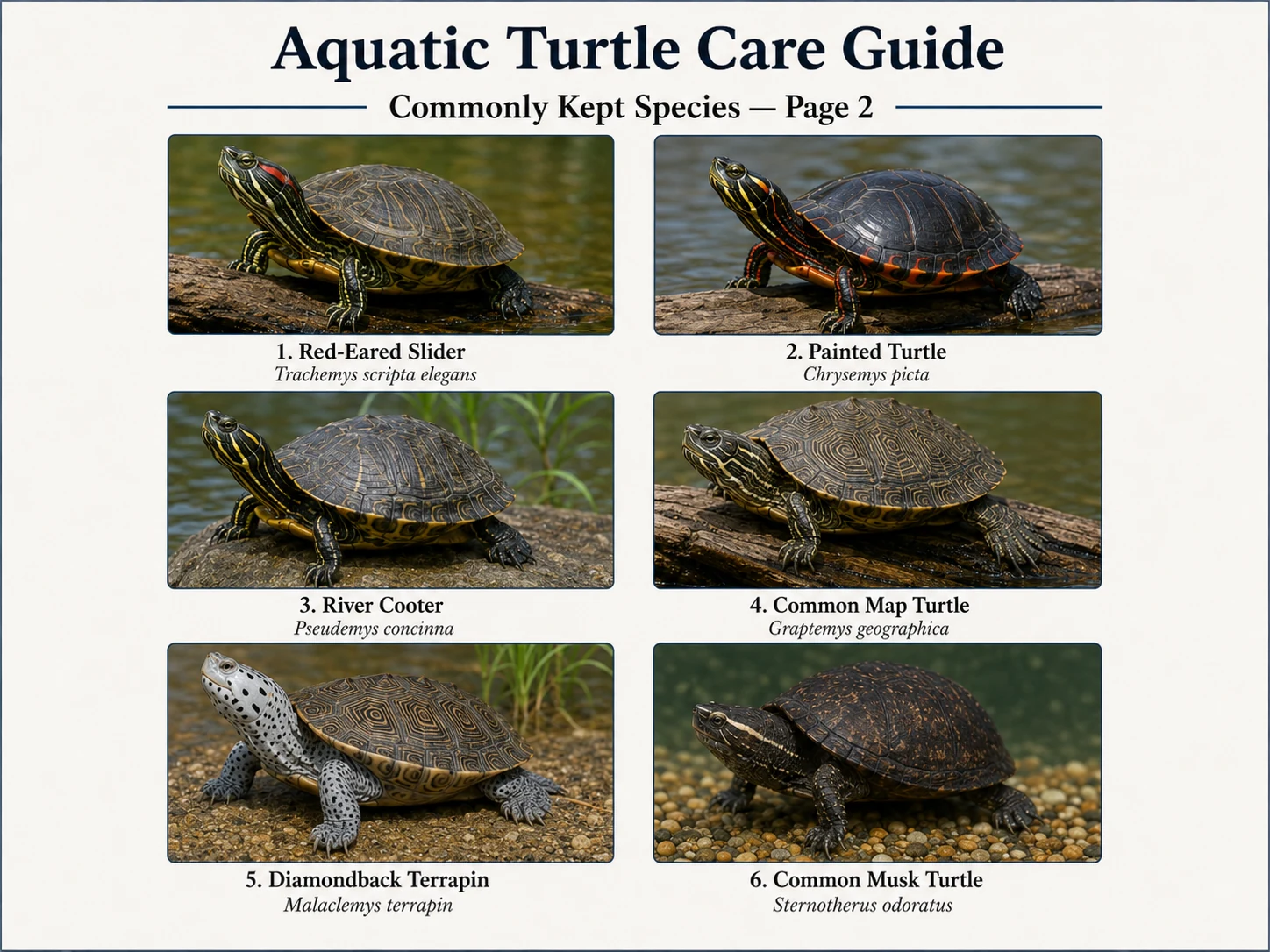
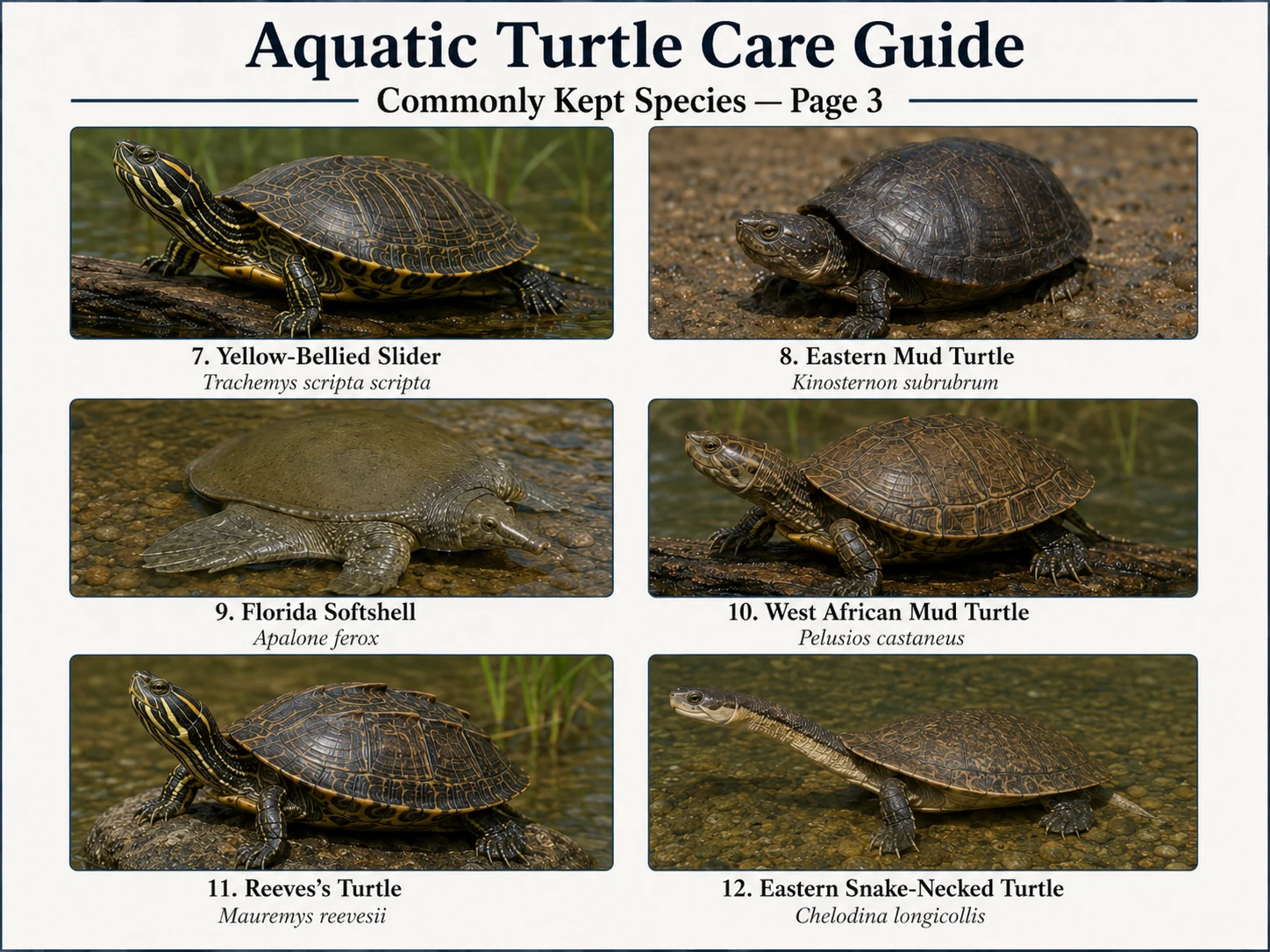
1. Pond Sliders — Trachemys
Representative species: pond slider Trachemys scripta, especially red-eared, yellow-bellied, and Cumberland sliders. The genus contains many additional tropical and subtropical species that should be adjusted to locality.
Approximate adult size: red-eared sliders can reach about 12 in (31 cm), with females usually larger.
Enclosure and water
Sliders are strong swimmers and active baskers. For most adult red-eared sliders, current specialist guidance treats roughly 100 US gal (379 L) of actual water as a practical minimum, with 120–125 gal (454–473 L) often easier to source and better for larger adults. Outdoor/indoor ponds are frequently superior to glass tanks.
Water should be at least as deep as shell length and preferably substantially deeper for a healthy adult, with submerged rests and an easy route to the surface. Provide a large completely dry basking area in addition to water volume.
Temperature and UVB
For adults, a stable indoor water temperature around 74–76°F (23–24°C) is a useful practical target; hatchlings are commonly maintained around 78–82°F (24–29°C). Current guidance uses basking air around 85–90°F (30–32°C) and a broad basking surface around 104°F (40°C). Target approximately UVI 3–4 at shell height on the basking surface.
Special cautions
Sliders are frequently abandoned when they outgrow small tanks. They are highly invasive in many regions. Do not release a pet slider. Single housing avoids aggression and reproductive harassment.
2. Cooters and Red-Bellied Turtles — Pseudemys
Species in the diet guide: P. alabamensis, P. concinna, P. floridana, P. gorzugi, P. nelsoni, P. peninsularis, P. rubriventris, and P. texana.
Approximate adult size: species are large; river cooters can reach about 17.2 in (43.7 cm) carapace length, with females typically larger.
These are powerful pond/river swimmers and avid baskers. Large females require a pond-scale enclosure; conventional 75–100 gal aquaria are inadequate for the largest animals. Provide deep open water, aquatic vegetation, logs or robust basking platforms, and a completely dry haul-out zone.
Specific controlled husbandry ranges are less standardized than for red-eared sliders. A reasonable starting point for many captive adults is water around 72–78°F (22–26°C), a broad basking surface around 90–95°F (32–35°C), and UVI around 3–4, adjusted by species, season, and locality.
Because many adult Pseudemys are strongly herbivorous, aquatic plant availability and room for grazing are part of enclosure design, not just diet.
3. Painted Turtles — Chrysemys
Species framework: Chrysemys picta and Chrysemys dorsalis, with familiar eastern, midland, western, and southern forms in husbandry literature.
Approximate adult size: roughly 4–10 in (10–25 cm) depending on form and sex.
Painted turtles are active swimmers and conspicuous baskers. A large adult approaching 10 in (25 cm) should have roughly 100 US gal (379 L) or more water, a full dry dock, plants/logs for structure, and excellent filtration.
Current care guidance uses water around 78–80°F (25–27°C) for juveniles and approximately 70–76°F (21–24°C) for adults/subadults. Basking surfaces are commonly 95–104°F (35–40°C), with UVI 3–4.
Temperate painted turtles have strong seasonal biology. Deep brumation should never be improvised for a sick, underweight, or poorly identified animal.
4. Map Turtles — Graptemys
Species in the diet framework: G. barbouri, G. caglei, G. ernsti, G. flavimaculata, G. geographica, G. gibbonsi, G. nigrinoda, G. oculifera, G. ouachitensis, G. pearlensis, G. pseudogeographica, G. pulchra, G. sabinensis, and G. versa.
Size varies dramatically by sex and species. Common map turtles illustrate the problem: males are about 3.5–6.5 in (9–16.5 cm), while females reach about 7–10.5 in (18–27 cm).
Map turtles should have large open-water areas plus substantial logs/branches for basking. Riverine species benefit from excellent oxygenation and moderate circulation, but current should never prevent normal resting.
A practical provisional starting range for many temperate Graptemys is water around 72–78°F (22–26°C), a basking surface around 90–95°F (32–35°C), and UVI around 3–4. Exact temperatures should be refined by species/locality.
Large molluscivorous females need much larger tanks and stronger filtration than small adult males. Do not purchase a hatchling without planning for the sex-dependent adult size.
5. Diamondback Terrapin — Malaclemys terrapin
The diamondback terrapin is an estuarine turtle, not simply a slider that tolerates salt. Wild populations occupy salt marshes, tidal creeks, lagoons, and brackish coastal systems and possess specialized salt glands.
Salinity
Captive-bred terrapins can sometimes be maintained in freshwater under excellent husbandry, but brackish water is biologically closer to their normal ecology and often reduces skin/shell problems. Experimental work in hatchlings cites approximately 1–10 ppt as an optimal intermediate range in prior literature, and research facilities commonly maintain hatchlings around 5–10 ppt. Adult/wild-origin protocols may use higher brackish salinity. Use a refractometer or reliable salinity meter rather than adding salt by guesswork.
Provide periodic access to freshwater for drinking when using brackish systems according to the specific managed-care protocol.
Enclosure
Use a large swimming system with exceptionally clean water, dry basking, and a sandy nesting area for mature females. A 75–100 gal (284–379 L) aquarium is only a starting scale for smaller adults; large females and pairs require substantially more space.
Temperature / UV
A reasonable adult starting point is water around 74–80°F (23–27°C), basking around 88–95°F (31–35°C), and UVI around 3–4. Hatchlings are often maintained warmer. Avoid chronic warm dirty water, which promotes skin and shell disease.
6. Musk Turtles — Sternotherus
Species: S. carinatus, S. depressus, S. intermedius, S. minor, S. odoratus, and S. peltifer.
Approximate adult size: most commonly kept musk turtles are roughly 3–6 in (8–15 cm).
Musk turtles are highly aquatic but are often better described as bottom walkers and climbers than as open-water cruisers. Natural habitats include ponds, swamps, quiet rivers, submerged vegetation, woody debris, and shallow margins.
Provide moderate water depth with multiple submerged branches, cork, plants, ledges, and ramps that allow the turtle to rest within a neck/body length of the surface. A healthy adult can use deeper water when the enclosure is richly structured.
A provisional temperate starting range is water around 72–78°F (22–26°C) and basking around 85–90°F (29–32°C). Provide a dry basking option even if the individual uses it infrequently, along with measured low-to-moderate UV exposure and shaded alternatives.
7. Mud Turtles — Kinosternon
The genus includes many small New World mud turtles. Eastern mud turtles illustrate the ecological point: they occupy still-water habitats, are relatively weak swimmers, spend meaningful time on land, and may bury themselves terrestrially for winter.
Approximate adult size: many commonly kept Kinosternon are roughly 3–5 in (8–13 cm), although some species are larger.
Use shallow-to-moderate water with abundant bottom structure and an actual land/burrowing area rather than a deep bare aquarium. Provide soft soil/sand, leaf litter or hides on land, and a nest site for females.
For many temperate species, a provisional starting range is water around 72–78°F (22–26°C) and basking/land warmth around 85–90°F (29–32°C). Tropical species may require warmer conditions and should not be cooled according to an eastern mud turtle calendar.
8. Snapping Turtles — Family Chelydridae
This group includes common snapping turtles (Chelydra) and alligator snapping turtles (Macrochelys). These are powerful, long-lived, potentially dangerous turtles that rapidly outgrow normal household aquaria.
Common snapping turtle size: approximately 8–18.5 in (20–47 cm) shell length and often 9–35 lb (4–16 kg). Alligator snapping turtles can become far larger and should be regarded as specialist/zoological animals.
Provide a very large stock tank or pond with deep but easily navigable water, a soft/muddy-bottom analogue or robust smooth substrate, submerged structure, and low-current zones. These turtles do not need a steep elevated basking dock designed for sliders, but should have safe shoreline/haul-out and nesting access.
Most temperate common snappers can be maintained with water in the low-to-mid 70s°F (low-to-mid 20s°C) indoors rather than warm tropical water. Exact seasonal management depends on locality. Solitary housing is mandatory for safety.
Never lift by the tail. Use trained chelonian restraint and large containers; the reach of the neck can surprise inexperienced handlers.
9. Softshell and Flapshell Turtles
Species represented in the diet guide: Florida softshell Apalone ferox, smooth softshell A. mutica, spiny softshell A. spinifera, Chinese softshell Pelodiscus sinensis, Indian flapshell Lissemys punctata, and African softshell Trionyx triunguis.
Adult size: highly variable from modest males to females exceeding 20 in (50 cm) in several species. Florida and African softshells can require pond-scale systems.
Water and substrate
Softshells are highly aquatic and need extensive swimming area, excellent water quality, and a deep layer of fine nonabrasive sand in which they can bury. Rough rock, sharp gravel, and coarse artificial décor can abrade the leathery shell and plastron.
Spiny softshells are associated with rivers/lakes with sand or mud; Florida softshells use quieter lakes, ponds, swamps, and slow water. Match current accordingly.
Temperature
For temperate Apalone, a cautious starting range is water around 72–78°F (22–26°C), with a warm shallow/basking shoreline available. Tropical Pelodiscus, Lissemys, and Trionyx require warmer species-specific management.
Softshells are fast, defensive, and capable of long-necked bites. Single housing is strongly recommended.
10. North American Pond, Spotted, Bog, Blanding's, and Wood Turtles
Species in the diet guide: northwestern pond turtle Actinemys marmorata, southwestern/southern Pacific pond turtle A. pallida, spotted turtle Clemmys guttata, Blanding's turtle Emydoidea blandingii, wood turtle Glyptemys insculpta, and bog turtle G. muhlenbergii.
Spotted turtle
At about 4–5.5 in (10–14 cm), spotted turtles are small but high-needs wetland turtles. Current care guidance recommends approximately 50% land / 50% water; adult water is only about 6–8 in (15–20 cm) deep. Use a basking area around 86–90°F (30–32°C), water 70–84°F (21–29°C) with heaters set near the lower end when needed, and UVI around 3–4.
Bog turtle
Bog turtles occupy shallow sedge bogs, fens, and wet meadows with low standing water, soft mud, dry/wet hummocks, abundant sunlight, and humid near-ground microclimates. They are highly protected and are a conservation-management species, not a routine pet-care target.
Wood turtle
Wood turtles are strongly semiaquatic and move extensively on land. A large riparian paludarium with flowing/clean water and a substantial terrestrial area is more appropriate than a deep aquarium.
Pond and Blanding's turtles
Use large shallow-to-deep wetland/pond systems with basking logs, vegetation, and extensive nesting land. Exact temperatures and seasonal cycles should follow species/locality rather than one generalized North American pond-turtle setting.
11. Asian Pond and Temple Turtles
Mauremys species in the diet guide: M. annamensis, M. caspica, M. japonica, M. leprosa, M. mutica, M. nigricans, M. reevesii, M. rivulata, and M. sinensis. The group also includes yellow-headed temple turtle Heosemys annandalii and giant Asian pond turtle H. grandis.
There is no one Asian pond-turtle climate. Some Mauremys are temperate/subtropical and strongly seasonal; tropical temple turtles are warmer and much larger.
For common warm-subtropical captive forms such as Reeves'/Chinese pond turtles, a practical starting setup uses a large aquatic area, robust dry basking/shoreline, water roughly 75–80°F (24–27°C) for active indoor management, basking around 88–95°F (31–35°C), and measured UV exposure. Cooler-temperate species may require lower seasonal temperatures.
Large Heosemys need far more shoreline/land area and shallow water than a slider. The spotted pond turtle (Geoclemys hamiltonii), represented on the reptile page as an additional Asian resource, reaches about 16 in (40.5 cm) and naturally uses shallow standing, heavily vegetated water.
Many Asian freshwater turtles are conservation-sensitive; documented captive origin is essential.
12. Neotropical Wood Turtles — Rhinoclemmys
Recognized species in the diet guide: R. annulata, R. areolata, R. diademata, R. funerea, R. melanosterna, R. nasuta, R. pulcherrima, R. punctularia, and R. rubida.
Approximate adult size: commonly about 6–12 in (15–30 cm), species dependent.
This genus spans terrestrial forest-floor to strongly semiaquatic lifestyles. The enclosure should therefore be a humid forest paludarium rather than a generic aquarium. Provide deep soil/leaf litter, dense cover, plants, multiple hides, and a shallow-to-moderate water area large enough for soaking/swimming.
A provisional tropical starting range for many species is ambient/water around 75–82°F (24–28°C) with a localized warm/basking area in the mid-to-upper 80s°F (about 29–31°C), high humidity, and good ventilation. Species such as R. pulcherrima that are more terrestrial should have substantially more land than R. funerea and other aquatic forms.
13. African Side-Neck Turtles — Pelomedusa and Pelusios
The diet article recognizes 10 Pelomedusa species and 18 Pelusios species. Commonly encountered examples include helmeted turtles and the West African mud turtle Pelusios castaneus.
Water and land
Many African side-necks use warm ponds, marshes, floodplains, and seasonal wetlands. Provide a large warm aquatic area with a dry basking/shoreline zone and nesting substrate. Some Pelomedusa experience profound dry-season aestivation in nature; this should not be improvised in a companion turtle.
Temperature
An older veterinary species-specific benchmark for Pelusios castaneus uses water around 80–83°F (26–28°C) by day, not below about 76°F (24°C) at night, and basking around 90–95°F (32–35°C). These values are useful for warm West African forms but should not be extrapolated to every species across the continent.
Provide UVB/daylight, excellent filtration, and a water depth that permits swimming while retaining submerged rests. Large Pelusios can be strong, territorial animals and need pond-scale housing.
14. South American Side-Necks and Mata Mata
This broad group includes Phrynops hilarii, Phrynops geoffroanus, multiple Mesoclemmys, and the mata mata complex (Chelus).
General South American side-necks
Active Phrynops/Mesoclemmys require warm tropical water, dry basking/shoreline access where used, submerged structure, and nesting land. A provisional starting water band around 76–82°F (24–28°C) is reasonable for many tropical forms, with basking around the upper 80s to low 90s°F (31–34°C) when the species basks.
Mata mata
Approximate adult size: shell nearly 18 in (45 cm) and up to about 38 lb (17.2 kg).
Mata matas are highly aquatic but are poor open-water swimmers. Smithsonian describes adults walking on the soft muddy bottoms of shallow pools, streams, swamps, and marshes. The enclosure should therefore prioritize large footprint over great depth, with shallow warm water, leaf/wood structure, soft bottom, low current, and the ability to reach the surface by extending the neck.
Do not force a mata mata to use a steep slider-style dry dock. Females require accessible nesting land when reproductively active.
15. South American River Turtles — Family Podocnemididae
Species in the diet guide: Erymnochelys madagascariensis, Peltocephalus dumerilianus, Podocnemis erythrocephala, P. expansa, P. lewyana, P. sextuberculata, P. unifilis, and P. vogli.
These include large, long-lived tropical river turtles. Yellow-spotted Amazon river turtles alone reach roughly 15–27 in (38–69 cm), with females much larger than males. Giant river turtles become larger still.
Adults require zoo-scale ponds or river-style systems with large unobstructed swimming space, robust filtration, multiple haul-out/basking areas where used, vegetation, and large sandy nesting banks. A conventional household aquarium is not an adult enclosure.
A broad managed-care starting band for tropical water is roughly 76–82°F (24–28°C), but species, river basin, and season matter. These animals should generally be maintained through conservation/zoological protocols rather than generic pet-turtle care sheets.
16. Australasian Long-Necked and Short-Necked Turtles
The diet guide focuses on long-necked turtles such as Chelodina longicollis and short-necked turtles such as Emydura macquarii, Emydura subglobosa, Elseya spp., and Myuchelys latisternum.
Eastern snake-necked turtle — Chelodina longicollis
Approximate adult size: about 10.2 in (26 cm). This temperate species uses wetlands and may make substantial overland movements. Provide ample water with open strike space, submerged structure, a shore/nesting area, and seasonal temperatures appropriate to southeastern Australia.
A practical active-season indoor starting range is water around 70–78°F (21–26°C), with a warm basking/shoreline option and measured daylight/UVB. Do not apply tropical Emydura temperatures to this species year-round.
Short-necked Emydura / Elseya
These turtles are active swimmers; tropical forms may require water in the upper 70s to low 80s°F (mid-to-upper 20s°C), large basking areas, and extensive plant matter depending on species. Elseya can become large, powerful river turtles and require pond-scale housing.
17. Pig-Nosed / Fly River Turtle — Carettochelys insculpta
Approximate adult size: up to about 27.5 in (70 cm) and 66 lb (30 kg).
Fly River turtles inhabit warm tropical rivers, lakes, lagoons, and slow currents and can use water several meters deep. Their flipper-like forelimbs make them powerful swimmers. Adults leave the water primarily to nest.
Provide a huge heated, filtered, open swimming system with soft/smooth bottom surfaces, low-to-moderate current zones, excellent water quality, and large turning radius. Avoid sharp rockwork because the shell is covered by leathery skin.
A provisional managed-care water range around 79–84°F (26–29°C) is reasonable for warm tropical indoor systems, with strong daylight and species-appropriate UV exposure. There is no need for a routine slider-style dry basking dock, but mature females require a large sand/mud nesting bank.
Because adults can reach 70 cm and 30 kg, long-term care is properly zoo-scale.
Shell, Skin, Scutes, Beak, Nails, Eyes, and Ears
Hard-shelled basking turtles should be able to dry fully. Chronic inability to bask, continuously warm dirty water, abrasion, trauma, and systemic illness can contribute to shell disease. Softshells and pig-nosed turtles have leathery shell coverings and require especially smooth surfaces and clean water.
- Do not peel normal scutes aggressively.
- Soft shell, deep pits, foul odor, discharge, bleeding, ulceration, or unstable tissue require veterinary examination.
- Swollen eyelids may reflect vitamin-A deficiency, infection, poor water quality, or other systemic disease; do not inject vitamin A without diagnosis.
- Rounded swelling over the tympanum suggests aural abscess; chelonian ear abscesses usually require surgical debridement.
- Beak overgrowth may reflect diet, lack of wear, metabolic disease, or chronic illness.
Seasonality, Brumation, Aestivation, and Dry-Season Cycling
Temperate sliders, painted turtles, maps, mud turtles, spotted turtles, wood turtles, and Australian temperate chelids experience seasonal changes. Tropical pig-nosed turtles, Amazon river turtles, and many African/South American species do not undergo temperate brumation.
Do not use reduced appetite as proof that a turtle “wants to hibernate.” Respiratory disease, poor water quality, reproductive disease, low temperature, nutritional disease, and systemic infection can look like seasonal slowing.
Intentional brumation or dry-season aestivation is an advanced husbandry procedure appropriate only to healthy, correctly identified animals under species-specific protocols.
Cleaning and Sanitation
- Use partial water changes, filter maintenance, substrate siphoning, and removal of food/feces as routine husbandry.
- Do not completely sterilize biological filter media during normal cleaning; chlorine and aggressive disinfectants can destroy nitrifying bacteria.
- Rinse biological media in dechlorinated or removed tank water when practical.
- Disinfect quarantine equipment between animals according to veterinary infectious-disease risk.
- Never clean turtle filters, tubs, or feeding equipment in kitchen food-preparation areas.
Salmonella and Household Hygiene
Healthy aquatic turtles can carry Salmonella without appearing ill. Tank water, filters, hoses, buckets, and basking surfaces can all be contaminated.
- Wash hands with soap and running water after handling the turtle or anything from the enclosure.
- Keep turtle equipment out of kitchens and food-preparation sinks.
- Do not kiss turtles or allow them close to the face.
- Children under 5, adults over 65, and immunocompromised people have greater risk of severe reptile-associated illness.
- Do not allow pet turtles to roam freely through living areas.
- The U.S. small-turtle sales restriction does not make larger turtles Salmonella-free.
Quarantine and Biosecurity
A practical minimum quarantine period is 90 days, with longer isolation for wild-caught, imported, conservation-sensitive, or symptomatic turtles.
- Use a separate tank/pond, separate filter, siphon, hoses, buckets, nets, feeding tools, and cleaning brushes.
- Care for established healthy turtles before quarantined animals.
- Record weight, appetite, feces, basking, shell/skin condition, buoyancy, and respiratory signs.
- Discuss fecal testing and risk-based infectious-disease diagnostics with a reptile veterinarian.
- Do not share water between turtle enclosures or with amphibian systems.
- Unexpected mortality, oral plaques, severe shell disease, neurologic signs, or respiratory outbreaks warrant collection-level investigation rather than empiric treatment alone.
Routine Health Monitoring
| Monitor | Suggested approach | Why it matters |
|---|---|---|
| Body weight | Weekly during quarantine/growth/illness, then monthly for stable adults. | Detects subtle chronic disease and obesity. |
| Shell/skin | Inspect during dry handling; photograph suspicious lesions. | Early shell/skin disease may be subtle underwater. |
| Basking | Observe frequency and ability to climb/dry completely. | Changes can indicate temperature, platform, illness, aggression, or respiratory problems. |
| Swimming/buoyancy | Watch for symmetrical swimming, normal diving, and easy surfacing. | Asymmetric flotation, inability to submerge, or weakness can indicate respiratory/GI/coelomic disease. |
| Water chemistry | Test ammonia, nitrite, nitrate, pH; salinity where relevant. | Prevents “invisible” chronic environmental disease. |
| Temperatures/UVI | Record water, basking surface/air, and UV periodically. | Equipment and room conditions drift over time. |
Common Diseases and Health Problems
| Problem | Common signs / contributors | Prevention and response |
|---|---|---|
| Shell disease / SCUD | Pitting, ulceration, foul odor, discharge, soft/unstable tissue; trauma and poor water quality increase risk. Classical SCUD is associated with Citrobacter freundii, but mixed bacterial/fungal infections occur. | Correct water quality and basking; veterinary cytology/culture/imaging or debridement as indicated. |
| Respiratory disease | Nasal bubbles, open-mouth breathing, wheezing, lethargy, asymmetric buoyancy, inability to dive. | Correct water/basking temperature and hygiene; veterinary examination, imaging and targeted therapy. |
| Aural abscess | Rounded swelling at the tympanum; can be associated with vitamin-A deficiency or oral infection. | Usually requires surgical debridement; correct diet/husbandry. |
| Hypovitaminosis A | Swollen eyelids, epithelial disease, poor appetite, respiratory/oral problems. | Correct diet using the Diet Guide; concentrated vitamin A only under veterinary direction. |
| Nutritional secondary hyperparathyroidism | Soft/deformed shell, weakness, fractures, abnormal growth. | Balanced diet, calcium, effective UVB, correct thermal environment. |
| Dystocia / follicular disease | Persistent escape/digging, anorexia, straining, abnormal buoyancy or hind-limb use. | Provide nesting land; radiographs/ultrasound and medical/surgical treatment as needed. |
| Septicemia | Lethargy, anorexia, erythema/petechiae of plastron, neurologic signs, rapid decline. | Urgent veterinary care; investigate source infection and environmental stress. |
| Trauma / bites | Missing toes/tail tips, shell-margin wounds, deep bites, softshell skin tears. | Single housing, smooth décor, safe handling. |
| Thermal burns | Skin/shell lesions near heater contact or basking lamp. | Guard heaters; measure basking surface; secure lamps. |
| Drowning / near-drowning | Weakness, unresponsiveness, respiratory distress after entrapment or inability to surface. | Emergency veterinary care; redesign depth, resting structure, platform, or cohabitation. |
| Obesity / fatty liver disease | Excess soft tissue, reduced activity, reproductive risk. | Use diet guide, large exercise space, body-condition monitoring. |
| Parasites | Weight loss, diarrhea, anemia, poor condition, sometimes no signs. | Risk-based fecal examination; treat diagnosed parasites rather than blind deworming. |
Warning Signs Requiring Veterinary Attention
- persistent nasal bubbles, open-mouth breathing, wheezing, or asymmetric floating;
- inability to submerge, inability to surface normally, or sudden swimming weakness;
- shell ulceration, foul odor, bleeding, deep pitting, softening, or rapidly spreading discoloration;
- swollen eyes, closed eyes, oral plaques, or aural swelling;
- progressive weight loss or prolonged anorexia at correct temperatures;
- persistent straining, repeated nesting attempts, or suspected egg retention;
- prolapse;
- severe bite wounds, heater burns, or softshell skin tears;
- collapse, neurologic signs, or suspected near-drowning;
- multiple sick or dead turtles in one collection.
Safe Transport
Most aquatic turtles should be transported dry or damp, not swimming in a container of water. Use a secure ventilated box with absorbent towel/paper and keep temperature stable. A water-filled carrier can slosh, chill, or drown an injured turtle.
For long transport of delicate softshells, pig-nosed turtles, or specialist conservation animals, follow veterinary/zoological protocols because skin hydration and temperature requirements may differ.
Recommended Equipment Checklist
- species-appropriate aquarium, stock tank, pond, or paludarium;
- structurally adequate stand/floor support;
- oversized mechanical/biological filtration;
- water test kit for ammonia, nitrite, nitrate, and pH;
- salinity meter/refractometer for brackish species;
- submersible digital water thermometer;
- guarded aquarium heater where needed;
- large stable dry basking platform for basking species;
- overhead heat lamps and dimmer/thermostatic control as appropriate;
- linear UVB fixture and UV Index meter when possible;
- bright visible daylight/plant lighting;
- GFCI/RCD protection and drip loops;
- siphon/water-change hose or pump;
- species-appropriate substrate (especially fine sand for softshells);
- submerged logs, shelves, plants, or resting structures;
- secure nesting land/substrate for mature females;
- digital gram/kilogram scale appropriate to animal size;
- dedicated quarantine equipment.
Feeding and Nutrition — Companion Article
Use the Aquatic Turtle Diet Guide for the complete species-specific nutrition program. It covers the same 17 groups, food preparation, commercial diets, whole prey, aquatic vegetation, fish/thiaminase cautions, calcium/vitamins, life-stage feeding, seasonality, and Frequency / When / Where / How guidance.
Selected References and Source Material
- Aquatic Turtle Diet Guide. Dr. Bob's Pet Health Information. Companion nutrition article and 17-group species framework.
- Reptile Resources — Aquatic and Semi-Aquatic Turtles. Dr. Bob's Pet Health Information. Current curated veterinary, university, zoological, conservation, and species resources.
- Divers SJ, Comolli JR. Management and Husbandry of Reptiles. Merck Veterinary Manual. Reviewed 2025.
- Important Husbandry Requirements for Selected Reptiles. Merck Veterinary Manual.
- Bacterial Diseases of Reptiles. Merck Veterinary Manual. Includes aquatic-turtle SCUD, septicemia, and chelonian aural abscesses.
- Reproductive Diseases of Reptiles. Merck Veterinary Manual. Reviewed 2025.
- Care of Aquatic & Semi-Aquatic Turtles. LafeberVet. Older broad veterinary handout retained for foundational enclosure, filtration, basking, and water-management concepts.
- Turtle Taxonomy Working Group. Turtles of the World: Annotated Checklist and Atlas, 10th ed. IUCN/SSC Tortoise and Freshwater Turtle Specialist Group. 2025.
- Red-Eared Slider Care Guide. ReptiFiles. Current detailed enclosure, basking, UVB, water-temperature, filtration, and enrichment reference.
- Painted Turtle Care Sheet. ReptiFiles.
- Spotted Turtle Care Sheet. ReptiFiles.
- Eastern Mud Turtle. University of Georgia Savannah River Ecology Laboratory.
- River Cooter — Pseudemys concinna. Animal Diversity Web, University of Michigan Museum of Zoology.
- Common Map Turtle — Graptemys geographica. Animal Diversity Web.
- Diamondback Terrapin. U.S. National Park Service.
- Choe R, Maerz JC, et al. Effects of Salinity on Hatchling Diamond-Backed Terrapin Growth, Behavior, and Stress Physiology. Peer-reviewed research, University of Georgia-associated authors.
- Spiny Softshell — Apalone spinifera. Animal Diversity Web.
- Florida Softshell — Apalone ferox. Animal Diversity Web.
- Bog Turtle — Glyptemys muhlenbergii. U.S. Fish & Wildlife Service.
- Wood Turtle — Glyptemys insculpta. Animal Diversity Web.
- Spotted Pond Turtle — Geoclemys hamiltonii. Smithsonian's National Zoo.
- Mata Mata Turtle. Smithsonian's National Zoo.
- Yellow-Spotted Amazon River Turtle. Smithsonian's National Zoo.
- Eastern Snake-Necked Turtle. Australian Museum.
- Fly River / Pig-Nosed Turtle. Smithsonian's National Zoo.
- Reptiles and Amphibians — Healthy Pets, Healthy People. U.S. Centers for Disease Control and Prevention. Updated January 2026.
- Divers SJ, Stahl SJ, eds. Mader's Reptile and Amphibian Medicine and Surgery. 3rd ed. Elsevier; 2019.
Social Housing and Aggression
Single housing is the safest default. Aquatic turtles may bask together in nature without forming a social bond that requires captivity companions.
Problems include biting, tail/limb injury, shell-margin damage, food competition, chronic hiding, forced displacement from basking areas, and mating harassment. A male can repeatedly mount or pin a female underwater; a weaker turtle can drown.
Professional group housing requires very large space, multiple basking zones, multiple feeding areas, visual barriers, compatible size/sex ratios, and the ability to separate animals immediately.