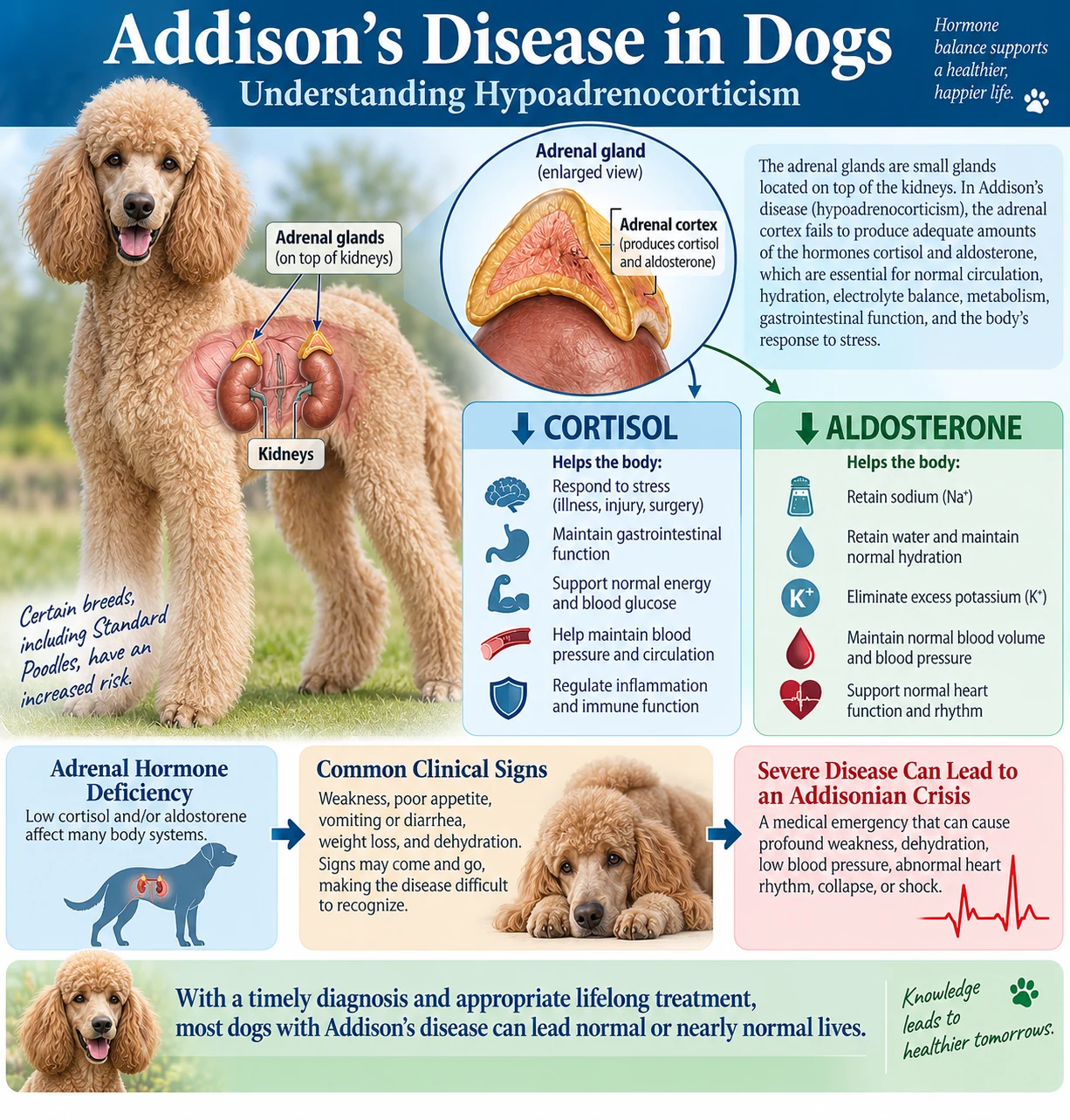
Addison's Disease in Dogs
Understanding Hypoadrenocorticism
Addison's disease, medically called hypoadrenocorticism, is an uncommon hormonal disease in which the adrenal glands fail to produce adequate amounts of hormones essential for normal circulation, hydration, electrolyte balance, metabolism, gastrointestinal function, and the body's response to illness and stress.
The disease can be difficult to recognize because its early signs are often vague and may come and go. A dog may have poor appetite, vomiting, diarrhea, weakness, or lethargy for several days, recover temporarily, and then become ill again. Because this pattern resembles many gastrointestinal, kidney, metabolic, and other disorders, Addison's disease has earned the nickname "the great pretender."
At the severe end of the spectrum, an affected dog can suddenly develop profound weakness, dehydration, cardiovascular collapse, or shock - an Addisonian crisis. This is a medical emergency. Despite the seriousness of an untreated crisis, the long-term outlook is generally excellent once the disease has been correctly diagnosed and appropriate hormone replacement has been established.
The Adrenal Glands and What Goes Wrong
Dogs have two small adrenal glands located near the kidneys. The outer portion of each gland, the adrenal cortex, produces two groups of hormones that are especially important in Addison's disease: glucocorticoids, principally cortisol, and mineralocorticoids, principally aldosterone.
Cortisol helps maintain blood pressure and circulation, normal blood glucose and energy metabolism, gastrointestinal function, regulation of inflammation, and the body's ability to adapt to illness, injury, surgery, and other forms of stress. Aldosterone regulates sodium, potassium, and water balance, largely through its effects on the kidneys. It helps the body retain sodium and water while eliminating excess potassium.
In the most common form of Addison's disease, adrenal cortical function is progressively lost. Cortisol deficiency contributes to poor appetite, vomiting, diarrhea, weakness, low blood glucose, impaired vascular tone, and an inadequate response to stress. When aldosterone production is also deficient, excessive sodium and water are lost while potassium is retained. The resulting dehydration and reduced blood volume can decrease kidney perfusion and make blood tests resemble kidney failure. Severe potassium elevation can interfere with normal electrical conduction through the heart and contribute to weakness, a slow heart rate, arrhythmias, and cardiovascular collapse.
What Causes Addison's Disease?
Most naturally occurring cases in dogs are primary hypoadrenocorticism, in which the adrenal cortex itself is damaged. In many dogs this is believed to be an immune-mediated process in which the immune system progressively destroys adrenal tissue. The occurrence of Addison's disease in particular breeds and family lines supports an inherited susceptibility in some populations.
Less commonly, both adrenal glands may be damaged by severe inflammation, hemorrhage, infiltrative disease, or cancer. Hypoadrenocorticism can also be associated with treatment. Medications used to suppress adrenal function in dogs with Cushing's disease can occasionally reduce adrenal hormone production excessively. Long-term corticosteroid administration suppresses the normal hypothalamic-pituitary-adrenal system, and abrupt withdrawal after sufficiently prolonged or suppressive therapy can result in temporary adrenal insufficiency.
A less common form, secondary hypoadrenocorticism, develops when the pituitary gland fails to produce adequate ACTH, the hormone that normally stimulates adrenal cortisol production. Because aldosterone is regulated largely through other mechanisms, these dogs generally have cortisol deficiency without the classic sodium and potassium abnormalities.
Predisposition: Breed, Age, Sex, and Genetics
Addison's disease can occur in any breed or mixed-breed dog, so breed, sex, or age should never be used to rule the disease out. Nevertheless, certain patterns can increase clinical suspicion.
The disease is most commonly recognized in young to middle-aged adult dogs, although dogs of any age can be affected. A female predisposition has been reported in a number of studies, although this finding has not been completely consistent and male dogs are also affected.
Several breeds have a recognized increased risk. These include the Standard Poodle, Portuguese Water Dog, Bearded Collie, Nova Scotia Duck Tolling Retriever, West Highland White Terrier, Great Dane, Soft Coated Wheaten Terrier, Rottweiler, and Labrador Retriever, among others. The genetics are not identical among all breeds; inherited susceptibility appears to contribute to immune-mediated adrenal destruction in some dogs rather than Addison's disease representing a single simple genetic disorder.
Family history can therefore be meaningful. Recurrent unexplained gastrointestinal or constitutional illness in a dog from a predisposed breed or affected family deserves particular consideration. At the same time, many dogs with Addison's disease have no recognizable breed or family predisposition.
Typical and Nonclassic Addison's Disease
In classic primary Addison's disease, both cortisol and aldosterone are deficient. These dogs often develop the familiar electrolyte pattern of low sodium and high potassium, together with dehydration and reduced circulating blood volume.
However, a significant minority of affected dogs have sodium and potassium values within the reference range at diagnosis. These cases have commonly been called "atypical Addison's disease." Such dogs may primarily have signs of cortisol deficiency, including recurrent poor appetite, vomiting, diarrhea, lethargy, weakness, weight loss, low albumin, or low cholesterol. Some later develop mineralocorticoid deficiency and electrolyte abnormalities, while others do not.
Symptoms and Clinical Pattern
The signs of Addison's disease are often nonspecific. Common presentations include poor appetite, intermittent vomiting or diarrhea, lethargy, weakness, weight loss, trembling, dehydration, abdominal discomfort, and sometimes increased drinking and urination. Gastrointestinal bleeding can occasionally result in dark, tarry stool or visible blood.
One of the most characteristic historical clues is the tendency for illness to wax and wane. A dog may become ill, recover, and then experience another unexplained episode weeks later. Stress can expose the problem because a healthy adrenal gland normally increases cortisol production during illness, injury, boarding, travel, surgery, or other physiologic stress. An Addisonian dog may be unable to make this adjustment.
Addisonian Crisis
An Addisonian crisis occurs when the hormonal deficiency becomes severe enough to cause major circulatory and metabolic abnormalities. Affected dogs may develop profound weakness, repeated vomiting or diarrhea, severe dehydration, low blood pressure, inability to stand, collapse, low blood glucose, severe sodium and potassium abnormalities, or an abnormal heart rhythm. A relatively slow heart rate in a dog that otherwise appears to be in shock can be an important clue when severe hyperkalemia is present.
Diagnosing Addison's Disease
Diagnosis typically occurs in stages. The veterinarian first recognizes a history, physical examination, or routine laboratory pattern compatible with hypoadrenocorticism and then uses specific adrenal testing to confirm or exclude the disease.
Routine Laboratory Testing
A complete blood count, chemistry profile, electrolytes, and urinalysis frequently provide the first clues. A sick or stressed dog normally develops predictable white blood cell changes known as a stress leukogram. Because cortisol helps produce this response, an Addisonian dog may fail to develop the expected pattern. Relative increases in lymphocytes or eosinophils may therefore increase suspicion.
Classic biochemical abnormalities include low sodium and high potassium. Other possible findings include low chloride, low blood glucose, low cholesterol, low albumin, increased calcium, and increased kidney values resulting from dehydration and decreased renal blood flow. The sodium-to-potassium ratio can be useful as a clue but is not diagnostic. Several unrelated diseases can produce a similar pattern, and some Addisonian dogs have normal electrolytes.
Urinalysis is also important because a dehydrated Addisonian dog may have elevated kidney values yet fail to concentrate urine as strongly as expected. This combination can initially resemble primary kidney disease.
Resting Cortisol as a Screening Test
A resting or baseline cortisol concentration is a useful screening test when Addison's disease is possible but not established. A resting cortisol above approximately 2 micrograms/dL makes naturally occurring hypoadrenocorticism extremely unlikely, assuming interfering corticosteroid medications have not been administered.
A low value has a very different meaning. Many dogs with illnesses other than Addison's disease have resting cortisol values below this level. Therefore, a low resting cortisol does not confirm Addison's disease; it indicates that definitive testing should be considered.
ACTH Stimulation Test
The ACTH stimulation test is the standard test used to confirm hypoadrenocorticism. ACTH normally stimulates the adrenal cortex to produce cortisol. During the test, cortisol is measured before and after synthetic ACTH is administered. A normal adrenal gland responds with increased cortisol production; in Addison's disease, cortisol remains abnormally low and the expected response fails to occur.
The veterinarian needs an accurate history of medications the dog has received because some corticosteroids can interfere with cortisol measurement. Relevant exposure may include tablets and injections as well as steroid-containing ear, eye, or skin medications. In selected cases, endogenous ACTH, aldosterone, or related testing may help distinguish primary from secondary disease or further characterize dogs whose electrolytes remain normal.
What Else Can Look Like Addison's Disease?
Because its signs are nonspecific, Addison's disease often enters a differential diagnosis alongside gastrointestinal disease, pancreatitis, gastrointestinal obstruction, intestinal parasites, chronic enteropathy, kidney or urinary disease, liver disease, serious infection, and other metabolic or endocrine disorders.
The classic combination of low sodium and high potassium also has other causes. Severe kidney dysfunction, urinary obstruction, urinary tract rupture, and certain gastrointestinal diseases can produce similar changes. Whipworm infection has historically been recognized as one cause of a pseudo-Addisonian electrolyte pattern. For these reasons, routine laboratory changes can raise suspicion but should not replace specific adrenal testing.
Treatment of an Addisonian Crisis
Emergency treatment is directed first at restoring circulation and correcting the consequences of severe hormone deficiency. Intravenous fluid therapy is the cornerstone of treatment. Fluids restore circulating blood volume and blood pressure, improve kidney perfusion, and usually begin correcting sodium and potassium abnormalities.
Glucocorticoid replacement is also required. When an ACTH stimulation test has not yet been completed, the veterinarian may select a corticosteroid that has minimal interference with cortisol testing. Low blood glucose is treated when necessary. Severe hyperkalemia often improves substantially with fluid therapy, but additional treatment may be required if potassium elevation is causing dangerous cardiac effects.
Blood pressure, heart rhythm, electrolytes, blood glucose, kidney values, hydration, urine production, and response to treatment may require repeated monitoring. Once the dog is stable and the diagnosis is confirmed, therapy transitions to long-term hormone replacement.
Long-Term Treatment
Naturally occurring primary Addison's disease usually requires lifelong hormone replacement. Dogs with aldosterone deficiency require a mineralocorticoid. Desoxycorticosterone pivalate (DOCP) is commonly given by injection at an individualized interval, often approximately monthly. Commercial veterinary preparations include Percorten-V and Zycortal. Sodium and potassium measurements are used to determine the most appropriate dose and interval for the individual dog.
DOCP replaces mineralocorticoid activity but does not replace cortisol, so dogs receiving it also require appropriate glucocorticoid supplementation. Fludrocortisone is an oral alternative with strong mineralocorticoid activity and some glucocorticoid activity.
Cortisol deficiency is generally managed with a small physiologic dose of a glucocorticoid such as prednisone or prednisolone. The objective is to replace the glucocorticoid activity needed for normal function, not to use the much higher doses sometimes required to suppress inflammation or immune disease. Persistent lethargy, poor appetite, vomiting, or diarrhea can indicate inadequate supplementation, whereas excessive thirst, urination, appetite, panting, weight gain, or other steroid effects may indicate that the dose is unnecessarily high.
Stress Dosing
A healthy dog automatically produces more cortisol during significant stress. A dog with Addison's disease cannot reliably do this, so glucocorticoid supplementation may need to be temporarily increased during illness or predictable stressful events, including surgery, anesthesia, significant injury or illness, hospitalization, boarding, and unusually stressful travel. Owners should have an individualized stress-dosing plan from their veterinarian rather than adjusting medication without guidance.
Monitoring and Life at Home
Monitoring is most intensive when treatment is first established. In dogs receiving DOCP, electrolyte measurements after initial injections help determine the appropriate dose and interval. Once the dog is stable, testing can generally be performed less frequently, but regular veterinary examinations and periodic laboratory monitoring remain important. Dogs diagnosed while their electrolytes are normal should continue to have sodium and potassium monitored because mineralocorticoid deficiency can subsequently become apparent in some patients.
At home, recurrence of poor appetite, vomiting, diarrhea, unusual lethargy, weakness, trembling, weight loss, or significant changes in drinking and urination should prompt contact with the veterinarian. These signs may indicate that hormone supplementation requires adjustment, but they can also represent an unrelated illness.
Owners should not stop or substantially alter Addison's medication without veterinary guidance. Maintaining an adequate medication supply and informing emergency hospitals, boarding facilities, and pet sitters about the diagnosis is particularly important.
Prognosis
The long-term prognosis for appropriately treated Addison's disease is generally excellent. The greatest danger is often the period before diagnosis or during the initial Addisonian crisis. After stabilization and adjustment of glucocorticoid and mineralocorticoid replacement, management usually becomes predictable.
Addison's Disease in Cats
Hypoadrenocorticism can occur in cats but is very rare compared with dogs. The same general hormonal principles apply, but many more common feline diseases can cause similar signs. A cat suspected of having adrenal insufficiency therefore requires an individualized diagnostic evaluation and treatment plan rather than simply applying a canine protocol.
Additional Resources
Cornell University College of Veterinary Medicine - Addison's Disease
A client-oriented overview of causes, predisposition, signs, diagnosis, treatment, and prognosis.
Veterinary Partner / Veterinary Information Network - Addison's Disease (Hypoadrenocorticism)
A detailed owner-oriented discussion of adrenal physiology, diagnosis, Addisonian crisis, and long-term treatment.
Mar Vista Animal Medical Center - Addison's Disease
A detailed educational review covering clinical presentation, testing, treatment, nonclassic disease, secondary hypoadrenocorticism, and differential diagnoses.
American Animal Hospital Association - Canine Hypoadrenocorticism Guidelines
Professional consensus guidance on recognition, diagnosis, treatment, and monitoring.
Today's Veterinary Practice - Diagnosis and Long-Term Management of Canine Hypoadrenocorticism
A peer-reviewed veterinary review of diagnosis and long-term management.
Clinician's Brief - Managing Canine Addisonian Crisis
A professional review of emergency presentation, stabilization, and treatment.
This article provides general educational information for pet owners. Addison's disease cannot be diagnosed from symptoms or routine blood-test abnormalities alone. Diagnosis and treatment must be individualized by a veterinarian according to the patient's history, physical examination, laboratory and endocrine testing, medications, concurrent diseases, and response to therapy. A dog that collapses, becomes profoundly weak, repeatedly vomits, develops severe diarrhea or dehydration, or otherwise appears critically ill should receive immediate veterinary care.