Abscesses in Dogs and Cats
Original Pet Health Article
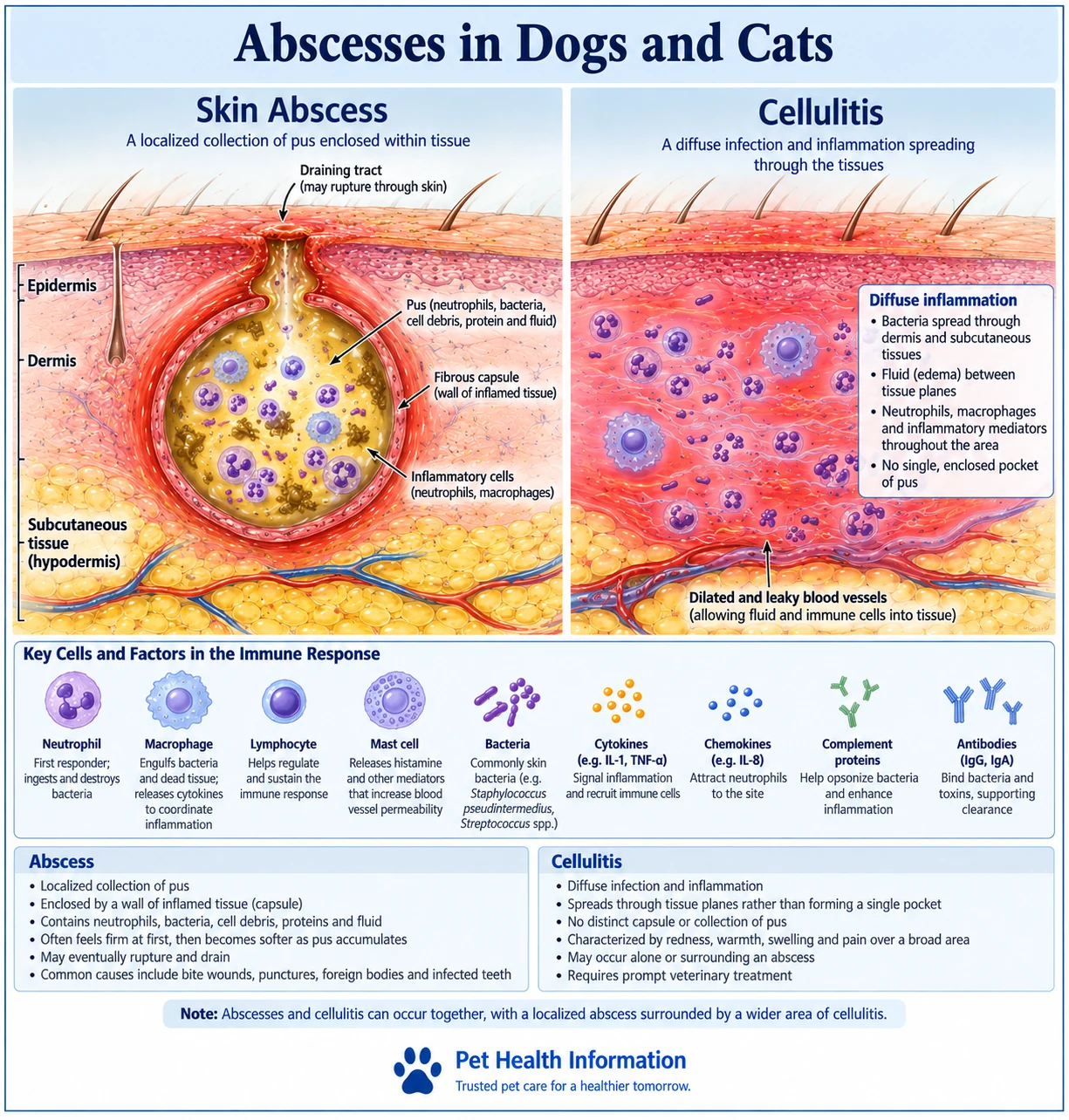
An abscess is a localized pocket of pus that develops when infection and inflammation become concentrated within tissue. In dogs and cats, common causes include bites, punctures, contaminated wounds, infected teeth, obstructed anal sacs, and penetrating foreign bodies. The visible swelling or wound may be much smaller than the infection or tissue damage beneath the surface.
Abscesses most often involve the skin and subcutaneous tissues, but infection can extend into muscle, teeth, joints, bone, or body cavities. Cellulitis differs from an abscess because infection and inflammation spread diffusely through tissue rather than forming a discrete pocket of pus. The two conditions may occur together.
Antibiotics Are Not a Substitute for Treating the Abscess
Antibiotics alone are often not sufficient. Pus, dead tissue, foreign material, or an untreated source such as an infected tooth may require drainage, cleaning, or surgical treatment before the infection can resolve. Antibiotics are used when appropriate, but antimicrobial resistance makes unnecessary or poorly targeted treatment an important concern. Recurrent, severe, deep, or poorly responding infections may require bacterial culture and susceptibility testing to help select an effective antibiotic.
Abscesses in Cats
The classic abscess in a cat develops following a bite from another cat. Cats that roam outdoors and engage in territorial fighting are at particular risk. Outdoor cats, and especially cats involved in repeated territorial encounters, have greater exposure to the bite wounds that commonly precede feline abscess formation.
A cat's canine teeth are long, narrow, and sharply pointed. During a fight, they can penetrate deeply through the skin while leaving only a very small puncture. When the tooth is withdrawn, the opening may contract and seal quickly, trapping bacteria within the subcutaneous tissues or muscle. The original injury may therefore go unnoticed.
Over the following days, the cat may become quiet, hide, sleep more, eat less, resent being touched, limp, or repeatedly groom one area. These behavioral changes may precede an obvious swelling. Fever can also develop.
Fight-wound abscesses commonly occur on the head, neck, shoulders, forelimbs, rump, hindquarters, and base of the tail. The pattern sometimes reflects the circumstances of the fight. Cats facing an opponent may sustain wounds to the front of the body, whereas a retreating cat is more likely to be bitten over the hindquarters or tail base.
As infection progresses, the affected tissue becomes warm, tender, and swollen. Thick hair can conceal substantial inflammation. Once the abscess ruptures, the owner may suddenly discover wet, matted fur and foul-smelling drainage. In more severe infections, the skin overlying the abscess may lose its blood supply and subsequently slough, revealing a larger wound than was initially apparent.
Although bites are the most common cause, feline abscesses can also result from claws, thorns, splinters, plant material, and other penetrating foreign bodies. Retained material should be suspected when a wound repeatedly drains and reforms.
Dental abscesses also occur in cats, particularly when a tooth is fractured and bacteria gain access to the pulp and root. Cats may show reluctance to chew, dropping of food, hypersalivation, bad breath, facial sensitivity, or few obvious outward signs despite significant dental pain. Depending on which tooth is involved, infection may drain into the oral cavity, beneath the chin, or occasionally onto the face. An infected maxillary fourth premolar can produce facial or infraorbital swelling, but the conspicuous swelling immediately below the eye that is classically associated with maxillary carnassial tooth-root abscesses in dogs is a less typical presentation in cats because of differences in skull and tooth-root anatomy.
Cats can also develop anal sac abscesses, although these are encountered more frequently in dogs. Lactating queens may develop bacterial mastitis that progresses to mammary abscessation and tissue necrosis.
The significance of a feline abscess depends partly on its location. A superficial subcutaneous infection is very different from infection involving a tooth root, joint, bone, eye, chest cavity, or another deep structure. Penetration into a joint can produce septic arthritis and rapid cartilage damage, while penetrating thoracic wounds can introduce bacteria into the pleural space and contribute to pyothorax.
Cat fights also have infectious-disease implications. Feline immunodeficiency virus (FIV) is transmitted primarily through deep bite wounds. Cats with significant outdoor exposure, recurrent fighting, or bites from cats of unknown status may therefore warrant review of their FIV and feline leukemia virus (FeLV) testing history. Testing recommendations should be individualized according to previous results, lifestyle, vaccination history, and the timing of potential exposure.
Most uncomplicated feline abscesses have a very good prognosis with appropriate treatment. Cats with marked lethargy, fever, dehydration, progressive swelling, severe pain, or reduced food intake should be evaluated promptly. Poor appetite deserves particular attention in cats because prolonged caloric deprivation can create additional metabolic problems.
Abscesses in Dogs
Dogs develop abscesses from a broader range of causes. Bite wounds are important, but punctures, contaminated trauma, penetrating plant material, splinters, anal sac infections, dental disease, surgical-site infections, and deeper infections are also frequent considerations.
Dog bites deserve particular respect because the visible punctures may substantially underestimate the underlying injury. A dog's jaws can crush tissue as the teeth penetrate, and shaking or pulling adds tearing and shearing forces. Subcutaneous tissue and muscle may be devitalized even when the surface openings appear relatively small.
This becomes especially important when a large dog attacks a much smaller dog. Crushing and shaking can injure the chest wall, lungs, abdominal organs, muscles, blood vessels, or bones without producing dramatic external wounds. A dog involved in a significant attack therefore warrants assessment of the entire patient rather than examination of the skin punctures alone.
A superficial canine abscess may appear as a warm, painful swelling that gradually softens as pus accumulates. The dog may lick the area excessively, resist handling, become lame if a limb is involved, or show fever, lethargy, reduced appetite, or reluctance to exercise.
Penetrating foreign bodies are an especially important cause of persistent or recurrent infection in dogs. Foxtails, grass awns, thorns, wood splinters, and other plant material can penetrate the skin and migrate through tissue. The entry wound may heal while the foreign material remains. The result may be a characteristic cycle of swelling, drainage, apparent improvement, and recurrence.
These lesions are often found between the toes or on the feet but can occur in almost any tissue exposed to penetrating vegetation. Some foreign bodies are not visible on routine radiographs and may require ultrasound, surgical exploration, CT, or other imaging for localization.
Anal sac abscesses are another common problem in dogs. When the anal sacs fail to empty normally, retained secretions may become thickened, inflamed, and infected. An affected dog may scoot, lick under the tail, resist sitting, or experience pain during defecation. As infection progresses, a painful red or purple swelling may develop beside the anus and eventually rupture through the skin, producing blood and pus.
Recurrent anal sac disease should prompt consideration of contributing factors rather than simply repeated treatment of each episode. Dermatologic disease, gastrointestinal abnormalities, obesity, and individual anatomy can influence anal sac function.
Dental abscesses are also important in dogs. Fractured teeth and advanced periodontal or endodontic disease can allow bacteria to extend through the root into surrounding bone and soft tissue. Infection of the maxillary fourth premolar or adjacent maxillary molars can classically produce swelling beneath the eye because of the relationship of these tooth roots to the overlying facial tissues. Dogs may also show bad breath, reluctance to chew, dropping food, chewing on one side, or pain when the face or mouth is handled.
Antibiotics may temporarily reduce inflammation associated with an infected tooth but do not remove the source. Definitive treatment generally requires extraction of the diseased tooth or, in selected cases, appropriate endodontic treatment.
Canine abscesses can also develop in contaminated traumatic wounds, mammary glands, surgical sites, muscles, the prostate, lungs, abdominal tissues, bones, or joints. A postoperative swelling is not automatically an abscess because seromas and hematomas can have a similar appearance. Increasing postoperative heat, pain, redness, discharge, wound separation, or systemic illness, however, warrants examination.
Deep infections may produce no visible external swelling. Fever, persistent lameness, weight loss, respiratory abnormalities, abdominal pain, urinary signs, or unexplained systemic illness may be the only clues.
First Aid and Home Care Before Veterinary Examination
First aid should protect the patient and limit additional contamination rather than attempt definitive treatment at home.
The entire animal should be assessed before concentrating on the wound. This is particularly important following a dog attack or other significant trauma. Difficulty breathing, weakness, collapse, pale gums, abdominal enlargement, severe pain, or inability to walk normally can indicate injuries far more important than the visible punctures.
Painful dogs and cats may bite or scratch even when normally gentle. Owners should avoid forcing examination of a frightened or painful animal. Safe transport to a veterinary hospital is preferable to extensive home manipulation.
Active bleeding can be controlled with steady direct pressure using clean gauze or a clean towel. Superficial contamination or drainage may be gently rinsed away with sterile saline or clean lukewarm water. A comfortably warm moist compress can sometimes provide temporary relief for a localized superficial swelling while veterinary care is being arranged.
Licking and chewing should be prevented when possible, usually with an Elizabethan collar. A clean light covering may be useful for transportation of some open wounds, but tight home bandaging should be avoided unless the owner has been taught how to apply it properly.
Several common home treatments can cause more harm than benefit:
- Do not squeeze, cut, or lance an abscess.
- Do not probe a puncture or draining tract.
- Do not remove a deeply embedded stick or other large object.
- Do not apply hydrogen peroxide, rubbing alcohol, concentrated disinfectants, or household cleaners to exposed tissue.
- Do not administer human pain medication unless specifically directed by a veterinarian.
Hydrogen peroxide remains a common household wound treatment, but it can injure viable cells required for healing and is not an appropriate routine wound-lavage solution. Human medications are an additional concern: acetaminophen can be fatal to cats, while ibuprofen, naproxen, and other medications can cause serious toxicity in dogs and cats.
Veterinary Examination and Diagnosis
Veterinary assessment begins with the patient's overall condition. Temperature, hydration, cardiovascular stability, pain, appetite, and evidence of systemic infection are considered before the wound itself is fully evaluated. In traumatic cases, examination also looks for injuries that may have occurred elsewhere.
Hair is usually clipped widely around the lesion. This often reveals additional punctures, bruising, draining tracts, necrotic skin, or a much larger area of injury than was visible through the coat.
Palpation helps determine whether a lesion is firm, fluctuant, diffuse, painful, or associated with deeper structures. Exploration of puncture wounds may require sedation or anesthesia so that depth, tissue viability, foreign material, and possible communication with important anatomic structures can be assessed safely.
Not every swelling that resembles an abscess contains pus. Hematomas, seromas, cysts, foreign-body granulomas, sterile inflammatory lesions, and tumors can produce similar appearances. Neoplasms may also become necrotic or secondarily infected and be mistaken for ordinary abscesses.
Cytologic examination of aspirated material can help characterize the inflammatory process and identify organisms. Bacterial culture and antimicrobial susceptibility testing are particularly useful when infection is severe, recurrent, unusually deep, postoperative, associated with bone or joint involvement, or not responding as expected.
Blood testing may be indicated in febrile, dehydrated, systemically ill, older, or anesthetized patients. A complete blood count can evaluate inflammatory changes and anemia, while serum chemistry testing helps assess organ function and identifies factors that may influence anesthesia or medication choices.
Imaging is selected according to the suspected underlying problem. Radiographs may reveal fractures, dental disease, bone involvement, chest abnormalities, or some foreign objects. Ultrasound is useful for identifying fluid-filled cavities and many soft-tissue foreign bodies. CT or MRI may be required for deep migrating objects, anatomically complex regions, spinal disease, skull involvement, or internal infection.
In cats exposed through fighting, FIV and FeLV testing may be recommended according to previous testing and exposure history. Because recent infection may not always be detectable immediately, the timing of testing and any necessary follow-up should be determined by the veterinarian.
Treatment of Abscesses
Treatment is directed at eliminating the source of infection and creating conditions in which healthy tissue can heal. For a straightforward subcutaneous abscess this usually means opening and draining the infected cavity. In more complicated cases it may require removal of a foreign body, extraction of an infected tooth, treatment of an anal sac, debridement of necrotic tissue, or surgery involving deeper structures.
Because abscesses are painful, sedation or general anesthesia is often required. The surrounding hair is clipped, the skin is prepared, and the abscess is opened sufficiently to allow adequate drainage and examination. A tiny spontaneous opening may need to be enlarged because abscess cavities are commonly irregular and may contain several interconnected pockets.
The wound is thoroughly lavaged to remove pus, debris, loose tissue, hair, and contamination. Tissue that is clearly dead or incapable of recovery is removed by debridement. Necrotic tissue lacks an effective blood supply and provides an environment in which infection can persist.
Extensive bite injuries sometimes require more than one debridement because the distinction between viable and nonviable tissue may evolve over several days. Tissue that initially appears damaged but potentially viable may subsequently recover, while other areas may lose circulation and become necrotic.
An infected wound is not necessarily closed immediately. Suturing contaminated tissue too early can trap bacteria, inflammatory fluid, and dead space beneath the skin. Depending on the wound, the veterinarian may choose primary closure, delayed closure after infection is controlled, or open management while granulation tissue develops.
A surgical drain may be placed when a large cavity or substantial dead space remains. Drains permit fluid to escape while the deeper tissues begin to heal. Passive drains allow gravity and tissue pressure to move fluid outward, while active closed systems use suction. Drains are temporary and are removed once drainage has decreased sufficiently.
Large defects may heal by second intention, in which granulation tissue fills the wound and the margins gradually contract and epithelialize. Other wounds eventually require reconstructive surgery once contamination, infection, and necrosis are controlled.
Pain management is an essential component of care. Drug selection depends on the animal's species, age, hydration, kidney and liver function, concurrent disease, degree of tissue trauma, and other medications.
Antimicrobial therapy is used when indicated by the type and extent of infection. Surrounding cellulitis, fever, systemic illness, deep contamination, extensive tissue damage, immune compromise, and bone or joint involvement can all influence the decision. Culture-directed treatment becomes increasingly valuable in complicated or recurrent infections.
The important principle is that antimicrobial medication complements rather than replaces correction of the underlying source. An infected tooth must be treated, retained foreign material must be removed when possible, and an enclosed collection of pus must be adequately drained.
Antimicrobial use is individualized. Drainage and correction of the underlying source remain central when source control is needed. When antibiotics are indicated, selection should consider the infection site and likely or identified bacteria. Culture and susceptibility testing are particularly useful for recurrent, deep, severe, unusual, postoperative, or poorly responding infections and can help avoid repeated empirical antibiotic use.
Recovery and Home Care
Recovery varies considerably. A small uncomplicated feline bite abscess may improve rapidly after drainage, whereas a large crushing dog-bite wound with tissue necrosis may require repeated treatment and prolonged wound care.
The overall trend should be toward decreasing pain, swelling, and purulent drainage, together with improvement in appetite and activity. Open wounds may initially appear dramatic, but healthy granulation tissue is normally moist and pink to red. As healing progresses, this tissue fills the defect, the wound contracts, and new epithelium gradually covers the surface.
Animals with surgical drains must be prevented from chewing or pulling at them, usually with an Elizabethan collar. Some drainage around a passive drain is expected. Owners should follow instructions for cleaning the surrounding skin and should contact the veterinarian if the drain falls out prematurely, disappears into the wound, or becomes damaged.
Bandages must remain clean and dry and should be changed according to veterinary instructions. A wet, foul-smelling, slipped, or excessively tight bandage requires attention.
Activity restriction may be needed to limit fluid accumulation, protect sutures, and prevent disruption of healing tissue. Prescribed medications should be administered exactly as directed.
Recheck examinations are important because they allow assessment of tissue viability, progression of healing, the need for additional debridement, and the appropriate time for drain or suture removal.
Increasing rather than decreasing pain, recurrent swelling, renewed purulent discharge, worsening odor, persistent fever, poor appetite, marked lethargy, wound separation, or development of gray or black tissue should prompt re-evaluation.
Recurrent or Nonhealing Abscesses
An abscess that repeatedly returns should be investigated for an unresolved underlying cause.
Retained foreign material is one of the most important possibilities. Foxtails, grass awns, thorns, wood fragments, tooth fragments, and other material can maintain inflammation and infection indefinitely. The wound may drain and temporarily heal only to recur later.
Other causes include incomplete drainage of a multiloculated cavity, premature surface closure, persistent necrotic tissue, resistant or unusual organisms, or infection extending into deeper structures.
Osteomyelitis can produce chronic pain, swelling, and draining tracts, while septic arthritis may cause severe lameness and progressive joint damage. Deep muscular, thoracic, abdominal, dental, or other internal infections may also persist unless specifically identified and treated.
Finally, a repeatedly draining lesion may not be a routine bacterial abscess. Ruptured cysts, sterile inflammatory disorders, fungal or atypical bacterial infections, foreign-body granulomas, and neoplasia can all resemble recurrent abscessation. Cytology, culture, imaging, biopsy, or combinations of these procedures may be necessary to establish the diagnosis.
When an Abscess Becomes an Emergency
Most superficial abscesses can be managed through prompt routine or urgent veterinary care, but the condition becomes an emergency when serious trauma, deep infection, or systemic instability is present.
Major bite injuries are an important example. A dog that has been shaken or crushed may have thoracic, abdominal, orthopedic, or soft-tissue injuries despite relatively minor skin wounds. A penetrating wound can also introduce bacteria directly into the chest, abdomen, joint, or other critical structure.
Severe local infection may produce extensive cellulitis and tissue necrosis. Bacteria and inflammatory mediators can also enter the circulation and contribute to sepsis. Infections involving bone, joints, the pleural cavity, or abdominal organs require substantially more intensive treatment than a routine subcutaneous abscess.
Emergency veterinary care is warranted for:
- difficulty breathing or unusually rapid breathing;
- collapse or profound weakness;
- pale, gray, or blue gums;
- uncontrolled bleeding;
- major crushing or bite trauma;
- penetrating chest or abdominal wounds;
- rapidly progressive swelling or tissue destruction;
- severe or escalating pain;
- inability to stand or walk normally;
- significant neurologic abnormalities; or
- rapid overall deterioration.
Prevention
In cats, prevention centers primarily on reducing fight exposure. Indoor housing offers the greatest protection from territorial encounters with unfamiliar cats. Secure outdoor enclosures and supervised outdoor access can provide environmental enrichment with considerably less risk. Cats known to have been in a fight should be observed closely over the following several days for pain, swelling, appetite changes, or altered behavior.
Preventive health care is also relevant for cats with outdoor exposure. FIV and FeLV risk, testing, and FeLV vaccination recommendations should be reviewed with the veterinarian according to lifestyle.
Prevention in dogs depends on the likely cause. Avoiding uncontrolled encounters with unfamiliar dogs reduces bite injuries. In areas where foxtails and other grass awns are common, the coat, ears, feet, and interdigital spaces should be inspected after exposure to dry vegetation. Sudden persistent licking of a foot, head shaking, or a recurrent draining tract following outdoor exposure warrants attention.
Good dental care helps reduce advanced periodontal disease, while avoiding extremely hard chew items can decrease tooth fractures that expose the dental pulp. Recurrent anal sac problems should be investigated for contributing disease rather than managed only by repeated expression. Punctures and contaminated wounds should receive appropriate attention before a mature abscess develops.
Abscesses and Human Health
Pus and wound drainage should be treated as biologically contaminated material. Routine precautions include careful hand washing before and after wound care, gloves when handling substantial drainage, and appropriate disposal of contaminated dressings.
Additional precautions may be appropriate for immunocompromised individuals or when resistant or potentially zoonotic organisms have been identified.
Cat bites and scratches have particular importance to human health. In addition to the bacteria normally present in the mouth and on the claws that can cause wound infections, cats can be associated with cat-scratch disease, caused by Bartonella henselae. The organism is maintained among cats largely through cat fleas, and infected cats frequently appear healthy. Human infection most commonly follows a scratch, particularly from a kitten or young cat, when the wound becomes contaminated with infected flea material; transmission associated with bites or contamination of an existing wound can also occur. Effective flea prevention is therefore an important part of reducing Bartonella exposure as well as protecting the cat from fleas.
In people, cat-scratch disease commonly causes a small papule or pustule at the inoculation site followed by enlargement and tenderness of nearby lymph nodes. Fever, fatigue, headache, and reduced appetite may occur. Most infections in otherwise healthy people are self-limiting, but uncommon complications can involve the eyes, nervous system, liver, spleen, heart, or other organs. Immunocompromised individuals are at greater risk for severe disease. Anyone who develops significant swelling, lymph-node enlargement, fever, or other illness after a cat bite or scratch should inform their healthcare provider about the cat exposure.
Owners should also recognize that painful animals may bite or scratch even when normally gentle. Dog and cat bites can introduce bacteria deeply into human tissue, and cat bites are particularly prone to infection because their narrow teeth produce deep puncture wounds. Bites and scratches should be washed promptly with soap and running water. Significant bites, especially cat bites, deep punctures, injuries involving the hand or face, or wounds in immunocompromised individuals, should receive appropriate human medical evaluation.
Prognosis
The prognosis for an uncomplicated superficial abscess is generally excellent when adequate drainage and appropriate treatment are provided.
Outcome becomes more dependent on the underlying problem when there is extensive crushing injury, tissue necrosis, retained foreign material, dental disease, recurrent anal sac infection, antimicrobial resistance, or involvement of bone, joints, the chest, abdomen, or other internal structures.
Large traumatic wounds may continue to evolve for several days as tissue viability becomes apparent. Foreign-body infections will often recur until the material is removed. Dental abscesses tend to persist or recur unless the diseased tooth is definitively treated.
Sepsis, extensive necrosis, difficult-to-treat infection, or major concurrent disease can worsen prognosis. In many complicated abscesses, successful identification and correction of the underlying source is the major determinant of outcome.
Final Perspective
Abscesses are usually very treatable, but their severity cannot always be judged from the appearance of the skin. Cats most commonly develop abscesses from narrow bite punctures that trap bacteria beneath the surface. Dogs develop abscesses from a wider range of causes, including bite trauma, foreign bodies, anal sac disease, dental infection, and contaminated wounds.
Prompt veterinary assessment is particularly important when an abscess is painful, recurrent, associated with systemic illness, or follows significant trauma. Appropriate drainage, removal of dead tissue or foreign material when present, treatment of the underlying source, pain control, and judicious antimicrobial therapy provide the foundation for successful treatment.
References and Further Reading
Additional Abscess Resources
- Abscesses in Dogs — The Spruce Pets
- Abscess from Bite Wounds — Veterinary Partner / VIN
- Abscess — First Aid — Veterinary Partner / VIN
Veterinary and Scientific References
- 2022 AAFP/AAHA Antimicrobial Stewardship Guidelines
- Cornell University College of Veterinary Medicine — Feline Skin Diseases
- Cornell University College of Veterinary Medicine — Anal Sac Diseases
- Cornell University College of Veterinary Medicine — Feline Immunodeficiency Virus
- Feline Veterinary Medical Association — Feline Retrovirus Management Guidelines
- MSD Veterinary Manual — Initial Wound Management in Small Animals
- MSD Veterinary Manual — Management of Specific Wounds in Small Animals
- MSD Veterinary Manual — Drains in Wound Management of Small Animals
- MSD Veterinary Manual — General Principles of Wound Healing in Small Animals
- Clinician's Brief — Management of Challenging Wounds in Dogs & Cats
- Centers for Disease Control and Prevention — Bartonella henselae / Cat-Scratch Disease
- Cornell Wildlife Health Lab — Abscesses
Medical Notice
This article is intended to provide general educational information for pet owners and is not a substitute for examination, diagnosis, or treatment by a veterinarian. The visible appearance of a wound does not reliably indicate its depth or severity. Bite wounds, painful swellings, draining wounds, recurrent infections, and suspected abscesses should be evaluated as appropriate. Animals with major trauma, difficulty breathing, collapse, uncontrolled bleeding, profound weakness, or rapidly progressive illness require emergency veterinary care.